

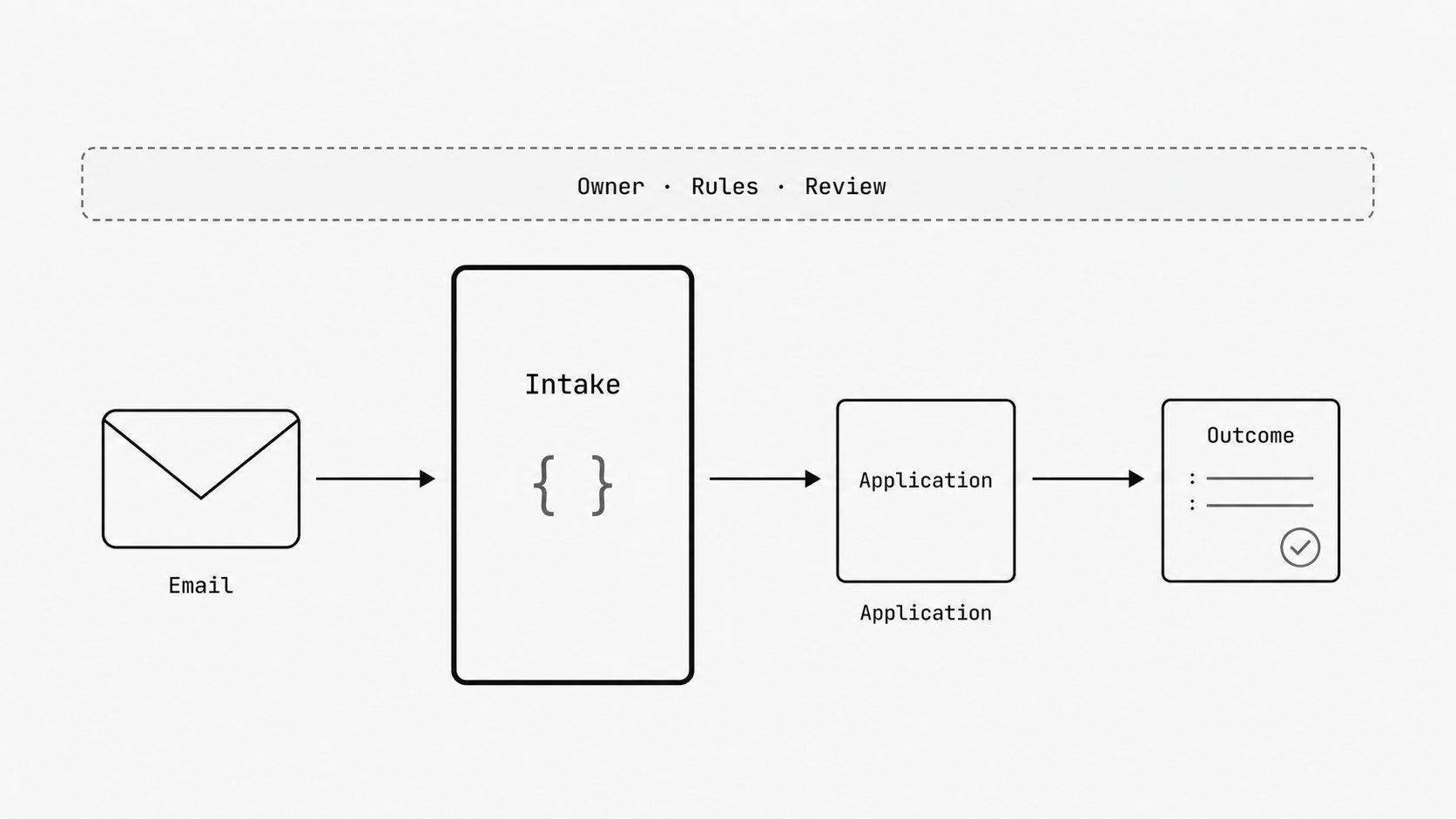
An automation strategy is incomplete when email-dependent work sits outside production accountability. Automating downstream applications does not resolve an inbox handoff that relies on someone noticing and transferring a request.
I close this series with a leadership argument: email deserves the same design attention as any other production input. Its operational importance follows the business work it carries and the impact of its failure. Treating that dependency explicitly is part of modernization.
Side-channel fallacy: email that drives work belongs in production design
Key term: A production dependency is an input or service a workflow needs to complete its work.
Email that starts or changes core business work belongs in production design. When a workflow depends on an emailed order or approval, include that input in the design of the service it supports.
Consider an order process where a person reads an email and enters its details into an application. The mailbox, the review, and the entry step all supply the order system. A design review that starts at the application leaves those dependencies unexamined. Include the handoff so that missed messages and failed entries are part of the failure analysis.
The level of care follows the effect on the business. Scope the controls to the work at risk and the time available to recover. A mailbox carrying only a few required approvals may deserve close attention because a single missed approval could block delivery.
Executive modernization mandate: give email a funded owner and clear rules
Key term: Cybersecurity governance is how leaders set security priorities, assign responsibility, provide resources, and oversee how cyber risks are managed.
Leaders must give email-dependent work a named owner, clear authority, and funding beyond launch. I treat those commitments as part of production approval.
The NIST Cybersecurity Framework (CSF) 2.0 connects leadership accountability, clear responsibilities, and resources matched to cybersecurity risk in its Govern function. Apply those principles to email operations by making ownership cover the full workflow.
Name one service owner for the path from message receipt to an accepted business record. Give that owner authority to resolve gaps between teams while keeping each team’s duties clear. Engineering maintains message processing, security sets access rules, and the business team defines valid requests and handles exceptions. Make the owner answerable for unresolved handoffs, including messages that arrive successfully but never reach the business system.
Funding needs to cover monitoring, upkeep, and recovery after launch. Agree on what automation may do and when work needs human review. Require a staffed, tested fallback for pending requests when automation pauses or fails; keep its capacity an open risk until testing supports the expected workload. These commitments define the service the organization is prepared to run. If the promised scope exceeds the support available, leadership must fund the gap or narrow the scope.
Systemic payoff of structured email handling: judge value by work completed
Key term: Toil is repetitive, often manual work that keeps a service running without creating a lasting improvement.
Judge structured email handling by the business work it completes correctly and the total effort that work takes.
Google’s Site Reliability Workbook advises measuring toil before and after automation, counting development and maintenance effort, and building safeguards into automated actions.
I apply that logic to inbound email parsing with three measures: staff time per completed request, time from receipt to completion, and the share of requests that need correction. Define completion at the business step the workflow owns, such as a valid order entered in the order system.
The value case includes review, recovery, and engineering upkeep across all teams involved. Lower data-entry effort can leave the total workload unchanged if another team spends that time fixing records. Keep unresolved requests visible with their status and owner so completion figures sit alongside a clear view of blocked work.
Fewer manual touches earn credit when required checks remain in place and correction rates stay within agreed limits. A request paused for review may be the right outcome when its details are unclear.
Series-closing strategic recommendation: assess where shared email ingestion fits
Key term: Platform as a product means managing shared technical services around users' needs, with a roadmap shaped by their feedback.
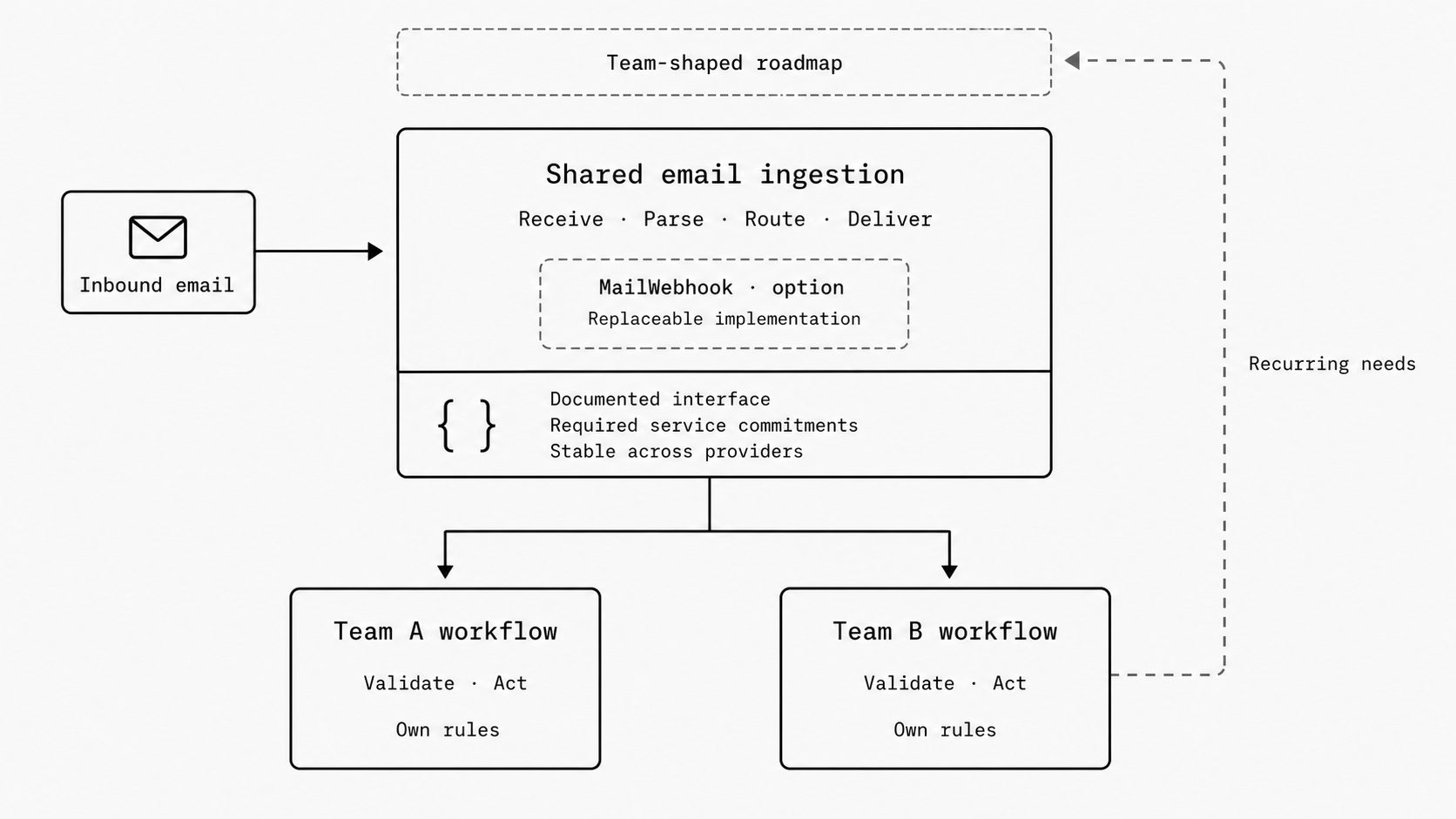
Where several workflows share recurring intake needs, assess a shared email ingestion capability against the duplicated work it removes and the ongoing support it requires. A workflow-specific integration may be sufficient when sharing adds more work than it saves; responsibility for the input and its outcome still needs a clear owner.
The CNCF Platforms White Paper treats platforms as products shaped by user needs and recognizes managed services as possible underlying implementations.
For email, I keep the shared scope focused on inbound email parsing, routing, and delivery. Each workflow retains its own rules for accepting business input. That boundary limits the range of business decisions the shared service must support. Shape its roadmap with the teams using it, and prioritize needs that recur across workflows.
An email webhook service is one implementation to assess. MailWebhook’s documentation describes mailbox ingestion, route-based transformations, signed JSON delivery, event inspection, retries, and replay. Treat those descriptions as a scope to evaluate. Production approval requires separate evidence that access controls, data retention, availability commitments, and recovery meet the needs of the intended workload.
If the provider changes, its replacement still has to meet the shared interface and service commitments that consuming teams rely on.
Treating email as infrastructure extends accountability to the point where business requests arrive. It makes the handling of business-critical messages a deliberate service commitment.