

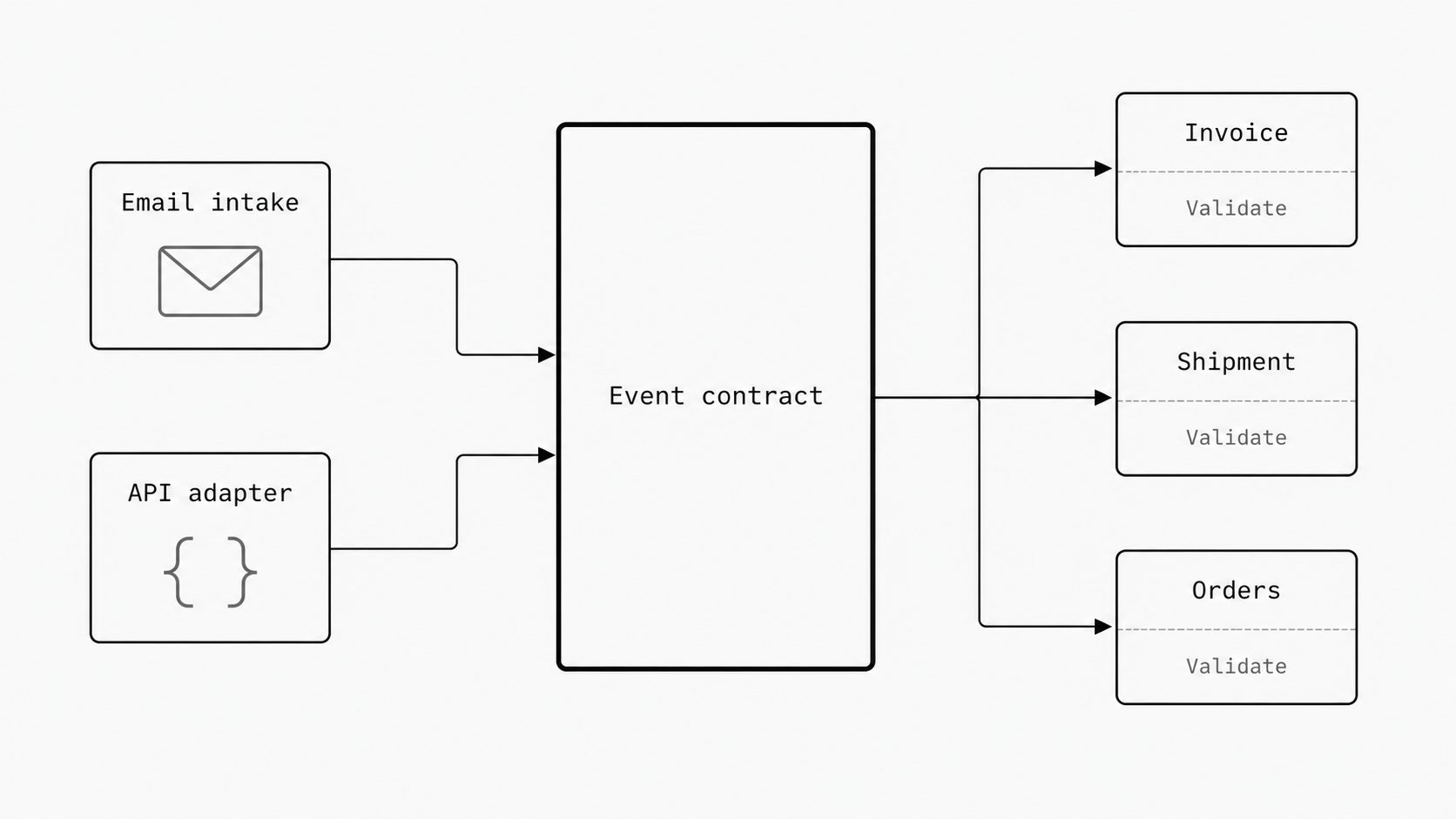
Email-originated business events belong inside enterprise architecture, with the same operational discipline as API events. Modernization starts at the receiving boundary, without waiting for every partner to offer an API.
I frame MailWebhook’s long-term opportunity as a shared operating layer between incoming messages and business applications. The investment case depends on reducing duplicated integration work while leaving business rules with the applications that enforce them.
Email-born event infrastructure: apply the same controls as API events
Key term: An event is a data record of something that happened, with context that helps another system understand it.
Email-originated business events deserve the same controls as events received through APIs. CloudEvents defines an event as a record of an occurrence and its context. I see the long-term role of an email webhook as carrying that discipline from the incoming message through to the business action.
MailWebhook documents part of this path: mailboxes, routes, and endpoints normalize messages, apply rules, transform content, and deliver JSON in signed POST requests. Its documentation also describes delivery inspection, retries for transient failures, and manual replay.
The sections below describe the architecture I want MailWebhook to support over time. Shared metadata conventions and organization-wide governance are proposed design goals; each deployment needs validation against its workload and operating requirements.
The broader architecture needs clear rules for when a message can trigger work. Define the required fields and format versions each workflow accepts. For an order-change email, include checks on the sender’s authority to change that order. Give inbound email parsing a review path for missing or unclear details before they affect business records.
Recovery also depends on the receiving application. If a retry delivers the same order-change request twice, the application needs to recognize the repeat and apply the change only once. Keep event identity stable across retries, and track delivery and business completion separately. A trace from the source message to the application’s decision gives operators a basis for finding failures after a successful handoff.
Legacy-channel modernization: modernize without waiting for partner APIs
Key term: An anti-corruption layer translates between systems with different data models so the receiving application can keep its own business concepts.
Modernize the receiving system on your own schedule while partners keep sending email.
Microsoft describes this pattern as useful for gradual migrations and identifies added processing delay and maintenance as tradeoffs.
I apply that principle to email: keep inbound email parsing and partner-specific mapping at the receiving boundary. In a shipment-notice workflow, this layer translates the supplier’s reference and date into the fields your application uses. The application keeps the rules for accepting the update. Changes to a supplier’s message layout then have a defined place to be handled.
This choice puts responsibility for adapting to partner formats inside your team. Give those mappings a clear owner and an ongoing maintenance budget. That upkeep belongs in the investment decision from the start.
If a partner later offers an API carrying the same business information, an API adapter can feed the same internal model. The next upgrade can then focus on how the data arrives while preserving the business workflow.
Standardize Event Metadata Across Email Workflows
Key term: CloudEvents is a specification for describing events in a common format so different systems can exchange them and read the same metadata.
Standardize metadata across email-born events, and let each workflow own the business fields carried inside them.
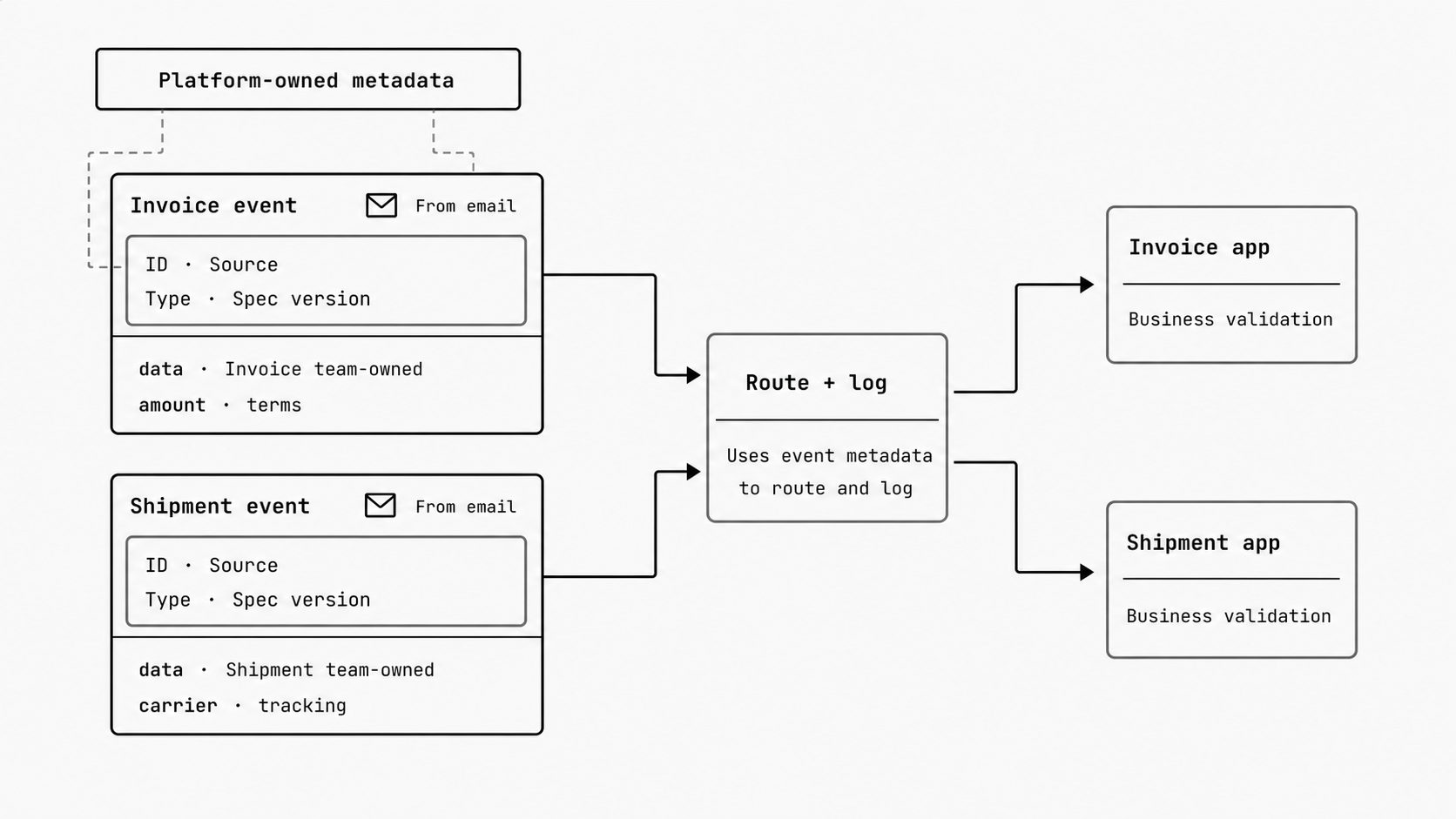
The CloudEvents primer describes a small set of shared metadata for routing and processing. Other event details belong in data. Business meaning and the processing model sit outside the specification’s scope. Evaluate authority to act and processing guarantees separately from format support.
I would keep the shared part of an email JSON schema small. In this proposed CloudEvents-inspired invoice and shipment design, both event types use common fields for event identity, source, type, and specification version. Invoice amounts and payment terms belong in the invoice payload; carrier names and tracking numbers belong in the shipment payload. Build shared routing and logging around the common metadata, with validation rules owned by each workflow.
That boundary also sets the scope of coordination. Give the platform team ownership of shared metadata conventions and workflow teams ownership of their business fields. Under this model, an invoice field change goes through review with invoice consumers. A change to shared event identity rules needs broader review. This keeps company-wide agreement focused on the parts that shared tools depend on.
Strategic relevance of unglamorous infrastructure: earn a lasting place through reuse
Key term: Platform engineering is the practice of building and maintaining shared tools and services around the needs of internal teams.
An email webhook earns a lasting place in enterprise architecture when reuse saves enough work to justify its upkeep.
Keep the proposed email layer thin, and expand its role only where teams have recurring needs it can serve well.
I judge that expansion by what the next workflow gains. If a team can reuse a supported service and avoid building another intake path, there is a concrete benefit to measure. If each addition needs extensive custom work, the case for expansion remains open.
The full operating cost belongs in that judgment, including support time, provider fees, and ongoing maintenance. Hold the service owner accountable for both the work removed from workflow teams and the work added to the shared service. This makes reuse an investment question: does sharing the service leave the organization with less work overall?