

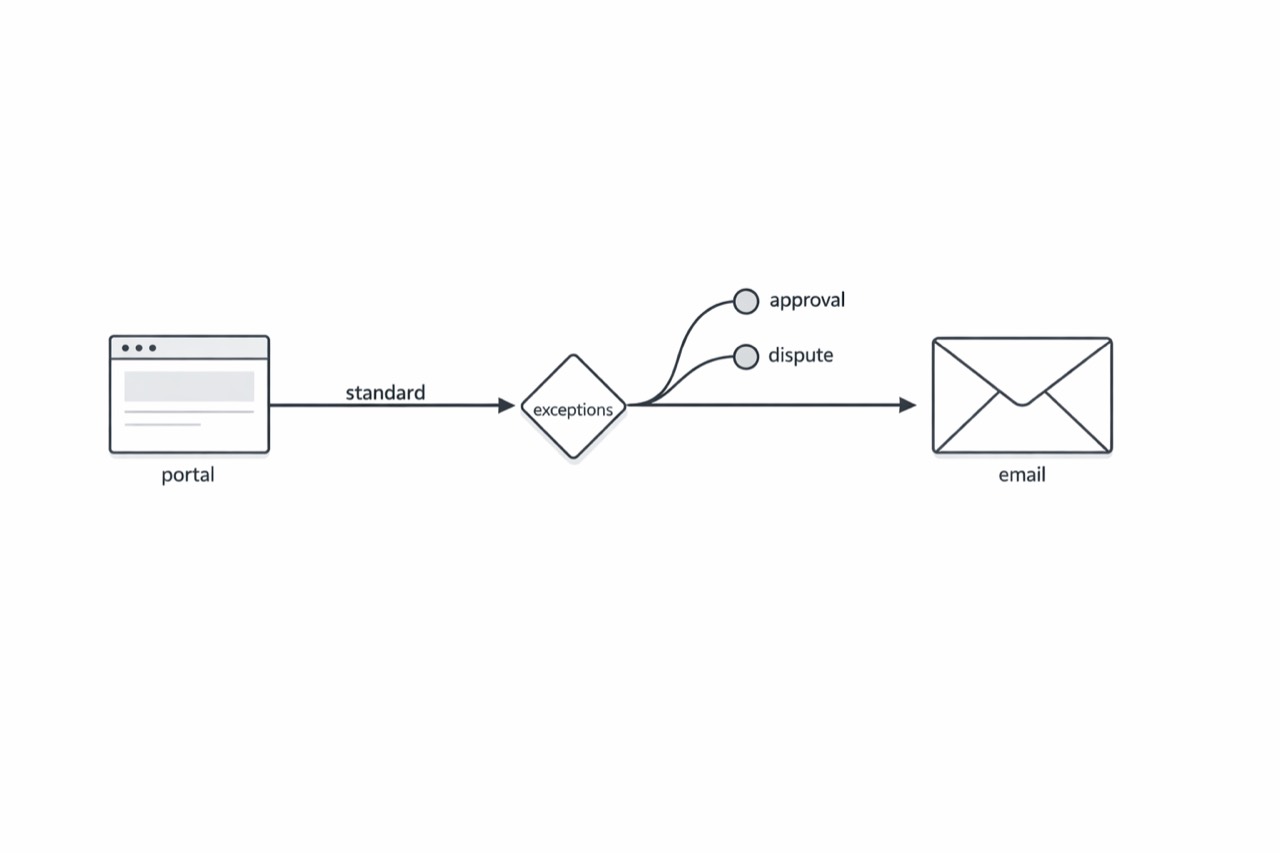
Most companies can improve the standard path. Fewer know what to do when the standard path stops working.
That is where I keep seeing the same operational pattern: a portal, workflow, or service system manages the routine case well, but the minute a request becomes disputed, urgent, incomplete, or shared across teams, the real work moves into email. The inbox becomes the place where context is rebuilt, ownership gets clarified, and decisions finally move.
For executives overseeing mixed manual and digital operations, this matters more now than it did a few years ago. As automation keeps absorbing the repeatable work, the operational burden shifts toward the messy minority. The question is no longer whether your systems can handle the common flow. It is whether your operating model can handle the unusual one without losing speed, visibility, or control.
This is the problem recognition stage many teams miss. They interpret the return to email as user noncompliance, when it is often a signal that the formal process is too narrow for the work it is supposed to contain. In this post, I make the case that email keeps winning in exceptions not because portals fail at structure, but because unusual work still demands flexibility, narrative context, and cross-functional coordination that many systems do not model well enough.
Why unusual work keeps pulling people back into email
A team can launch a polished portal, automate the common path, and still watch unusual approvals, disputes, and cross-team fixes slide back into email because people prioritize the fastest route to resolution when work becomes messy. (Salesforce Case Implementation Guide)
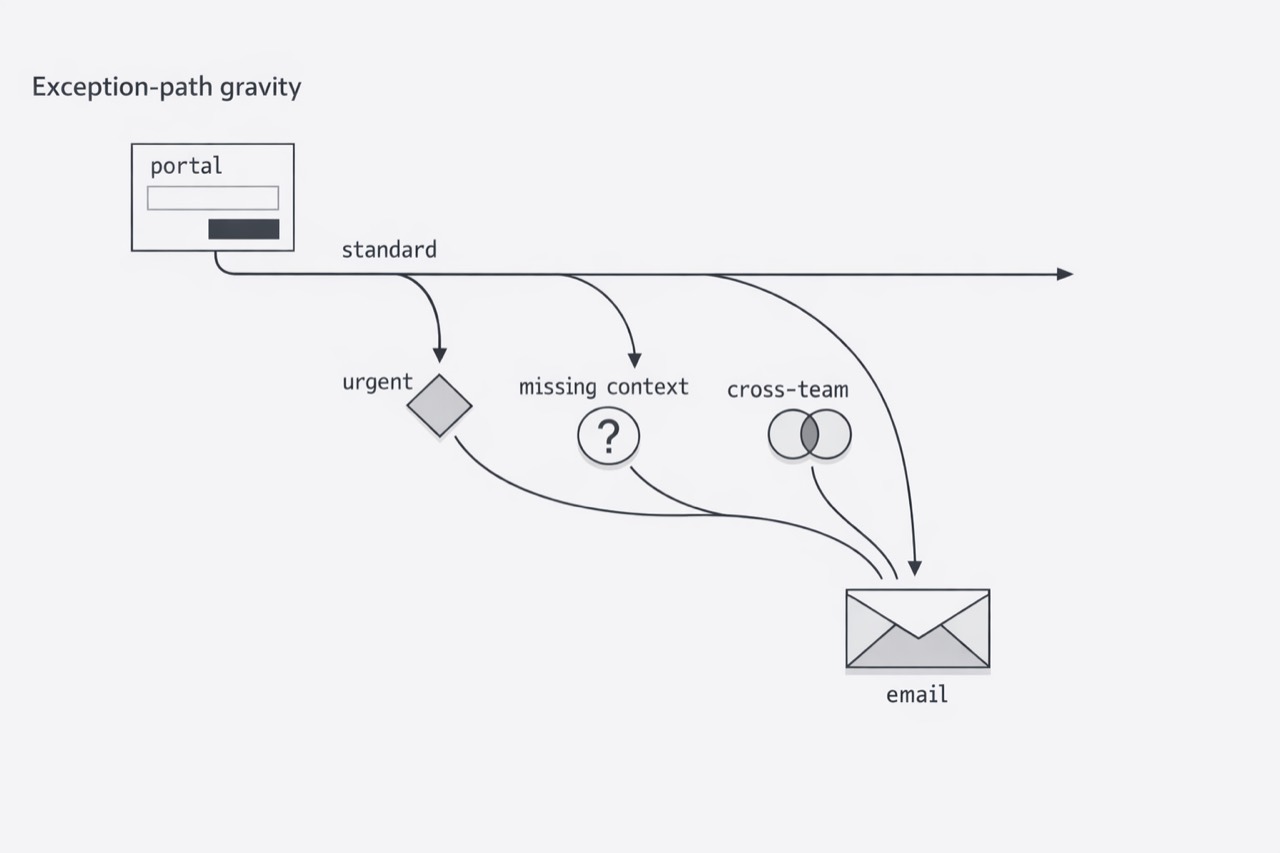
I call this exception-path gravity: the pull that sends ambiguous, urgent, or cross-functional work back into email when the formal workflow handles the standard case better than the messy one. This happens because enterprise service platforms still support inbound email as a core intake channel for creating and routing cases, showing that unstructured requests remain operationally important. It also persists because modern service AI is aimed at reducing repetitive back-and-forth so human teams can focus on more complex problem-solving, which implies that judgment-heavy work still needs flexible handling. And email remains widely used at scale, making it the default channel people already have open when speed, context, and coordination matter most. (Set up Case Management Agent to resolve cases)
Treat the return to email as process feedback, not simple user noncompliance: if exceptions keep appearing there, your operation likely needs better intake, routing, and decision support for unstructured work. A useful next question is not how to force every case back into the portal, but which kinds of work still require more context, judgment, or flexible collaboration than the current system can support.
What people are really doing when they leave the portal
I have seen this pattern too many times to call it user behavior alone. A portal works well right up to the moment a case becomes unclear, urgent, or shared across teams. Then someone sends an email. That move usually looks small, yet it tells you something important: the person is trying to rebuild the missing parts of the process in plain sight. They want a full thread, a named owner, a timestamped record, and a way to pull in the right people without waiting for the system to catch up. You might be wondering: are they rejecting the portal? In most cases, no. They are trying to finish the work with the tools that still carry the most flexible context. (Zendesk Support Addresses API Reference)
That is why I think of email as an escape hatch in operations. People use it when the formal path cannot hold the real shape of the issue. Modern service platforms still keep email deeply built into their operating model. Zendesk documents support addresses as a standard part of ticket intake, which shows that even mature platforms expect work to begin or continue through email. Microsoft documents queue and routing design for cases and activities that come in from email, which means enterprise teams are still planning around email-driven work rather than treating it as a rare exception. Salesforce also frames service email as a channel for trusted, trackable customer communication, especially when the exchange needs continuity and reference value over time. (Create and manage basic queues for cases)
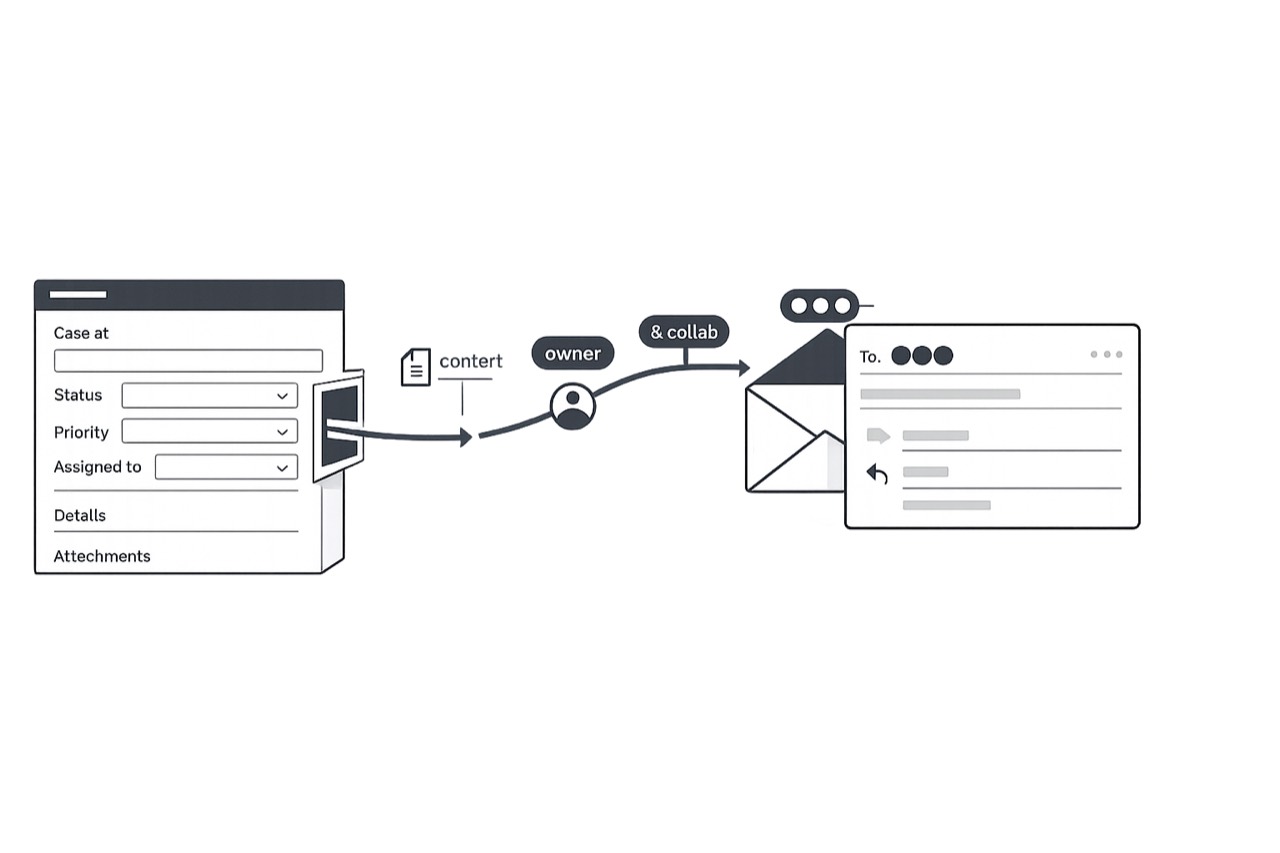
So what is the user really saying when they leave the portal? Usually one of three things. First, “the form does not capture what matters here.” Second, “I do not know who owns this now.” Third, “I need to bring more people into the conversation than the workflow allows.” Those are operating signals, not signs of laziness. Email helps because it carries narrative context naturally. A person can explain what changed, attach prior messages, copy a finance lead, add a supplier, and preserve the exact thread in one move. A portal is usually better for standardization. Email is often better at handling ambiguity. When a team reaches for email, they are often choosing adaptability over structure because the case has already outgrown the model the portal was built to enforce. (Salesforce Customer Service Email)
From an executive view, this matters because the escape hatch is doing real operational work. It is restoring context, speed, and ownership where the formal flow is thin. If you treat every move to email as policy drift, you will miss the design lesson inside it. The better question is: what capability did the person have to recreate manually?
Here is the practical insight I would carry forward: when people leave the portal, they are often patching a design gap, not avoiding discipline. That gap usually sits in one of three places - missing context, unclear ownership, or weak collaboration paths. If you map the emails that appear around disputed orders, urgent approvals, corrections, or cross-team handoffs, you can see exactly where your formal system stops being helpful and human coordination takes over. That is a much more useful reading than saying, “users keep bypassing the system.” In my experience, the smartest operators study the escape hatch closely, because it shows them where the next round of process design should begin.
The real design challenge lives in the stubborn minority
The better a company gets at automating routine work, the more the remaining queue tends to concentrate the cases that need judgment, coordination, and extra context. That means the real operating burden often shifts from the common path to the stubborn minority that standard workflows do not handle well. (Salesforce Customer Self-Service)
Automation and self-service are commonly positioned as ways to absorb routine requests, while human support is reserved for more complex situations. As the easy work is removed from the queue, the remaining cases become denser with exceptions, cross-team dependencies, and policy judgment. That is why workflow quality cannot be judged only by straight-through completion on the happy path: an operation can look efficient on the surface while difficult cases spill into email threads, escalations, and manual coordination. In practice, long-tail workflow design means giving these cases explicit intake, flexible routing, and a place to capture evolving decisions and context. (Use Case Management Agent to create and update cases)
A useful next step is to review the exceptions that remain after automation and ask three questions: which cases still need narrative context, which require judgment across teams, and which repeatedly force people to stitch the process together by hand. The answers identify where the next workflow investment should go and help treat exceptions as a design target rather than cleanup work.
Where consistency breaks first
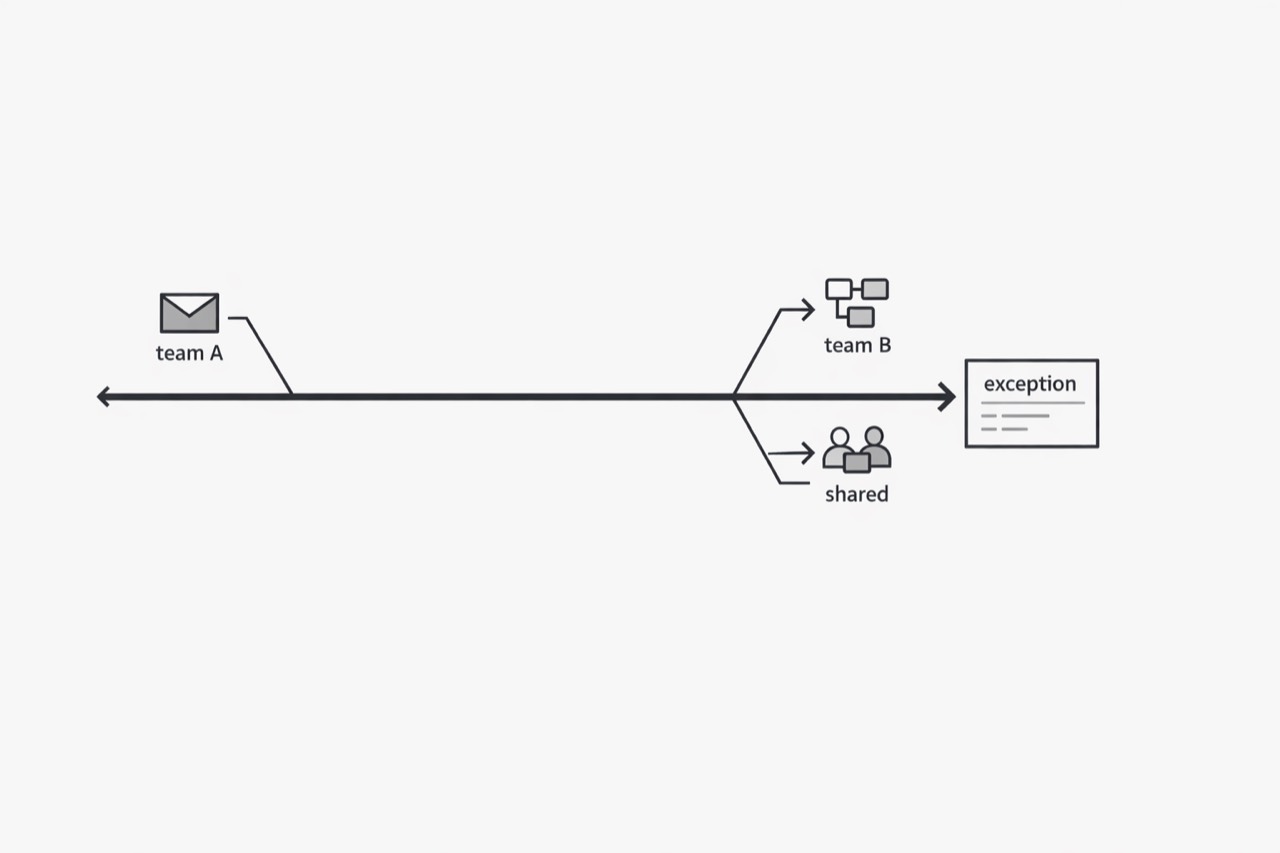
The first visible crack in a well-run process usually does not appear in the middle of the standard flow. It often shows up at the margins, when one unusual message needs two teams, ownership is unclear, or a case starts in one mailbox and then spreads into several. What looked consistent in the dashboard starts behaving like a chain of local fixes, creating fragmentation around the very cases leaders most need to track cleanly. (Create multiple cases from an email sent to multiple mailboxes)
Operational fragmentation at the margins means process consistency breaks down fastest in unusual, urgent, or shared cases. This tends to happen first at the edges because unusual work puts pressure on handoffs, ownership rules, and routing logic that looked solid on the common path. Microsoft documents special handling for situations where one inbound email can create multiple cases across mailboxes, a sign that shared or overlapping intake creates ambiguity unless context is preserved carefully. Intermedia describes routing models where many-to-one and one-to-many relationships between addresses and queues require a default queue so messages do not get lost, showing how quickly routing complexity grows when work no longer maps neatly to a single destination. Cisco also documents default exception queues for emails that fail expected routing, reinforcing the operating lesson that less predictable paths need a deliberate place for exceptions to land and be reviewed. (Contact Center Email Routing)
If you want to find where your operating model is least consistent, do not start with the clean path. Start with the cases that involve multiple teams, multiple mailboxes, or routing failures. Those cases reveal where context splits, ownership blurs, and reviewability weakens. Treat that pattern as an executive signal that the margins need more intentional design: clearer exception ownership, better shared case visibility, and a dependable place for unusual work to land before it fragments further. (Troubleshoot Emails Going to Default Exception Queue in ECE - Cisco)
The lesson is not that portals are weak or that email should run the business. The lesson is that exceptions expose the real limits of process design.
If unusual approvals, disputes, corrections, and multi-team issues repeatedly end up in the inbox, that is not just channel drift. It is evidence. It tells you where context is missing, where ownership is unclear, and where the formal workflow stops matching the shape of the work. The organizations that respond well are not the ones that try to eliminate every email. They are the ones that study why those messages appear and design better operating support around them.
When exception-heavy intake still needs a system of record, email data entry automation gives that work a managed path. For teams designing their own controlled intake layer, the software-owned route is the better fit.
As standard flows become more automated, competitive advantage shifts toward handling the messy remainder with more clarity and less fragmentation. In other words, the future of operational quality is not only in perfecting the clean path. It is in designing for the exceptions that keep pulling people back to email.