

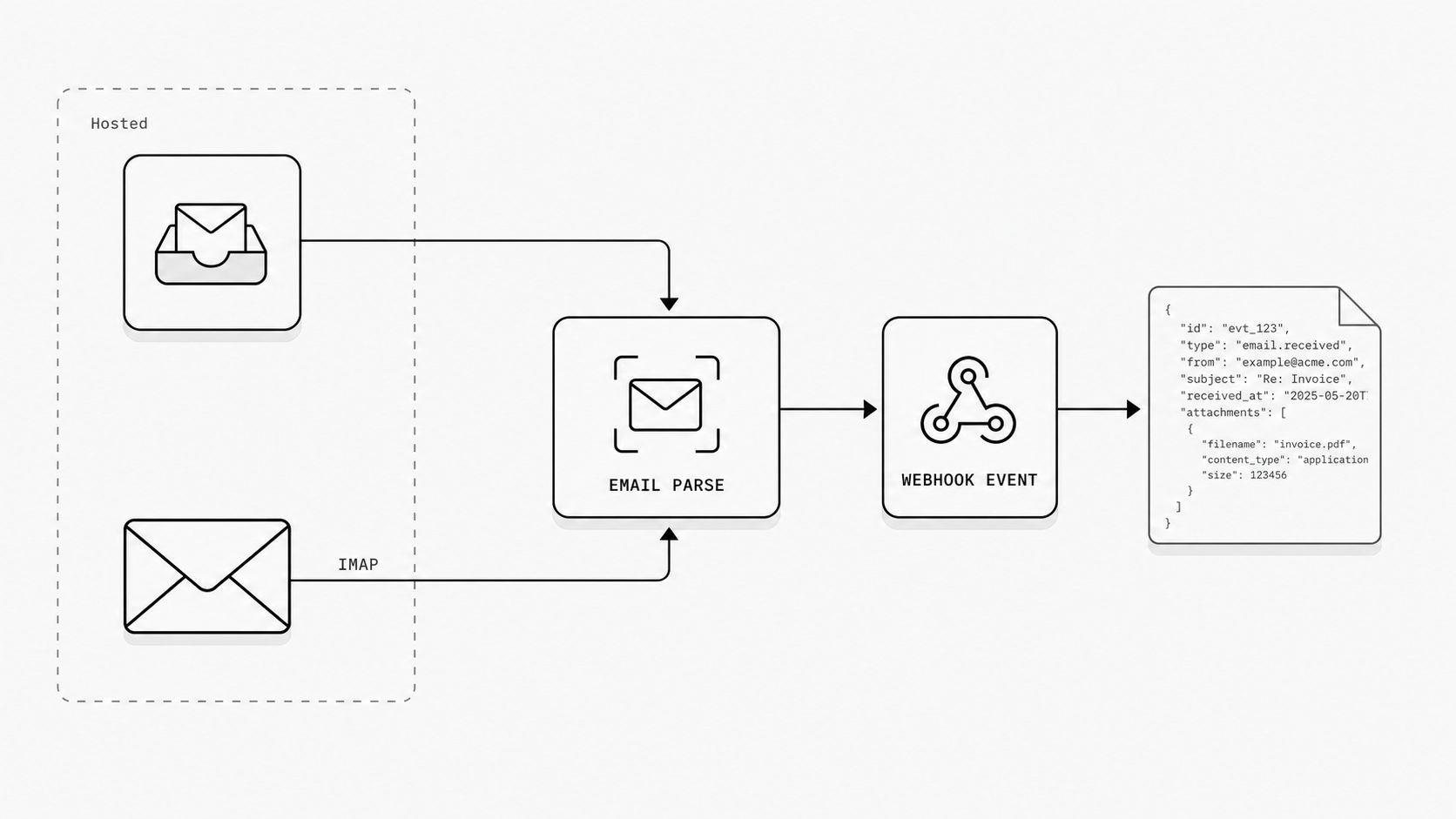
When technical buyers evaluate inbound email automation, the conversation often drifts into a feature checklist too early. I think the better starting point is simpler and more strategic: where should inbound mail enter the system in the first place?
That choice affects much more than setup mechanics. It shapes how quickly a team can launch, how much it depends on an existing mailbox provider, and who will carry operational responsibility once the workflow is live. In practice, the decision usually comes down to two workable paths: using a hosted mailbox inside the platform or connecting to an existing mailbox over IMAP.
For the broader architecture context behind that boundary, start with The Case for an Email Ingestion Layer. That post explains why inbound mail needs a governed intake layer before downstream applications use it.
In this post, I am not trying to argue that one model wins in every case. I want to help you see the design choice clearly. If rollout speed matters most, one path tends to reduce friction. If the existing mailbox environment is the immovable constraint, the other often fits reality better. The useful question is not which option looks better in isolation, but which one aligns with your ownership boundaries, provider constraints, and day-two operating model.
If speed matters first, start with the hosted mailbox model
When a team says it needs inbound email live fast, a hosted mailbox model can reduce early setup friction by giving the platform a managed intake address first. (RFC 5321 - Simple Mail Transfer Protocol)
The main advantage is sequencing. Instead of beginning with mailbox access, identity coordination, and provider-specific administration, the team can begin with standard mail delivery into a platform-controlled intake path. Internet mail architecture distinguishes message transfer roles from mailbox roles, which supports treating hosted intake as a separate operational layer during rollout. (RFC 5598 - Internet Mail Architecture)
The alias model is a big part of that advantage. Unlimited aliases per mailbox let a team create purpose-built entry points for products, vendors, regions, customers, or workflow types without asking the mailbox provider to create more human inboxes. Each alias can carry intake intent from the address itself, which makes early routing and later analysis easier.
Hosted mailboxes are also built for machine intake. The mailbox exists to receive, classify, route, and deliver messages into software. No one has to preserve the habits of a shared inbox, protect a user’s personal workflow, or design around a person reading and replying from the same place.
Spam and quarantine behavior matters for the same reason. In a human inbox, questionable mail is often a productivity problem. In a machine-intake path, spam and quarantine thresholds become part of the reliability model. Teams need to know which messages are accepted, which are held back, and which conditions should trigger review before automation runs.
Use this rule of thumb: if urgency is high and you want to validate routing, normalization, and downstream automation before touching deeper mailbox dependencies, start with the hosted mailbox model. It gives you a fast way to prove the workflow before expanding scope. The hosted mailboxes deep-dive later in this sequence should go deeper on aliases, thresholds, quarantine behavior, and the operational shape of platform-managed intake.
When the real constraint is the existing mailbox estate, I look at IMAP-connected sources
I reach for a connected mailbox model when the buyer tells me the mailbox setup is already fixed by policy, process, or ownership. In that moment, the question usually is not which intake path looks cleaner on a slide. The question is how to work with the mailboxes the organization already runs every day. IMAP4rev2 is a standard protocol for accessing and working with remote mailboxes, which is why this path is often the most practical way to plug existing inboxes into downstream processing. If the team is trying to turn inbox activity into an email webhook flow, this model can preserve the current provider footprint while still giving engineering a path to process inbound mail programmatically. (RFC 9051 - IMAP4rev2)
Here is how I frame it with technical buyers. A connected mailbox model is usually a fit when operations, compliance, or a business team already owns the mailbox and does not want that ownership pattern to change right away. Instead of creating a new intake address inside the platform, the platform connects to the mailbox that already exists and reads messages through IMAP. That can make rollout easier in organizations where shared mailboxes, departmental inboxes, or long-lived addresses are already embedded in workflows.
IMAP still has operational overhead: provider access, mailbox state, polling behavior, and recovery logic need clear ownership. I covered that maintenance case in Why Custom IMAP Scripts Age Badly. Here, the more useful question is narrower: given that overhead, when is the connected path still the right first move?
Usually, the connected path makes sense when continuity is more valuable than a clean intake boundary:
- The live address is already known by customers, vendors, partners, or internal systems.
- Operations, compliance, or a business team already owns the mailbox.
- Moving or forwarding mail would require a slow governance project.
- The mailbox is the system of record for requests, alerts, or case-driven traffic.
- The team wants automation beside the existing inbox before it changes ownership.
Those are fit conditions. A connected mailbox model is strategic when changing the mailbox would create more organizational risk than connecting to it. In that case, preserving address continuity and existing ownership can be worth the added provider dependency.
My rule of thumb is simple: if the mailbox itself is politically or operationally hard to move, start where the mailbox already lives and design the integration around that fact. A connected mailbox model is often the right first step when the existing provider environment is part of the boundary conditions, especially for teams exploring an IMAP to webhook approach without reworking established inbox ownership. The benefit is organizational fit. The caution is operational dependency, because the provider environment stays part of the operating boundary over time. When I see a team make that trade consciously, rollout conversations get much clearer and a lot less theoretical.
The source-control tradeoff: where does operational ownership sit?
Key term: Source-control tradeoff means deciding whether inbound email operations are managed mainly inside the platform or mainly inside the existing mailbox provider environment.
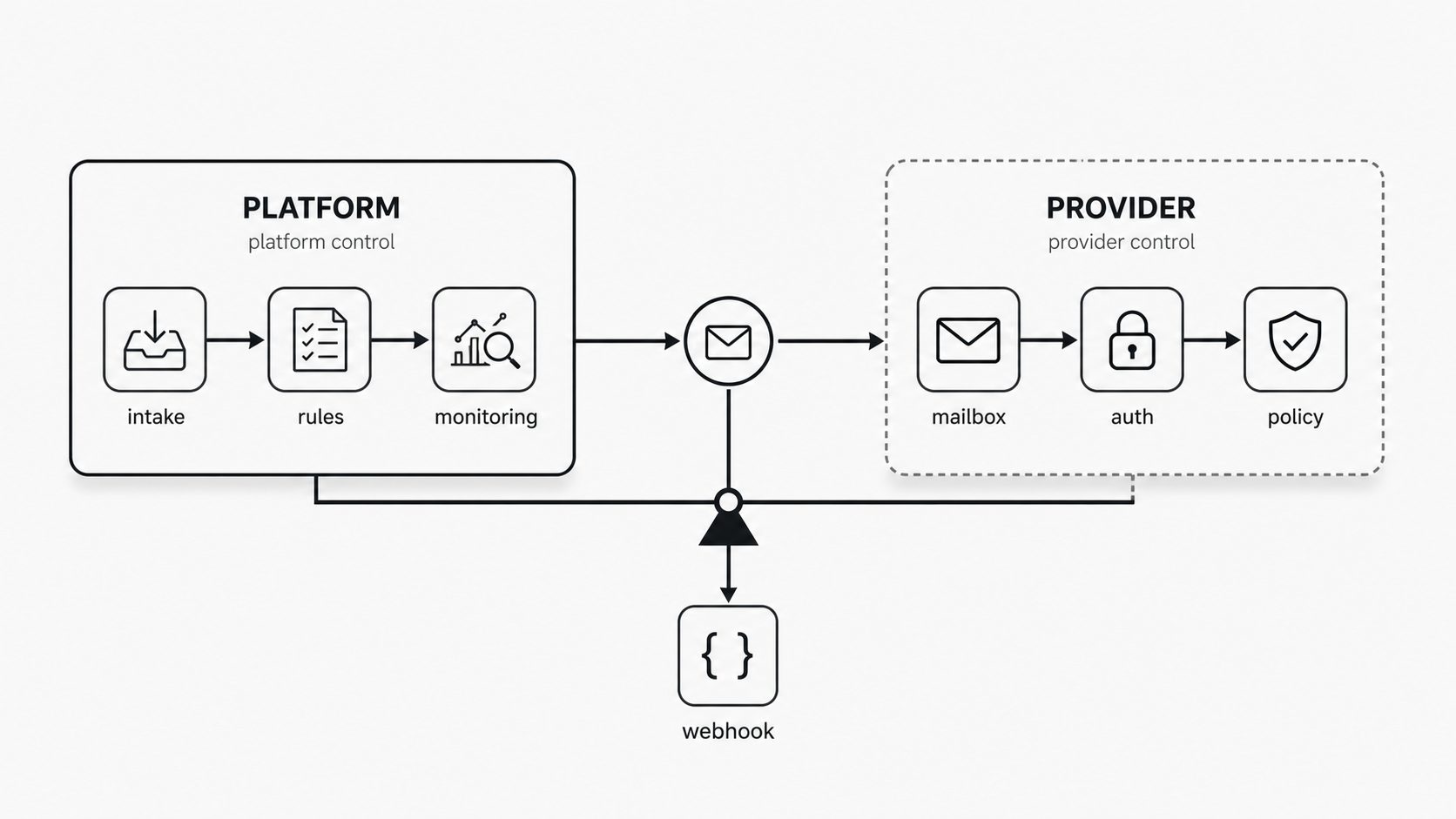
When I get buyers past the first feature questions, the real decision usually gets simpler. I am choosing where operational control should live. That choice shapes who can change intake behavior fast, who approves changes, and how much coordination is needed once the workflow is live. In a connected mailbox design, the platform can read from an existing inbox through IMAP, while the mailbox provider and mailbox owner still hold part of the operating boundary.
I like to make this concrete for technical buyers. If control lives more inside the platform, the intake layer can usually be changed, observed, and supported by the team running the application path. If control lives more inside the mailbox provider, the application team still owns outcomes, while intake decisions are shared with the team that owns mailbox policy, access, and address continuity. That is why I treat this as an operating model choice first and a connection method choice second.
You might be wondering: where does this show up in real life? Usually in decision rights. A hosted intake path often lets the application team adjust routing, observability, and delivery behavior in one place. A connected source ties those decisions to the mailbox owner and the provider administration model. That can be a good fit when the messaging environment already owns intake decisions.
This is the part I want buyers to see early. A provider-connected source can be a very smart move when the existing mailbox estate is the center of gravity. The strategic risk is decision latency. Changes may require coordination across mailbox owners and application owners. That risk is often worth accepting when continuity and established mailbox ownership matter more than a platform-managed intake boundary.
That is why I avoid turning this into a checklist war. The better question is: which team do I want holding the steering wheel when intake rules, failure response, and day-two operations need to change? If the answer is the application or automation team, a more platform-managed intake layer often creates a shorter path from issue to fix. If the answer is the existing messaging environment, then an email webhook design tied to provider access can still work well, as long as everyone accepts the dependency clearly up front.
My advice is simple. Pick the model that matches the owner you want in the critical path six months after rollout, not just the team that can approve setup this week. When buyers frame the decision that way, the tradeoff becomes easier to explain. More platform-managed intake usually means tighter operational control in the application lane. More provider-centered intake usually means stronger continuity with existing mailbox operations, along with more inherited provider behavior in the long-term support model. Once that is visible, the conversation gets more honest, and the architecture choice stops feeling abstract.
Rollout path selection: matching the intake model to the team that owns it
If I had to choose a first path, I would usually start by asking a simple question: who can say yes today without opening a long mailbox governance project? That question matters because rollout speed is often shaped less by protocol theory and more by admin control over provider settings, mailbox access, and forwarding rules. In Google Workspace, admins can turn POP and IMAP access on or off for users, which is a clear example of how mailbox connectivity can be governed at the tenant level. So when a buyer asks me whether to begin with a platform-managed intake or an IMAP-connected source, I do not start with a feature grid. I start with control boundaries. (Google Workspace Help - Working with Gmail Admin settings in Google Workspace)
That is where rollout path selection becomes practical. If the application team can stand up intake on its own, I lean toward the hosted route first because it usually creates a shorter path to proving the workflow end to end. That is especially useful when the real goal is to validate routing, parsing, and downstream automation such as an email webhook flow before the organization commits to deeper mailbox coordination. If the messaging team already owns the live addresses, the policies, and the provider relationship, I am more likely to begin with the connected path because the rollout has to fit the mailbox environment that already exists.
You might be wondering: what does that look like in a real buying conversation? I keep it to three checks. First, who controls mailbox access settings today? Second, can the team create or reroute intake without waiting on a provider admin queue? Third, which group will own failures when mail stops flowing on a Tuesday morning? Those answers usually tell me more than a long product comparison ever will.
I also watch for a common pattern. Many teams want to forward email to webhook processing quickly, but they are split on who owns the mailbox side. When ownership is unclear, the fastest technical path can still turn into the slowest organizational path. That is why I prefer a first move that matches the current owner of the intake surface, even if it is not the final long-term design. A first rollout should lower uncertainty. It should show whether the workflow delivers value, where support tickets land, and which dependencies create friction in day-two operations.
My default advice is straightforward. If speed, experimentation, and application-team control are the priority, I would start with the hosted path and use it to prove the operational flow first. If the existing mailbox estate is the real center of gravity, I would start with the connected path and design around provider ownership from day one. In other words, I choose the path that the current owners can actually operate, support, and approve now. That is how rollout path selection stays grounded in reality instead of drifting into architecture theater. And once the first path is live, the team has something much more valuable than a debate - it has evidence.
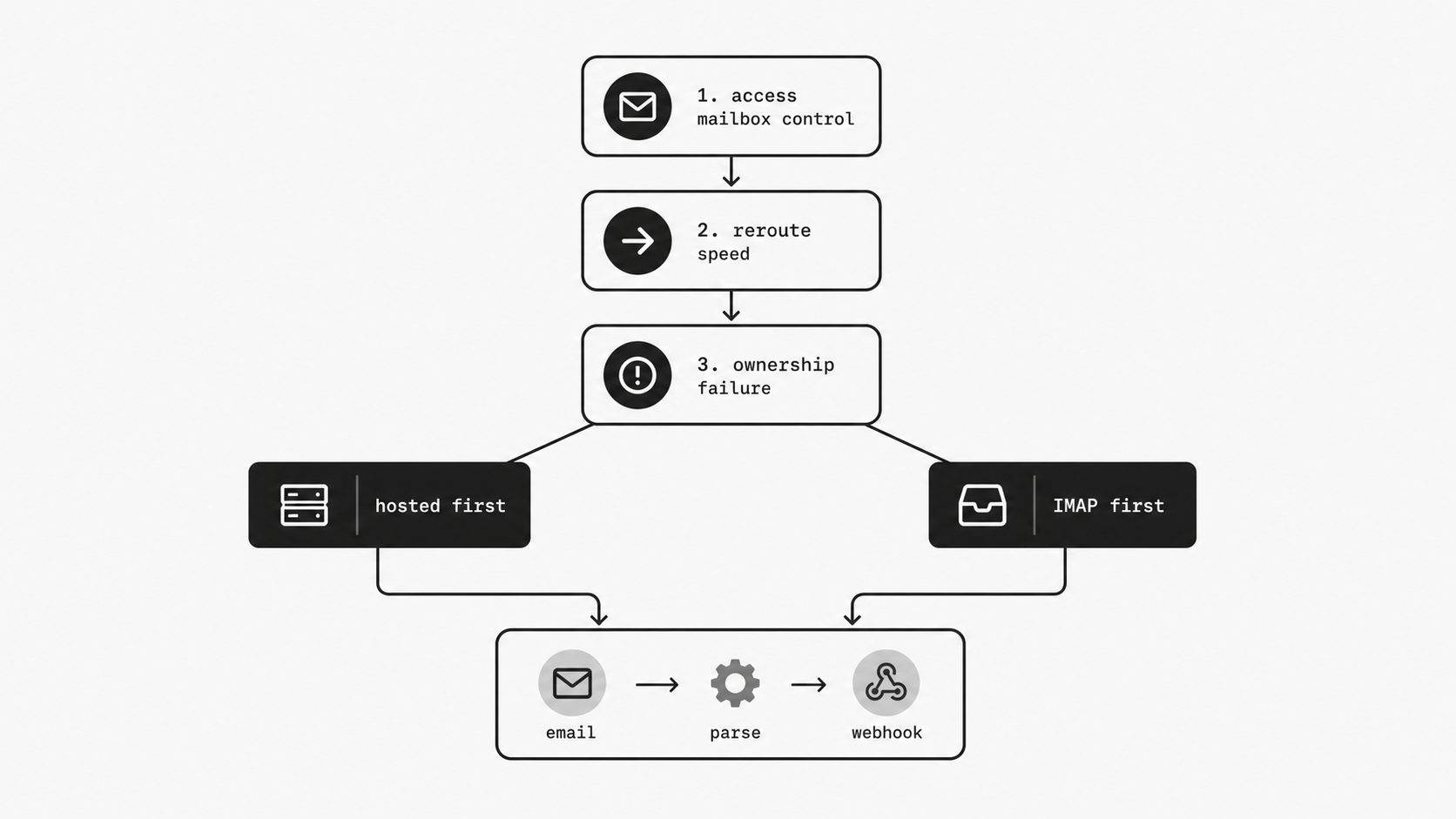
If you take one thing from this decision, let it be this: choosing an inbound source is really choosing an operating model. A hosted path usually gives the application side a faster route to launch and tighter control over intake behavior. A connected IMAP path usually gives you better continuity with the mailbox environment you already have, but it keeps provider policies and access rules firmly in the picture.
That is why I prefer to frame the choice around control, dependency, and support ownership instead of a long list of product features. The best first move is the one your organization can actually approve, operate, and troubleshoot without confusion. Once that is clear, the architecture discussion gets easier, rollout gets faster, and the team can make progress with evidence instead of debate.
If you are leaning toward the hosted path, the natural next read is the hosted mailboxes deep-dive in this sequence. It should go deeper on what platform-managed intake changes after the first source decision is clear.