

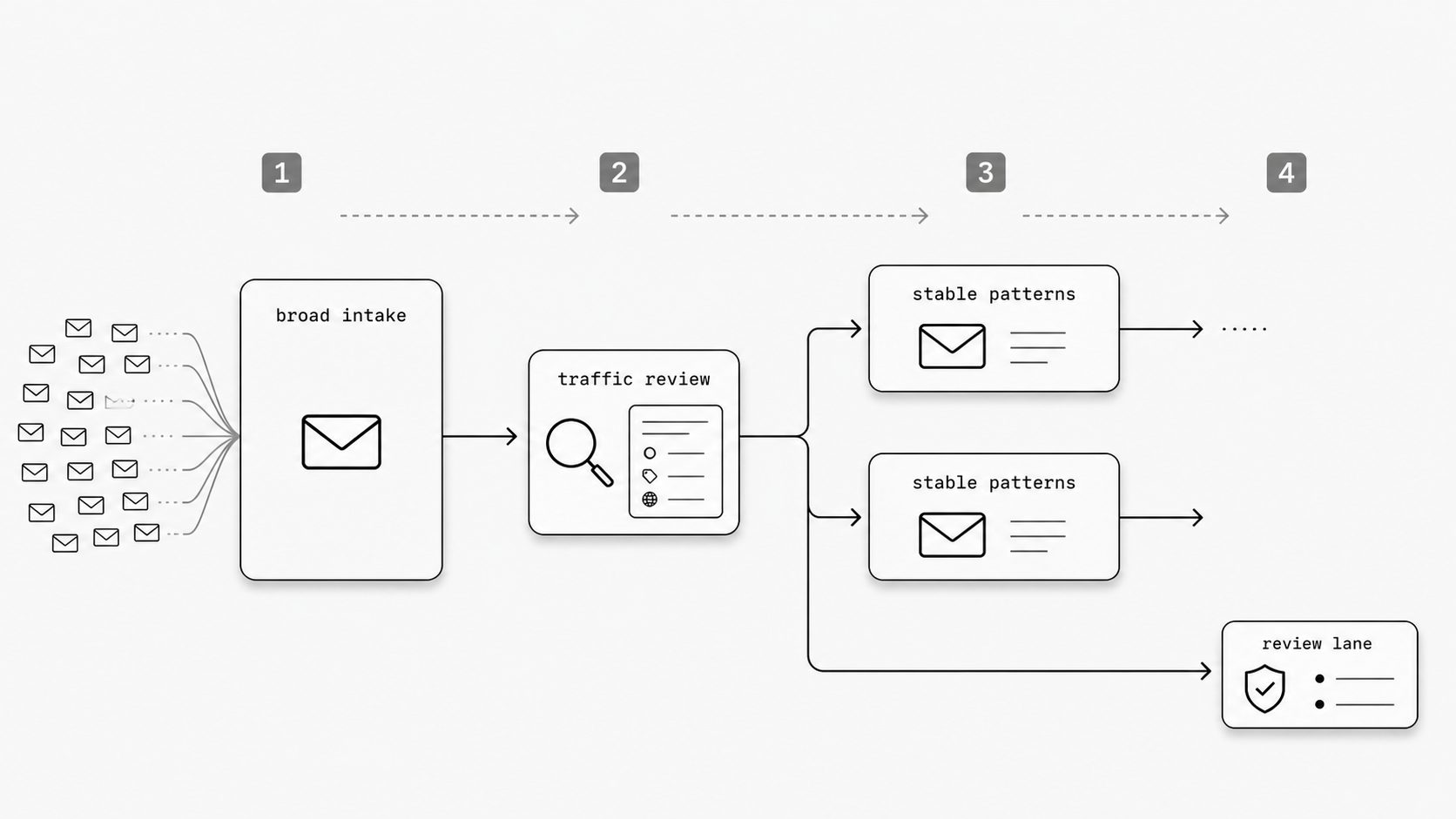
Early in an email deployment, uncertainty is normal. Teams may know the business process they need to support, but still not know every sender pattern, alias, forwarding path, or edge case that will show up once real traffic starts flowing. That is exactly why a catch-all route can be the right move. Not as a shortcut, and not as an excuse to avoid good design, but as a deliberate operating choice that prioritizes coverage, visibility, and safe learning before precision.
In this post, I make the case for starting broad when missing a valid message would be more costly than reviewing extra noise. I walk through when this approach makes sense, why an observation phase matters, what controls have to exist behind a wide intake path, and how to turn that early broad route into a more refined routing system over time. The goal is simple: use broad intake intentionally, then tighten with evidence.
This post covers the starting configuration before your rule set is fully defined. If you want to see the destination first, Email Routing Rules for Automation Platforms explains the governed matching architecture that follows. For the broader system boundary around both stages, The Case for an Email Ingestion Layer covers how inbound messages move from intake to application-ready events.
So when does a catch-all route actually make sense?
I reach for a catch-all route when the bigger risk is missing a real message than letting in extra noise. Early in deployment, that is often the honest operating reality. A team may know the domain, the receiving system, and the business outcome they need, yet still have only a partial view of sender patterns, mailbox names, and edge cases across vendors, partners, and role accounts. In that moment, trying to design perfect matching logic too early can create blind spots. A broad intake path becomes a deliberate choice because it gives me coverage first and precision second. You might be wondering: is that sloppy design? I would say no. It is disciplined design for an environment where variation is still being discovered.
This approach makes the most sense in three situations. First, I use it when a team is standing up a new mail flow and does not yet know all the valid address patterns that will appear in production. Internet email already includes widely recognized role mailboxes like postmaster, abuse, and support, which shows how much operational variation can exist even before a company adds its own conventions. Second, I use it when many subdomains or aliases may need to receive mail, but the exact traffic mix is still unclear. Third, I use it when I want one intake layer to forward email to webhook processing or another review pipeline while I learn what should later become stricter conditional email routing rules. (RFC 2142: Mailbox Names for Common Services, Roles and Functions)
A broad route also needs a clear intake source. A dedicated hosted mailbox for automation gives it a purpose-built entry point with explicit ownership, aliases, and processing rules.
In practice, this means I may begin with a small number of known controls - domain, destination, and processing path - instead of trying to encode every sender condition on day one. If the platform exposes an email routing rules API, that broad first route can act like an operational sensor. I can inspect volume, address patterns, sender domains, attachment behavior, and recurring exceptions before I decide how to split the stream into narrower rules. That matters because early routing mistakes usually fail quietly. The message that never enters the system is far harder to recover than the message that enters a controlled review flow. (Enable mail flow for subdomains in Exchange)
The key is intent. A catch-all route makes sense when it is paired with downstream discipline. I want clear tagging, logging, triage, and ownership once the message lands. I also want a plan for what I will learn from the broad stream: which senders are trusted, which recipient patterns are common, and which cases deserve their own route later. Without that follow-through, wide capture just creates a messy queue. With it, broad acceptance becomes a practical starting position for teams that need safe coverage while the real traffic pattern is still emerging.
So my rule of thumb is simple: a catch-all route makes sense when uncertainty is high, inbound loss is expensive, and I have enough downstream control to review what I accept. It is especially useful at the beginning, when I need evidence before I can build precise email routing by sender domain or recipient logic with confidence. The value is not in staying broad forever. The value is in buying visibility now so I can tighten intelligently later.
Here is the part most teams skip too early
Here is the mistake I see over and over: a team gets a new mail flow live, then rushes to write tight rules before they have seen enough real traffic. I understand why. Specific rules feel mature. They look clean in a dashboard. They make architecture diagrams easier to explain. But early precision can hide a basic problem - the team is still guessing. When sender paths, recipient variations, and forwarding patterns are still emerging, I would rather learn from production safely than hard-code assumptions too soon. That is where discovery-first routing earns its keep. I use it as a short observation phase that lets me inspect how messages actually arrive, how they are transformed in transit, and which patterns repeat enough to deserve their own logic later. (Enhanced filtering for connectors in Exchange)
You might be wondering: what am I really learning during that phase? More than most teams expect. I am looking at recipient names, alias spread, sender domains, attachment habits, reply chains, automated forwards, and system-generated mail that no one remembered during design. If I am using inbound email parsing or an email parsing API, I can turn those raw messages into structured records and review them as operational evidence instead of anecdotes. That matters because mail routes often look simpler on paper than they do in production.
Microsoft makes a closely related point in its guidance on enhanced filtering for connectors. In complex routing setups, the source that appears to have sent the message may not represent the true origin after intermediaries and forwarding steps are involved. I take that as a practical warning for routing design. If the visible path can be misleading, then a team benefits from an intake stage that is built to observe before it narrows. In other words, discovery-first routing is not hesitation. It is a way to collect the facts your stricter rules will depend on.
So what does this actually look like in practice? I keep the intake broad enough to capture the stream, then I make the review disciplined. I want every accepted message tagged with enough metadata to answer simple questions fast: who sent it, who it was addressed to, what path it took, what type of content it carried, and whether it matched an expected business case. Over a short period, those observations usually reveal natural clusters. A vendor invoice pattern may deserve one route. Status notifications may deserve another. Human-to-human exceptions may need manual review. The point is that the route design starts to come from evidence.
This is also where I try to protect teams from a false sense of confidence. A rule can be syntactically correct and still be operationally weak if it was based on an incomplete sample. When teams skip the learning window, they often discover the missing cases only after someone asks why an expected message never reached the system. I would rather accept that the first version is an observation system with boundaries than pretend the first version is already final architecture.
The payoff is simple: I get a cleaner route set later because I allowed myself to learn first. Discovery-first routing helps me move from assumption to evidence, which is exactly what early deployment teams need when traffic variation is still unknown. It also gives me better inputs for the next step - deciding which message patterns deserve automation, which deserve stricter matching, and which deserve a human checkpoint. If section one was about why broad intake can be a smart starting move, this is the discipline that makes that move useful. I am not staying broad for comfort. I am staying broad long enough to see the truth of the flow.
Broad intake only works if the controls are boring and clear
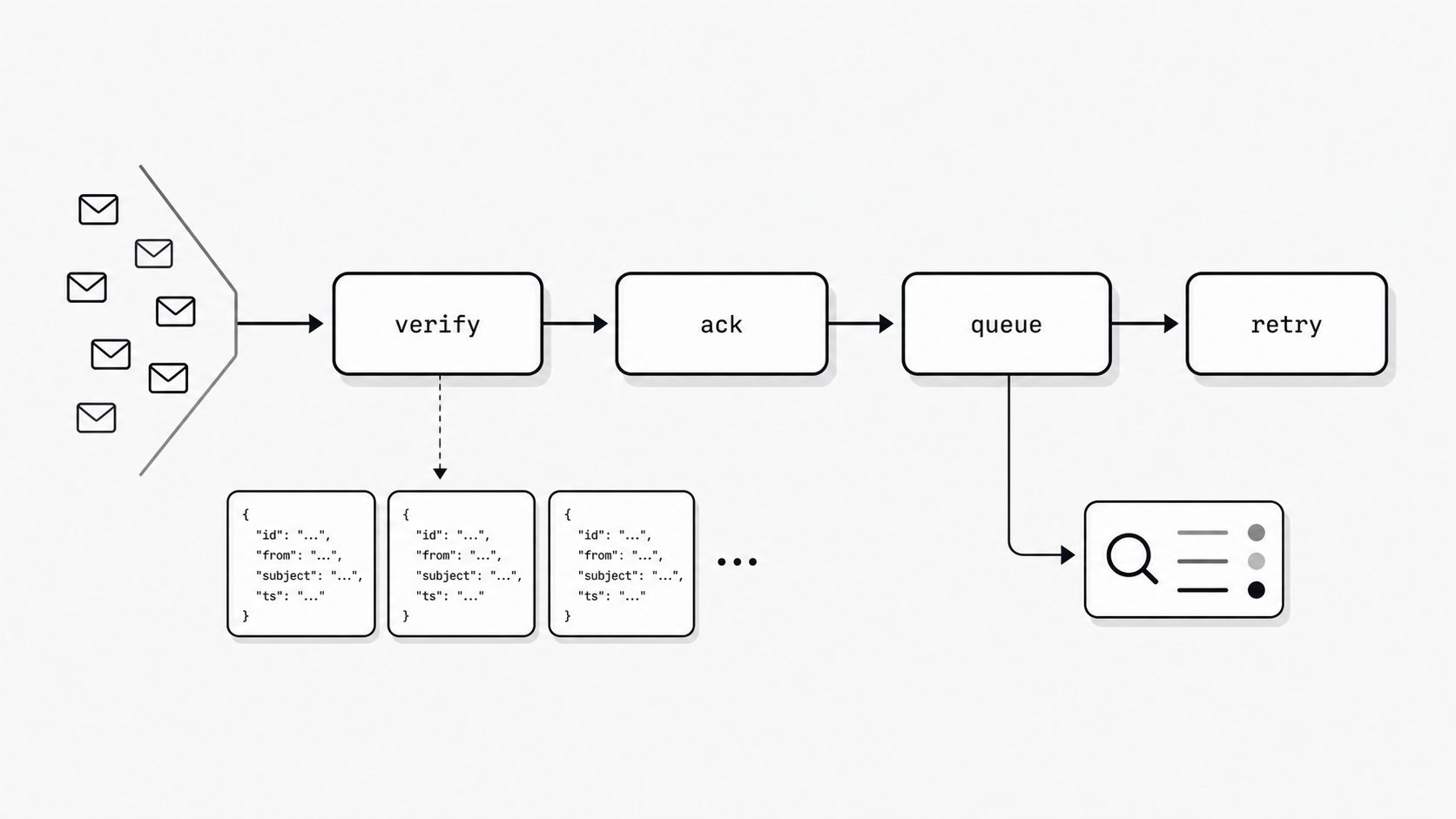
A broad route is safe only when its downstream contract is explicit. Every accepted message should be verified, recorded, and handed off through a predictable delivery path that operators can inspect.
Signature verification protects the handoff, while quick acknowledgment and asynchronous processing keep receiver work from blocking delivery. Reliable Webhook Delivery Best Practices covers those mechanics and the sender-side retry contract in full.
Retries and duplicates need defined behavior too. Why Retries and Duplicates Break Trust in Email Webhooks explains the operating risk, while Idempotency Keys for Email Webhook Automation shows how receivers preserve one business outcome when deliveries repeat.
For a catch-all routing strategy, the requirement is simpler: tag every message with enough metadata to identify its source, recipient, route, and review status. Operators should be able to see what arrived, what failed, and what still needs attention without tracing the whole system.
That boundary keeps this route focused on coverage and observation. Once validation, delivery, and duplicate control are owned downstream, the broad route can stay broad long enough to reveal the patterns that should become tighter rules.
Then the route grows up
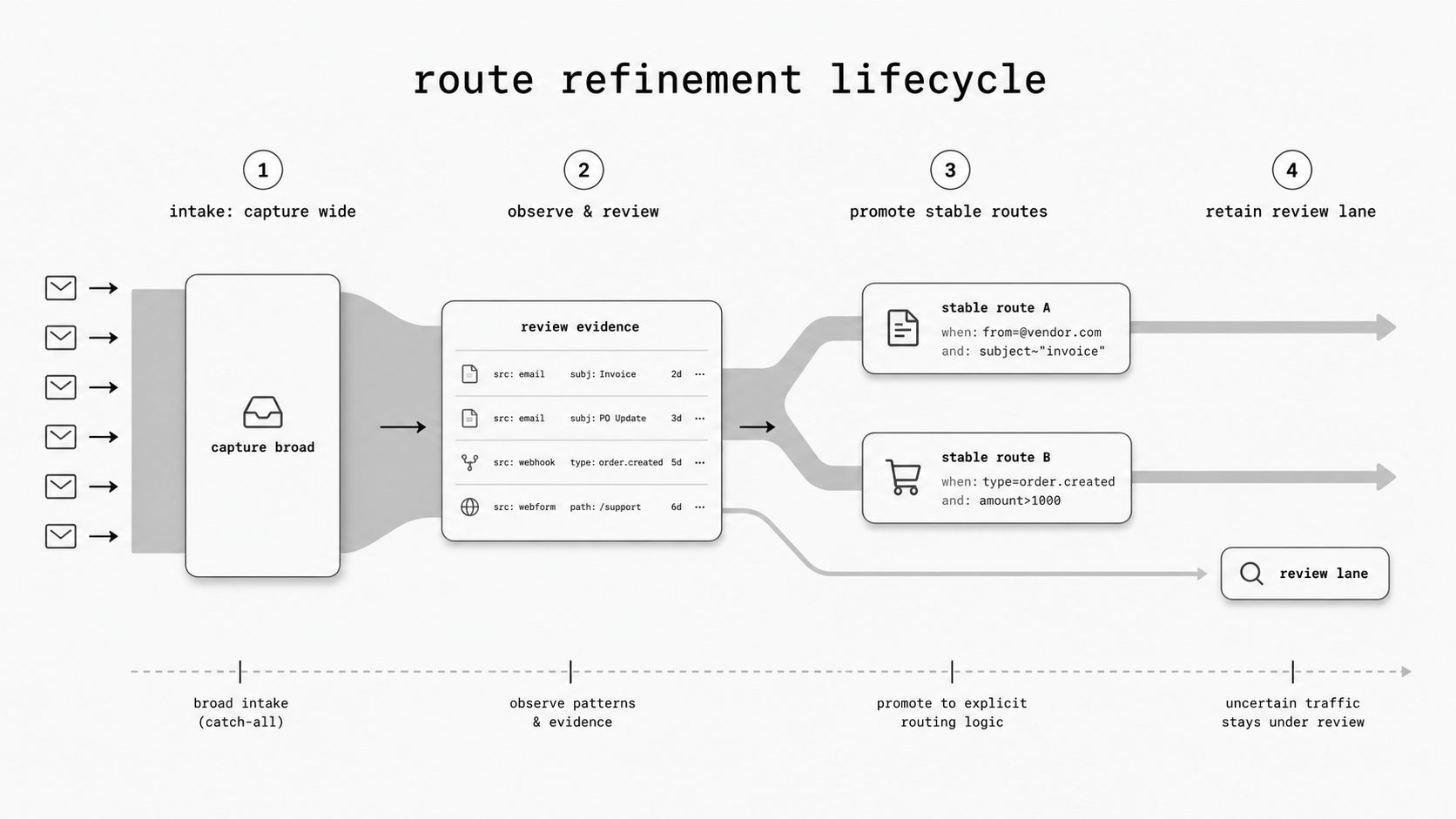
A catch-all route earns its value early, but its real test comes later. Teams often launch broad, learn fast, and keep mail flowing, yet leave that first route in place long after recurring patterns are visible. That is often when avoidable noise, manual review fatigue, and fuzzy ownership begin to grow. Once stable patterns appear, those patterns can be promoted into explicit routing logic with clearer boundaries and accountability.
Routes should not be tightened just because a dashboard looks messy; they should be tightened when traffic keeps telling the same story repeatedly. If the same vendor domains keep sending the same document types to the same addresses, that pattern is a candidate for its own rule. If system notifications always arrive with a consistent recipient format, that is another candidate. The goal is to move from one review-heavy lane into a smaller set of predictable lanes, each with a clear reason to exist.
A practical lifecycle is: capture broadly, review evidence from inbound parsing or webhook feeds, carve out stable patterns into narrower rules, and leave uncertain traffic in the broad route for continued review. Over time, the broad route gets smaller, the specific routes get more useful, and the overall mail flow becomes easier to explain and govern. Mail systems are built around delivery and routing stages, so planning how messages enter and then move toward the right destination is a core part of transport design. (Mail flow and the transport pipeline in Exchange)
The payoff is that the broad route stops being a permanent safety blanket and becomes what it was meant to be: a learning stage in a maturing system. That usually means fewer messages in manual review, clearer ownership by traffic type, and a route design that reflects evidence gathered in production. In practice, the pattern is simple: start wide, learn what is real, split out what is stable, and keep a smaller intake lane for cases that still need observation.
A catch-all route is not the end state I aim for. It is the opening move I use when a team needs dependable intake before it fully understands the shape of its inbound mail. When used intentionally, it gives ops and technical teams a safer rollout path, better operational evidence, and a clearer way to decide what deserves stricter logic later.
That is the pattern I keep coming back to: start with coverage, add disciplined handling, study the traffic, and then refine the route set as stable patterns emerge. Broad intake works best when it is paired with a plan to learn from it. If you treat it that way, a catch-all route stops looking like a compromise and starts looking like what it often is in early deployment: the most practical design choice available.
Once those traffic patterns are stable, use the full email routing rules architecture to turn your observations into governed matching logic.