

Email automation ROI measurement depends on how the work changes, not just how many messages the system handles. A functioning integration establishes technical capability; the investment case also needs evidence of operational value.
I look for a compact case that separates observed improvements from estimates and recovered capacity from cash savings. Three operational measures provide that starting point without requiring an exhaustive financial model. Deployment and running costs remain part of the comparison.
Three-metric ROI model: connect inbound email work to value
Key term: For this model, incident resolution time measures the time from detecting a fault until the workflow is restored and affected messages are handled.
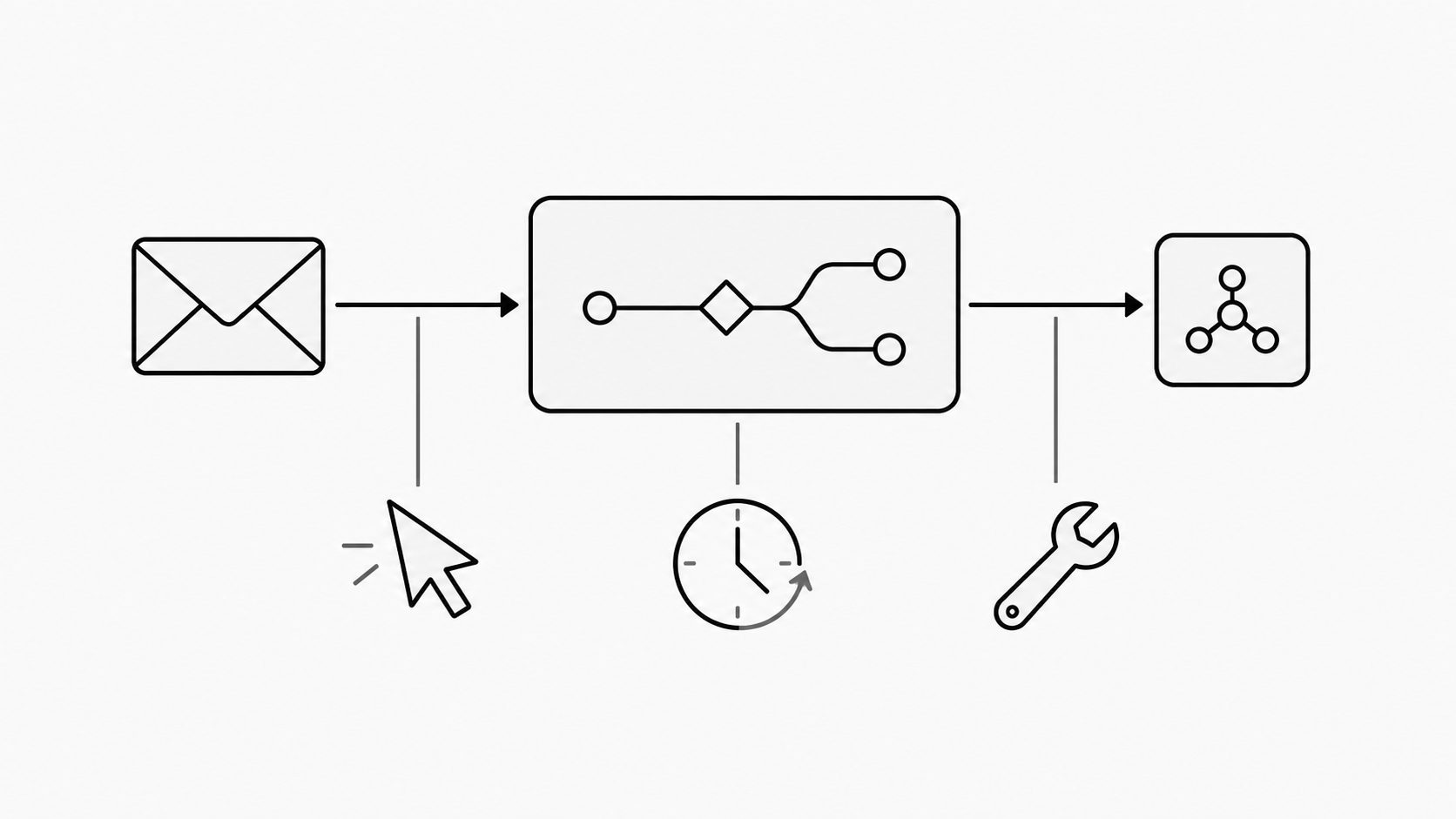
I frame email automation ROI measurement around three changes: fewer manual touches per message, shorter incident resolution time, and fewer engineering hours spent on integration upkeep.
Measure manual touches per inbound message, including sorting, copying fields, and handling exceptions. A lower touch count supports a labor-savings claim only when the time spent also falls. Compare similar message types so easier traffic does not inflate the result.
For incident resolution time, compare similar faults and use incident records to test whether preview and replay shorten recovery. Keep elapsed incident time separate from active staff hours when estimating labor savings.
MailWebhook documents Webhook Preview for inspecting requests and responses, Mailbox Preview for checking a stored message against a selected route rule, Delivery Attempts History, and Replay Event. Its route-level Send Test uses a synthetic message. Keep those results separate from real-message tests for provider-specific parsing and attachments.
For integration maintenance, compare monthly engineering hours spent on custom parsing and routing with the hours still needed after the email webhook deployment. Include rule changes and downstream handler upkeep. Credit only the net reduction, and count incident work once if it also appears in maintenance records.
I treat recovered hours as capacity returned to the team. Cash-savings claims require an actual drop in spending, and any financial return calculation must include deployment and running costs.
Baseline capture method: make the before-and-after comparison fair
Key term: A baseline is a set of measurements taken before a change and kept as a reference for judging later results.
A fair ROI comparison uses the same counting rules before and after automation.
Capture the starting figures in a shared sheet, with sample dates, message types, message counts, and a source for each figure. Include routine work and exceptions. I accept estimates when their source and limits are clear; later savings claims need to reflect that uncertainty.
For manual work, define which human actions count as touches and record handling minutes alongside them. Include zero-touch messages and count each original inbound message once, even when delivery is retried. This keeps retries from inflating the message count.
For maintenance, review recent parsing and routing tickets with the engineers doing that work to estimate hours for a stated period. Use a range when records are incomplete, and separate setup work from recurring upkeep. Google’s SRE workbook calls for consistent effort units tracked before, during, and after toil reduction.
Incident timing needs an equally clear boundary, such as detection to restored message processing. Use ticket and log timestamps to build that interval, keeping the fault type and impact with each duration. Link any webhook event inspector records to the timeline so reviewers can check where time went.
Google’s incident-metrics study used simulation and statistical analysis to show that average recovery and mitigation times were poorly suited to tracking production-incident trends. Keep incident counts visible and treat results from a few cases as tentative. If comparable incidents are missing after rollout, leave the recovery benefit unproven.
Measurement simplicity principle: keep the scorecard small and the costs complete
Key term: Total cost of ownership (TCO) covers the full cost of acquiring, running, supporting, and using a system over time, including staff work and training.
Keep benefit tracking to three measures while accounting for every material cost of the deployment.
Use one review period for benefits and costs, such as the first year. Compare email webhook pricing at the message volume being evaluated, including applicable usage fees. Add setup, testing, migration, and training costs, plus changes in hosting, storage, monitoring, and support. Keep one-time costs separate from recurring costs.
Use ROI = net benefit / investment cost × 100, where net benefit is benefits minus investment cost for the same period. Label a return that includes recovered staff capacity separately from cash return.
Fictional first-year example, in USD: Assume finance agrees on fully loaded rates of $40 per operations hour and $60 per engineering hour. These are invented planning figures, not customer results or product prices. Hours below cover the first year, including rollout time, with no overlap between categories.
For comparable message types, divide handling minutes by original message count in each period. Suppose the before sample has 6,000 minutes across 2,000 messages (3 minutes each), while the after sample has 1,500 minutes across 1,500 messages (1 minute each). Apply both rates to the same first-year evaluation volume of 18,000 messages: before = 900 hours; after = 300 hours; recovered = 600 hours. This prevents lower traffic from appearing as automation savings. For multiple message types, repeat the calculation per type using the same evaluation mix.
The maintenance and upkeep hours below are fixed annual estimates, assessed separately from volume-dependent handling. Do not multiply them by message volume.
| Benefit before new upkeep | Recovered hours | Agreed rate | Capacity value |
|---|---|---|---|
| Manual handling removed | 600 | $40/hour | $24,000 |
| Active incident work avoided | 100 | $60/hour | $6,000 |
| Old integration maintenance removed | 100 | $60/hour | $6,000 |
| Total | 800 | $36,000 |
The investment denominator includes every added cost for that year:
- Recurring staff work: 120 engineering hours for review and handler upkeep × $60 = $7,200.
- Recurring nonlabor costs: $400/month × 12 = $4,800 for the subscription, usage, hosting, storage, monitoring, and support.
- One-time setup: 40 engineering hours × $60 = $2,400 for setup, testing, and migration, plus $1,600 for external training.
Investment cost = $7,200 + $4,800 + $2,400 + $1,600 = $16,000. With no retired nonlabor costs, first-year net value = $36,000 - $16,000 = $20,000. Capacity-valued ROI = $20,000 / $16,000 × 100 = 125%.
Count new upkeep once: the table shows hours released before that work, and the denominator includes its cost. If your scorecard already deducts upkeep from recovered hours, add it back before using this layout. Setup hours are separate. Unchanged costs cancel out; using investment cost as the divisor does not subtract it again.
For the cash view, assume all staff remain on the same payroll, with no overtime, contractor, or other spending reductions and no added revenue. Incremental cash benefits are $0; cash investment is $4,800 + $1,600 = $6,400. First-year net cash benefit is -$6,400, and cash ROI is -$6,400 / $6,400 × 100 = -100%. The positive capacity-valued result therefore supports a case for redeploying staff time; it does not establish cash savings.
Keep the scorecard at three measures as the estimates improve. Add detail where an uncertain input can change the funding decision. If plausible estimates produce both positive and negative net value, the financial case remains unresolved.
Executive ROI narrative: turn measured gains into an approval decision
Key term: Return on investment (ROI) expresses net benefit as a percentage of the total cost invested.
An approval request ties measured gains to a business priority and a deployment scope the evidence supports.
State the scope and cost of the email webhook deployment over the review period, then explain what the three measured changes make possible. Assign recovered staff time to a named priority and an accountable owner. Tie any claimed spending reduction to a specific budget line. This gives the sponsor a concrete use for the gains when weighing the funding request.
Require evidence of complete and correct downstream processing alongside the labor gains. For a claim of fewer missed events, compare expected events with actual downstream results before and after deployment. Treat broader claims of safer automation as unproven unless separate evidence supports them. The approval case needs to account for the quality of the work being automated.
I limit expansion claims to the workflows and message types covered by the data. Projected gains elsewhere remain estimates. When a missing input could change the decision, a capped pilot is a request to fund further testing. Wider deployment remains a separate approval.
A compact ROI case gives sponsors a basis for reviewing the investment as workloads and costs change. Its lasting value is accountability: the rationale for continued funding stays tied to observable results rather than a one-time promise of efficiency.