

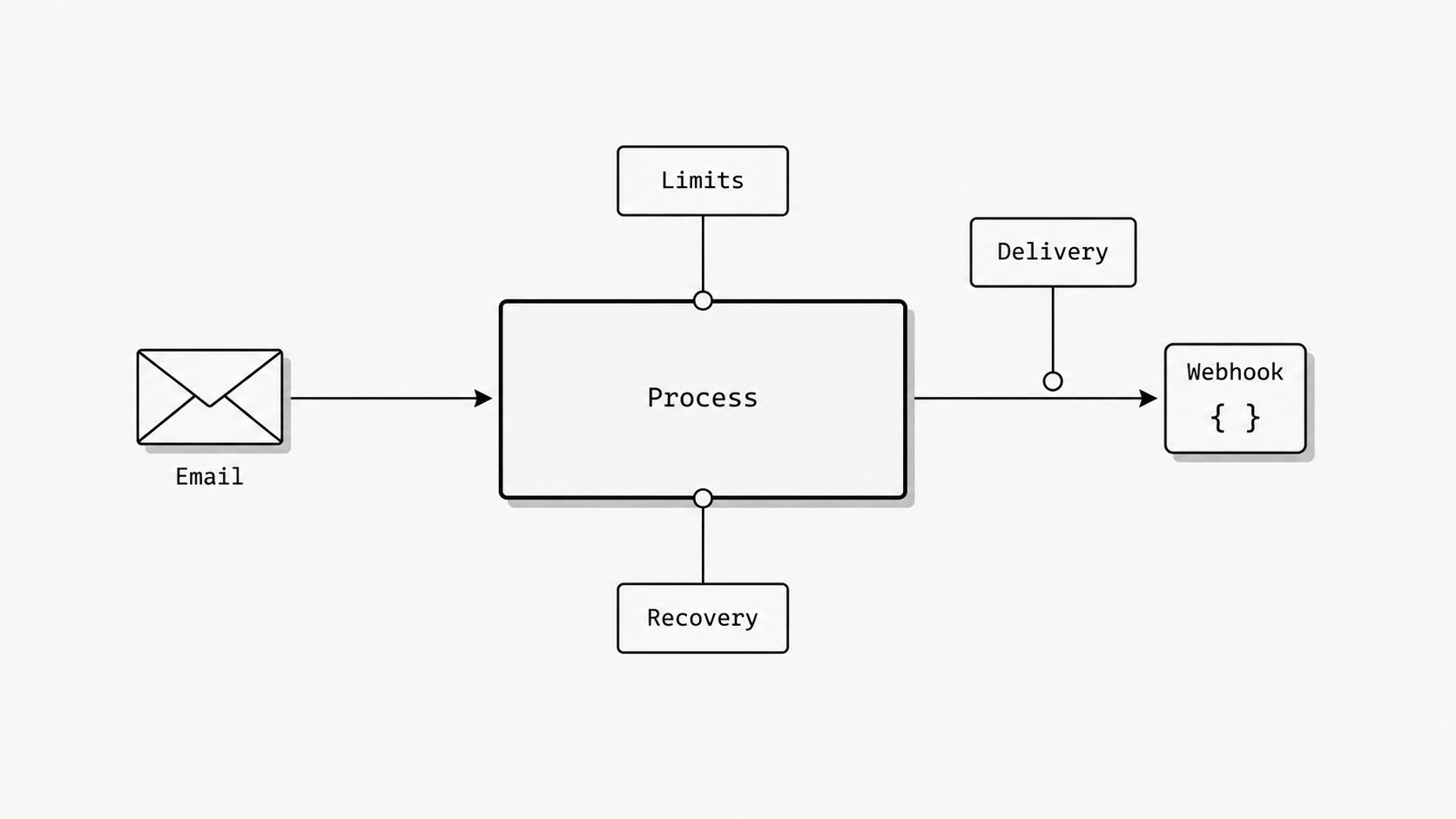
Product age provides context; operational evidence shows maturity. Buyers should look for evidence that a platform handles its promised work and states its limits.
For technical buyers, that shifts the question from whether a vendor looks established to whether its product supports a specific business need at an acceptable level of risk. Email webhook services make this distinction concrete: delivery failures and ambiguous data rules have consequences beyond the integration itself.
Operational maturity signals: make reliability claims reviewable
Key term: Operational maturity is a product’s ability to handle failures predictably and make its limits clear.
Assess an early-stage platform’s operational maturity through failure handling a buyer can inspect and test.
For an email webhook service, ask to see a failed delivery and its recovery. The delivery attempt history should show the error, any receiver response, and whether another attempt is planned. Replay and backfill deserve clear limits: which past events remain recoverable, how long they are kept, and who handles duplicates. These details make the division of responsibility between your team and the provider clear.
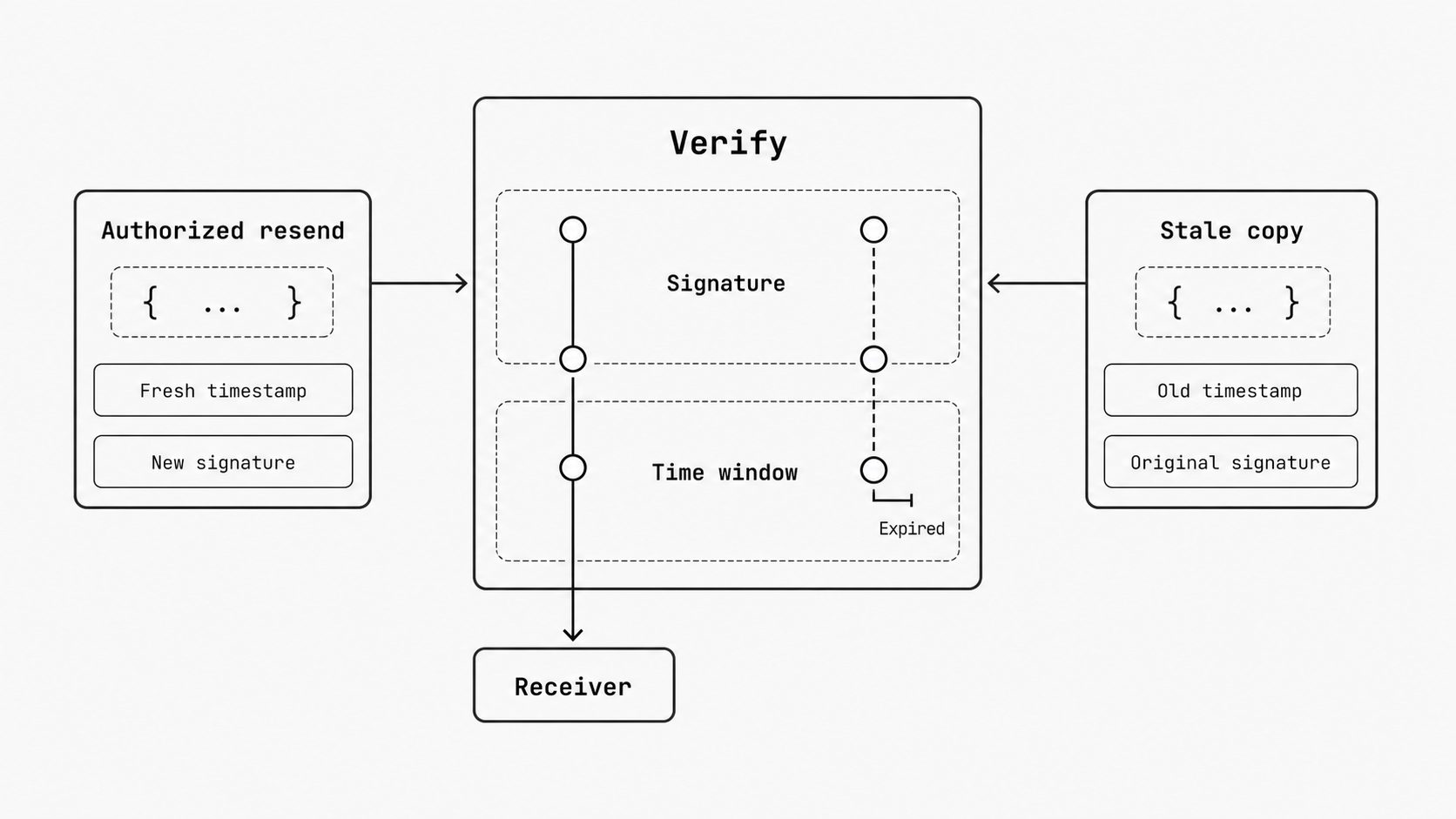
Stripe documents automatic retries, manual resends, and how receivers should handle duplicate events. Its HMAC-SHA256 verification uses the unchanged request body and a signed timestamp. Authorized recovery resends receive fresh timestamps and signatures. A replay attack reuses a captured request and signature; checking the signed timestamp helps the receiver reject stale requests.
That example sets the level of detail to seek from each provider. Require a demonstration of how invalid signatures and malformed data are handled, and how access to recovery actions is controlled. Each service needs its own evidence. Documentation defines the expected behavior; a test record shows whether it holds under the conditions reviewed.
Early-stage product reading: use release history to judge follow-through
Key term: A changelog is a user-facing record of product changes, including added features, fixes, and changes in behavior.
Use release history to judge how a young product follows through on its stated scope.
MailWebhook’s March 2026 changelog entry documented native Gmail and Microsoft 365 mailbox support. Its May 2026 entry documented DOM extraction for pulling data from HTML, alongside limits, truncation, and required-field behavior. These entries show how the documented scope developed. Release notes alone cannot establish reliability under a buyer’s workload; that requires operational evidence.
Use successive release entries to judge whether the product’s stated scope becomes clearer. Read feature additions alongside explanations of their limits and later changes. That gives the review a useful focus: how well the team explains what it delivers. Entry counts alone carry little weight in that judgment.
Read the roadmap against this history. Ask which earlier commitments reached a reported release and how the team explains changes in direction. That discussion helps establish what follow-through means for this vendor. If the purchase depends on a feature still on the roadmap, that dependency remains open until the feature is available and its behavior is demonstrated for the intended workflow.
Scope-versus-polish judgment: judge depth within the promised scope
Key term: Feature completeness is how fully a product supports the requirements within its stated scope.
Judge a young product’s maturity by the care it shows within the work it promises to handle.
Assess integration coverage for fit and interface polish for ease of use. Design depth gets its own review: how fully does the product define and support the behavior your workflow needs? Clear data rules and protective initial settings make that judgment concrete.
For an email service, review the email JSON schema as the documented structure of the data your code receives. Require clear field meanings, data types, and rules for missing values. A sample should show what happens when a required value is unavailable. An unclear rule leaves your team to make an assumption about a core part of the workflow.
Secure defaults deserve the same attention. NIST’s Secure Software Development Framework Version 1.1 addresses secure initial settings and their documentation in practice PW.9. Apply that guidance to the intended use. For a service handling sensitive email, require evidence that its initial access settings meet your access requirements. That requirement applies even to a product with a single integration.
Pragmatic buyer confidence: match approval to the evidence and risk
Key term: A service level objective (SLO) sets a target for measured service quality over a defined period, such as the share of messages delivered on time each month.
Approve a young platform for a defined use when the evidence supports that workflow and the remaining risk is acceptable.
Tie approval to the cost of failure. An internal task with tolerable delays and a tested manual fallback is a candidate for a limited pilot. A workflow tied to strict customer deadlines needs stronger evidence before approval.
Google’s SRE guidance bases useful service targets on what users need. For an email webhook, define the share of accepted messages that must reach your receiver within the required time over a stated review period. Specify where timing starts and what counts as success. If the workflow requires a later business action, measure through that action.
A target alone leaves achieved performance unproven. Judge the results available at review time, record unresolved risks, and name who accepts them. Keep approval within the conditions the evidence covers. Larger loads, more sensitive data, or a higher cost of failure call for a new decision.
Confidence in a young platform rests on evidence for a defined use and explicit acceptance of the remaining risk. That standard leaves room for early-stage products without turning limited evidence into a general assurance of safety.