

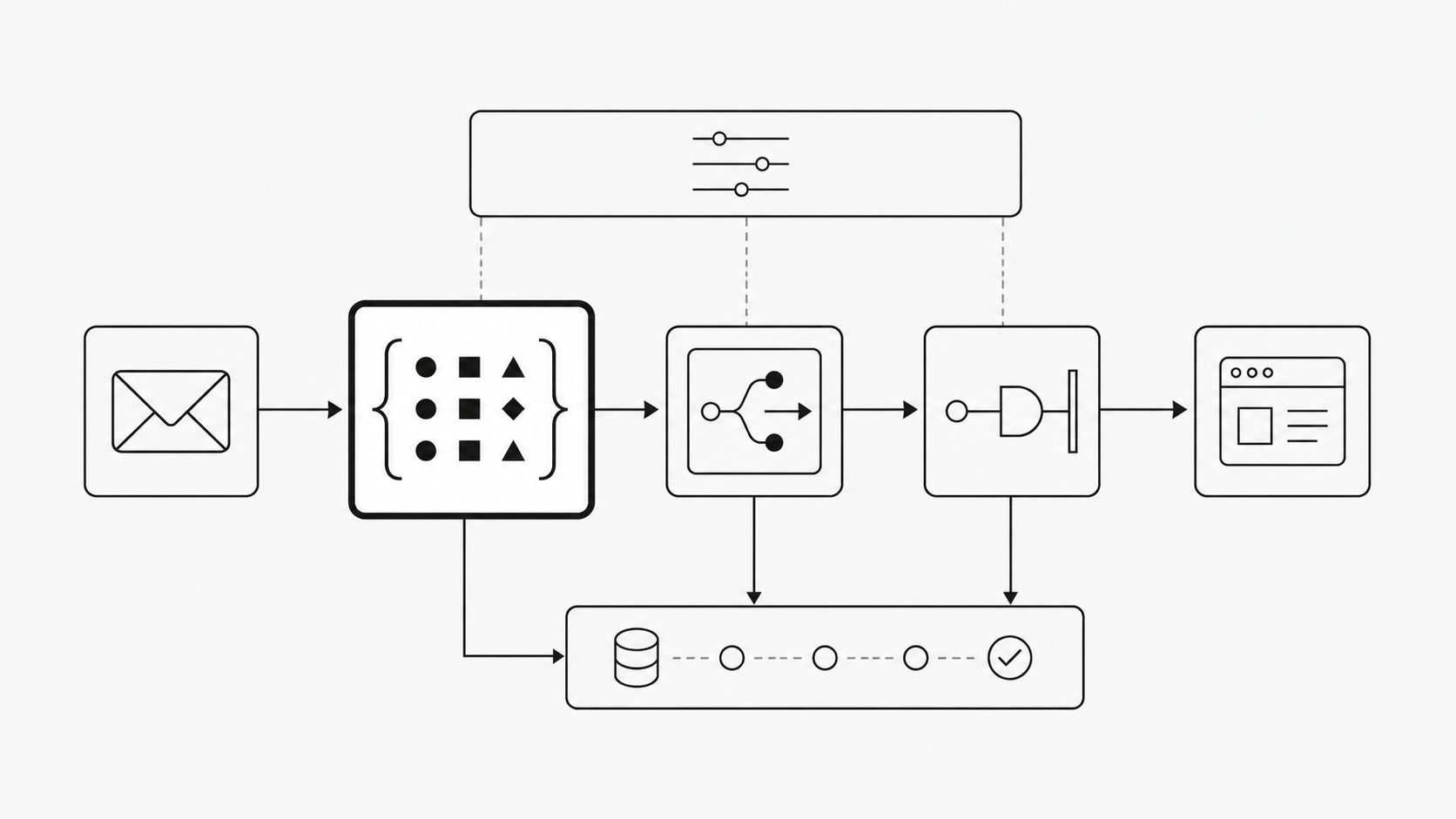
Reliable email automation depends on clear responsibility for data meaning and failure handling alongside successful webhook delivery. As integrations grow, those responsibilities need named owners and explicit limits.
The series’ central lesson is the boundary between shared infrastructure and application logic. The shared layer establishes the input contract and governs delivery; applications retain their business decisions. The principles below explain that division and its tradeoffs for MailWebhook and other platforms. These principles are design and evaluation criteria. Check each platform’s documented behavior against your workflow.
Normalize email before adding integrations
Key term: An anti-corruption layer translates data between systems so an application can keep its own data model while working with outside systems.
Normalize and validate inbound email before expanding downstream integrations. Establish the shared input contract before more applications depend on it.
Microsoft’s anti-corruption layer pattern describes a translation boundary that can live inside an application or run as a separate service. The guidance identifies latency and maintenance costs. At email intake, this pattern gives translation a clear owner and defined output before adding consumers.
At the email webhook boundary, define the shared input contract together with field meanings and rules for missing or invalid data. For example, require a clear distinction between “no attachments” and “attachments could not be read.” The purpose is to give each application a clear basis for handling incomplete input. Keep decisions such as ticket priority in the application that owns that workflow.
Contract ownership also covers changes in meaning. Include those changes in compatibility reviews even when the JSON structure stays the same. The intake team’s responsibility is to preserve the agreed meaning of the data as source formats evolve. Keeping that obligation narrow leaves each application room to develop its own business logic.
Centralize shared routing and recovery policy
Key term: A control plane manages and distributes changes to a system’s resources and settings. The data plane performs the ongoing work.
Keep shared routing, transformation, and recovery policy in one reviewable place as integrations grow.
AWS’s explanation of control and data planes provides a useful architectural model. Its static-stability guidance describes how existing work can continue through a control-plane impairment, while configuration updates may be delayed.
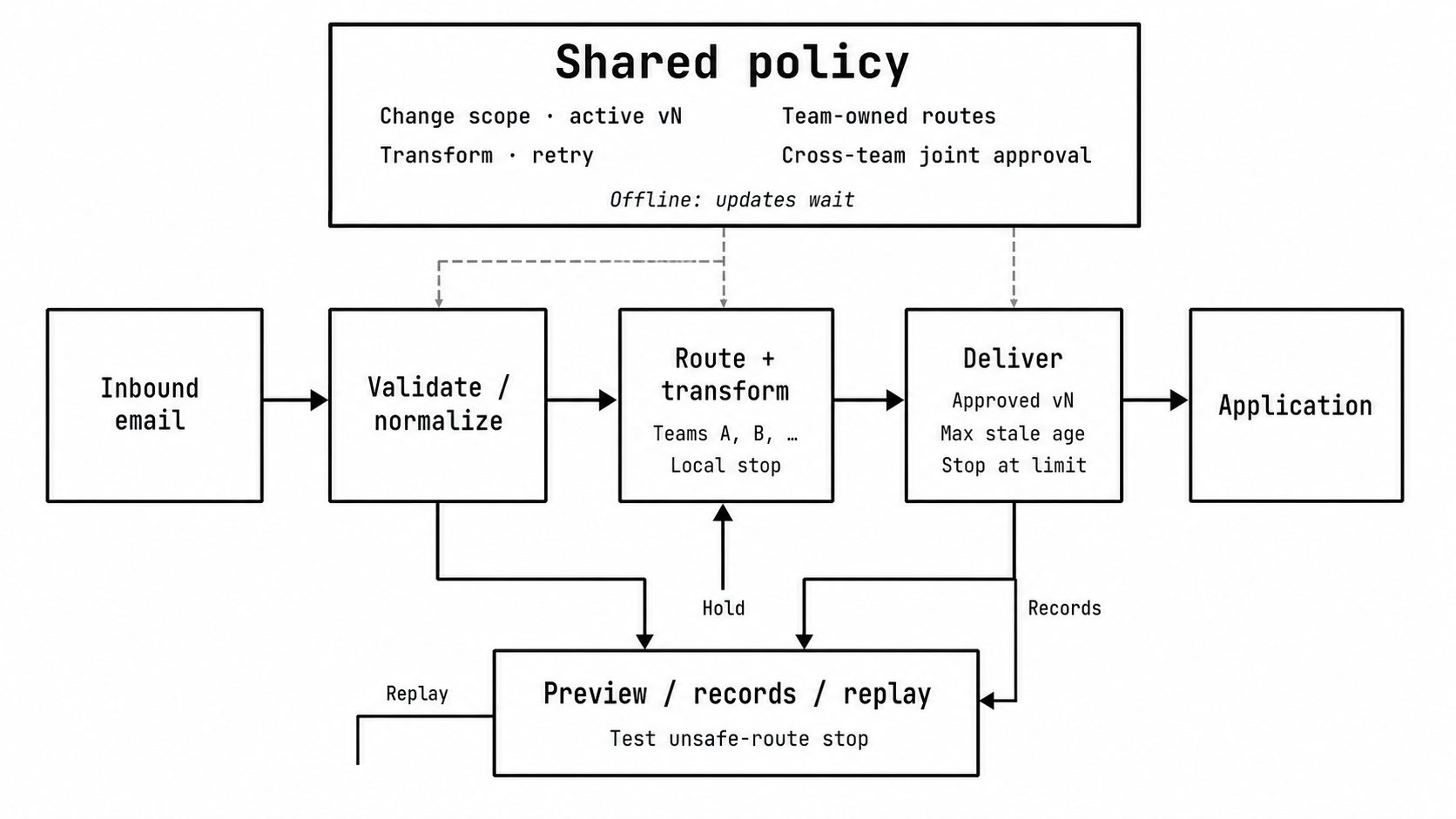
An email routing rules API should expose a change’s scope and the rule version in use. Keep shared transformation and retry settings visible alongside those rules. Give each team authority over its routes, with joint approval for changes that span teams. A common policy view then supports local ownership as integrations grow.
Policy review also needs to cover failures in the service used to change those rules. Require evidence that delivery workers can keep using approved rules while that service is unavailable. Continued delivery carries a tradeoff: if a destination becomes unsafe during the outage, an old rule could keep sending messages there. The design needs an explicit limit on how long workers can use stale rules and a tested way to stop an unsafe route. Both belong in the decision about acceptable availability.
Bound email customization with clear limits
Key term: An expression language lets users write rules that check data or calculate values within an application.
Keep email customization within explicit limits on data access, allowed actions, and resource use.
Google’s Eventarc Advanced supports Common Expression Language (CEL) for event conditions and data transformations. Google warns against putting secrets or personal data in transformation expressions because it treats those expressions as service configuration, with different protections from event payloads.
Every permission a custom rule receives needs a clear reason. Give email routing rules only the allowed fields and approved destinations their task needs. Keep external calls and secret values outside that scope. Custom output must satisfy the receiving application’s agreed contract. Assign the receiving application responsibility for checking required fields and rejecting invalid input before business changes occur. Test execution failures and incomplete output separately.
Test allowed operations, access controls, time and memory limits, and behavior when a rule fails. MailWebhook’s Custom JSON validation and limits distinguish ordinary expression failures that can produce null from hard execution-limit failures that stop delivery. Check both the delivery outcome after an execution failure and the receiver’s rejection of output that lacks business-required fields. Work beyond the agreed limits belongs in a separately reviewed application step, with its added engineering cost included in the design decision.
Make recovery part of email automation
Key term: Idempotency means repeating an operation has the same intended effect as performing it once.
Build recovery into the architecture from day one. Preview, delivery logs, quarantine, and replay are core requirements for an email webhook system.
An operator needs enough context to decide whether to fix a rule, retry delivery, or correct work already accepted by an application. Require previews that show proposed output without sending it, delivery attempt history for diagnosis, and quarantine that holds suspect messages for review. Define who can inspect retained email and how long it remains available.
MailWebhook’s retry and replay documentation describes delivery-attempt records and replay that rebuilds a request using the current route and pipeline. Retries and replay keep the same X-Idempotency-Key for the same original message and route. The receiver remains responsible for handling duplicates. A 2xx response sets the event’s status to delivered; the documentation advises saving the work durably before acknowledging receipt.
Those documented rules imply a recovery risk: after a pipeline fix, replay may carry a changed payload with the same key. A receiver that already accepted the original may skip the correction as a duplicate. Give approved corrections an explicit path to update existing business records, with their outcome tracked separately from delivery status.
These principles give technical leaders a basis for an email automation strategy that evaluates platforms beyond feature lists. Documented behavior and test evidence matter more than assurances that an integration is flexible or reliable. The lasting measure of the architecture is how clearly teams can explain and correct application outcomes after delivery.