

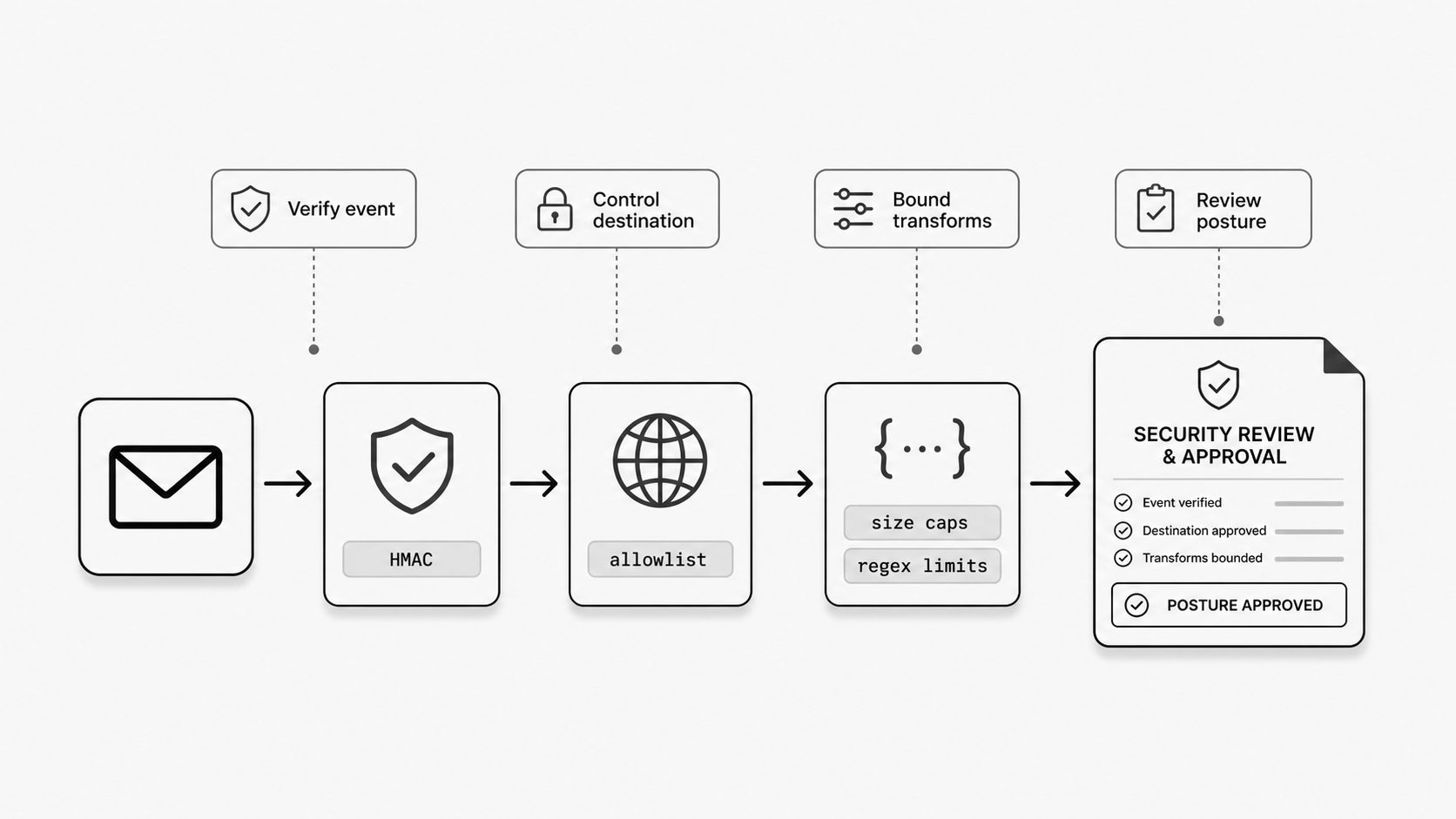
Security reviews for email automation platforms often get harder than they should be. The risks are usually clear. The harder part is that answers are scattered across webhook docs, parsing docs, routing settings, and implementation notes. By the time a security team is asked to approve an email-to-webhook platform, they are usually trying to determine whether the system has a defensible security posture they can explain, challenge, and ultimately greenlight.
That is the frame I use in these reviews. I start with four questions: can I verify every event I receive, where can the platform send data, what keeps transformations inside safe limits, and can pattern matching stay safe under messy input? Together, those questions define the real approval surface for an email automation platform. They also reflect a simple design principle: secure email intake depends on multiple controls working together from receipt through delivery.
For the broader architecture context behind this review, start with The Case for an Email Ingestion Layer, which explains why inbound email needs one owned intake layer before it feeds applications.
In this post, I will walk through each question the way an approver or technical lead would ask it, then answer it with the principle that should sit behind the product design. The goal is to make the security posture easier to review from one place.
If you are reviewing the product surface directly, MailWebhook’s email webhook API is the starting point for the email-to-webhook path this review evaluates.
Question 1: Event verification - can I confirm every webhook is authentic?
When I sit in on a security approval call for an email webhook platform, I usually start with one simple question: if this event shows up at 2:00 a.m., how do we know it is real? That question matters because the first risk in any email to webhook flow is trust. Before anyone talks about routing, parsing, or automation logic, the team needs a clear way to prove message authenticity and payload integrity. If that proof is weak, every downstream control sits on top of a shaky foundation. (webhooks.fyi - Webhook Security)
This is where many reviews drift into product trivia. I try to keep the conversation centered on the approval surface that actually matters. For an inbound email webhook or email parsing API, the first control to inspect is whether the platform signs outbound webhook events in a way the receiver can validate consistently. In practice, that usually means a shared-secret signing model such as an HMAC webhook signature, where your endpoint recomputes the signature and compares it to the value sent by the platform. That gives the reviewer concrete approval questions: what is signed, how is replay risk handled, where is the secret stored, and what happens when validation fails? The answers determine whether the system treats inbound data as trusted only after verification. (OWASP Input Validation Cheat Sheet)
For MailWebhook specifically, the signed delivery documentation is the reference point for the X-MailWebhook-Signature control a receiver validates against the raw request body.
I also look for discipline in what happens next. A valid signature answers who likely sent the event and whether the signed content was altered in transit. The receiving system still has to validate structure, fields, and expected content before downstream processing. OWASP’s input validation guidance is helpful here because it reinforces a simple point security teams already believe: external input should be accepted through explicit validation rules and clear trust boundaries. For approvers, that framing is useful because it turns a vague product promise into a reviewable design principle. The platform should help you establish authenticity first, then enforce predictable handling of the payload that arrives.
You might be wondering: is this too basic to lead with? In my experience, it is the right starting point because every later question depends on it. Endpoint restrictions matter after you know the sender can be verified. Transformation guardrails matter after you know the event itself is authentic. Pattern safety matters after you trust the source enough to process the content. The sequence matters in a review meeting because security approvers are trying to decide whether the whole chain begins with a trustworthy event.
So the practical takeaway I use is this: for any mail webhook product, the first greenlight question is whether every event can be verified with a clear, repeatable control the receiving system can enforce on its own side. If the answer is yes, the review starts on solid ground. If the answer is fuzzy, the rest of the platform story gets harder to approve because the intake point remains uncertain. That is why I treat verification as the opening gate in the webhook security review surface. It gives security teams a clean first test and gives technical leads a concrete principle to carry into the rest of the evaluation.
Question 2: Endpoint restrictions - where can this platform send data?
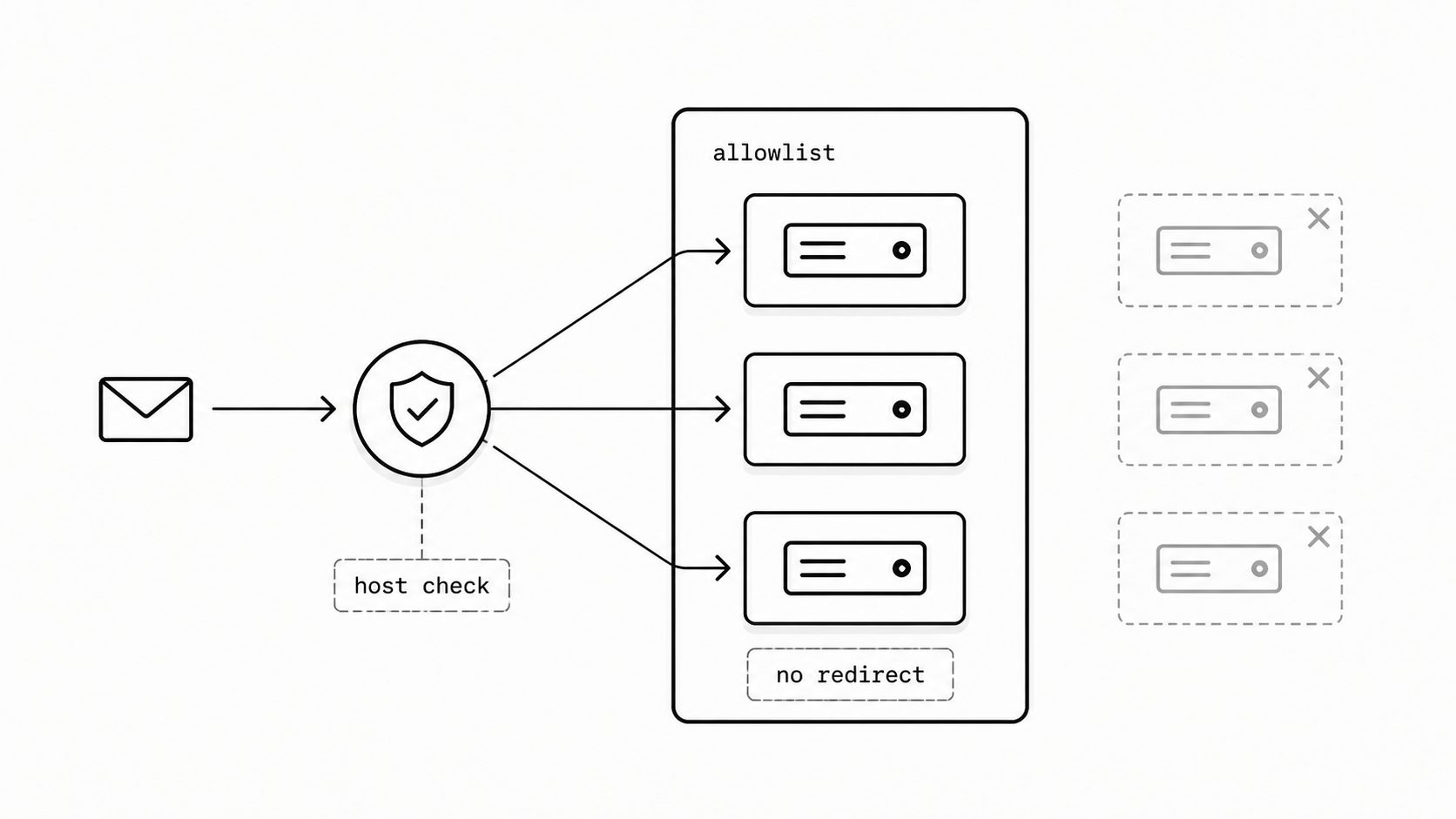
Right after I am satisfied that an event can be verified, I move to the next approval question: where can this platform send the data once it has it? In a real review, destination setup is a core risk question. If a platform can forward parsed email content to broad, user-defined, or weakly validated destinations, the exposure risk rises quickly. Security approvers are trying to answer something very specific: can sensitive email data be routed to known, intended systems, and how does the platform prevent drift into places the organization never meant to trust? That is why I frame destination control as an approval issue first. The routing feature matters because the boundary matters. (OWASP Server Side Request Forgery Prevention Cheat Sheet)
This is where I see teams talk past each other. Flexibility claims need to be translated into constraint questions: what destinations are allowed, how are they validated, and what prevents bypasses through redirects, internal addresses, or overly broad patterns? OWASP’s SSRF guidance is useful here because it recommends allowlist-based controls for flows that send requests to external destinations and warns that weak redirect handling can undermine destination validation. For an email automation platform, that principle maps cleanly to webhook delivery. A reviewer should be able to see that outbound delivery is constrained to approved targets, with clear checks around hostname and protocol. Redirect behavior stays a separate review question: if a target redirects, does the same destination validation still hold?
I also look for whether the platform makes those restrictions easy to inspect. If an approver has to infer the posture from scattered settings across onboarding docs, webhook docs, and an email routing rules API, confidence drops. A stronger design makes the policy obvious. For example, if the platform supports conditional email routing or an email filter webhook, the review question is whether those routing paths inherit the same destination limits and keep unvetted endpoints out of the path. The same goes for email routing by sender domain. Useful routing logic is fine. What matters in approval language is whether routing logic changes destination choice only within a bounded set the organization has already accepted.
MailWebhook’s endpoints documentation is the product reference for the concrete endpoint limits it documents: allowed http and https schemes, rejected userinfo, hostname resolution, and public-address checks.
The same controls also reduce ordinary mistakes. A platform that allows any arbitrary callback URL creates room for accidental data disclosure, misconfigured test endpoints, and hard-to-see routing drift over time. A stronger posture has narrow defaults, explicit approvals, and validation that holds even when users try to add new destinations later. Broad delivery promises give reviewers little comfort. An approval-ready principle is narrower: “we can send data only where policy allows, and the platform enforces that boundary consistently.”
So my practical test for this second question is simple: can the team show me a destination policy that is both restrictive and reviewable? If the answer is yes, I know the platform is speaking in the terms security approvers need - approved targets, enforced limits, and reduced chance of silent data sprawl. If the answer is vague, I treat that as a sign the routing model is still being presented as an engineering convenience. A governed control surface earns trust faster when its sending boundaries are clear enough to survive a review meeting.
Question 3: Transformation limits - what keeps processing safely bounded?
By the time a platform has passed my first two approval questions, I usually ask the one that exposes how mature the design really is: what stops a valid email from turning into an unsafe workload? That is the moment where many reviews shift. Webhook signature validation and controlled destinations answer one part of the intake risk. A signed event can still contain oversized fields, expensive payloads, or malformed content that forces downstream systems to do too much work. For me, this is where defense-in-depth for email intake becomes real. I want to see whether the platform treats parsing and transformation as a bounded activity with clear limits. (OWASP API Security Top 10 - API4: Lack of Resources and Rate Limiting)
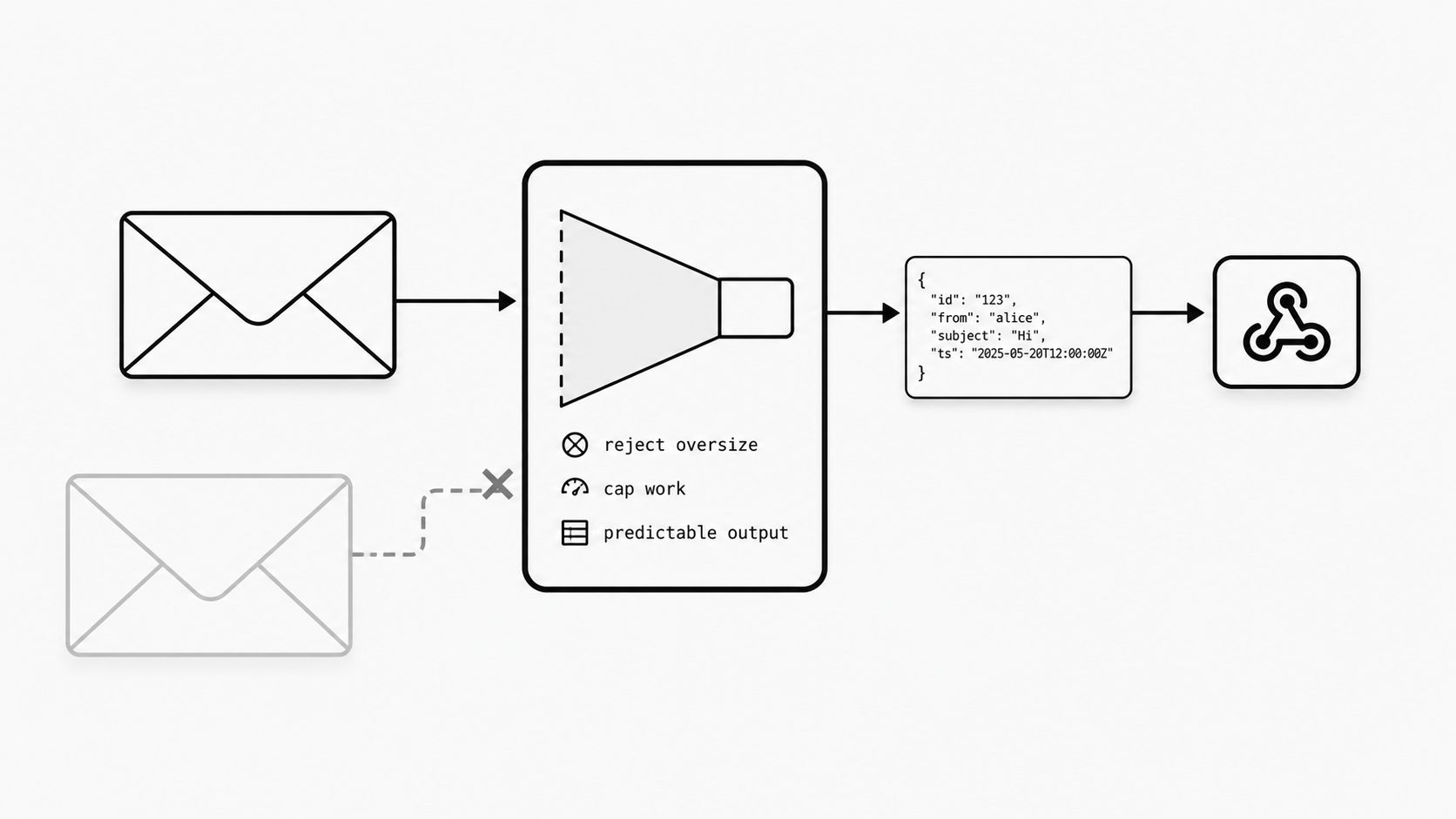
I frame this in simple approval language. If an inbound parse webhook or email parsing API accepts email from the outside world and turns it into structured data, what are the limits on size, shape, and processing cost? OWASP advises teams to define allowed input and explicit minimum and maximum length boundaries during validation. OWASP’s API security guidance also calls out request payload size and other resource-related limits as core defenses against resource exhaustion. Those ideas map cleanly to email automation. I expect reviewers to ask whether the platform places boundaries on raw message size, attachment handling, field lengths, header counts, parsing depth, and the amount of transformed output it will produce from one inbound message.
This matters because transformation is where trusted delivery turns into active processing. The system has moved from receipt into decoding content, extracting fields, normalizing text, maybe evaluating patterns, and then preparing that result for a webhook target or another internal service. Each step adds work. Each step can amplify risk if the platform fails to enforce boundaries first. In a review meeting, I am listening for design principles such as fail closed on oversized input, reject unexpected structures early, cap expensive operations, and keep transformed output predictable.
You might be wondering: why press so hard on limits if the sender is already authenticated with an HMAC webhook signature? Authenticity proves source. Processing cost comes from content shape, size, and expansion risk. In practical terms, that means I want bounded processing even for trusted sources. A good platform makes those guardrails inspectable enough that an approver can see the operating envelope in one place. That is especially important when the product is presented as an email to JSON API, because structured output can hide the fact that parsing still has to survive messy input safely.
So my third approval test is straightforward: can the team show me hard limits that keep transformation work small, predictable, and enforceable? If they can, I see a platform that understands secure intake across sender verification, routing hygiene, and bounded processing. I see a system designed to absorb messy real-world email while keeping one message from consuming unreasonable resources or generating unstable downstream output. That answer gives security approvers something they can actually greenlight: a bounded processing model they can inspect, explain, and defend in the room.
Question 4: Regex safety - can pattern matching stay bounded?
The fourth question is narrower and easy to miss: if the platform lets teams use regular expressions for routing, extraction, or validation, what keeps those patterns safe under hostile or messy input? Regex can be a useful control in email automation, especially when subjects, senders, and message bodies vary. It also runs against content that came from outside the organization, which means pattern matching needs its own review surface.
Regex risk includes match accuracy, availability, and processing behavior. OWASP warns that poorly designed regular expressions can trigger Regular Expression Denial of Service through extreme backtracking, and OWASP’s input validation guidance separately flags ReDoS as a concern in regex-based validation. If regex sits inside an inbound parse webhook, an email filter webhook, or a routing rule, an approver should ask which engine is used, whether unsafe constructs are rejected, whether input length and evaluation time are bounded, and what happens when a pattern fails. (OWASP Regular expression Denial of Service - ReDoS)
For MailWebhook’s rule layer, the safe regex documentation is the implementation reference for regex matching controls.
I also want pattern behavior to remain explainable. The review should show who can edit patterns, how changes are tested, whether examples are logged, and whether a broad expression can quietly route sensitive messages into the wrong workflow. Those are governance questions as much as engineering questions because regex can become hidden business logic if the platform treats it as a small configuration detail.
So my fourth approval test is this: can the team prove that regex matching is limited, observable, and fail-safe? Clear proof makes pattern matching a bounded control in the security story. A fuzzy answer forces the review to treat every regex-powered route or extractor as another place where untrusted email can create unpredictable work.
If a platform handles pattern safety clearly, the fourth question completes the review surface. You now have a way to test event authenticity, destination boundaries, processing limits, and regex behavior as separate controls before asking whether the whole posture holds together.
When I look back at most approval conversations around email webhook platforms, the friction usually comes from weak controls or controls presented in a way that makes them hard to evaluate. These four questions surface those gaps quickly. They give security approvers a practical structure for testing trust at the intake point, confinement around delivery, limits on processing work, and safety around pattern-based extraction.
More importantly, they turn a broad platform evaluation into something concrete and reviewable. A team that can answer all four clearly presents a coherent posture that can stand up in a real approval meeting. That is the standard worth aiming for, especially now that security teams are more directly involved in automation reviews.
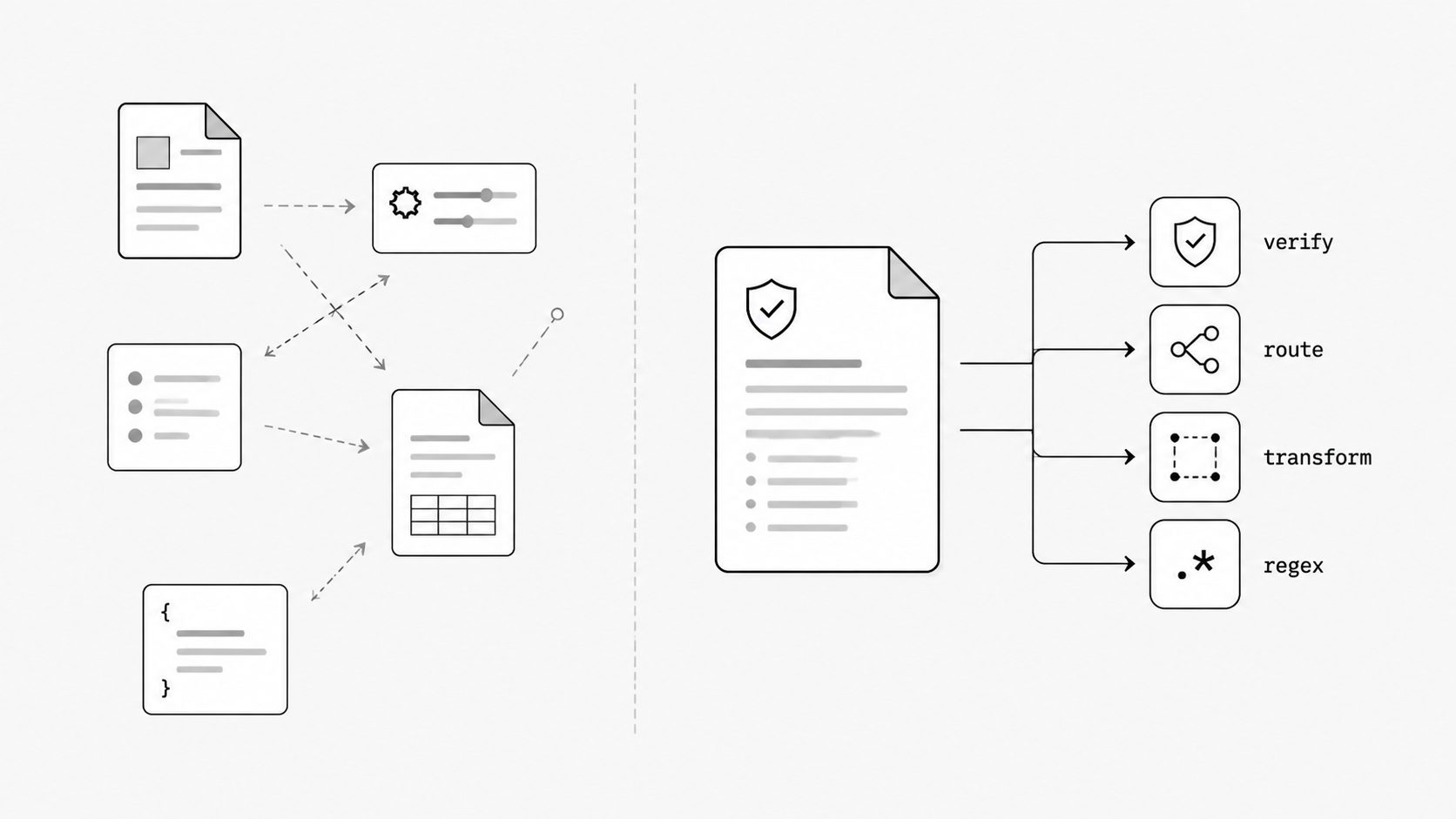
The final step is to make that posture inspectable in one place. A reviewer should be able to see how events are verified, where data can go, which limits bound transformation work, and how pattern matching is controlled. Scattered pages and verbal explanations push blind spots late into the review. A single artifact makes the controls easier to challenge, explain, and approve.
Coming next in this series
Each question in this review maps to one deeper control area planned for this security series:
- Signed Webhooks for Reviewable Trust will cover HMAC signature verification and the approval checks that prove each event is authentic.
- Public Endpoint Restrictions Are a Feature will cover SSRF prevention, destination allowlists, and the public endpoint boundaries that keep delivery constrained.
- Guardrails Matter More Than Flexibility will cover size, shape, and processing limits that keep webhook transformations predictable.
- Safe Regex Is a Leadership Topic Too will cover catastrophic backtracking risk and the review standards regex-based matching needs.
Taken together, those four checks give you a practical review path. If you can carry these questions into a review, you will have the structure needed to judge whether an email automation platform is ready for security approval.