

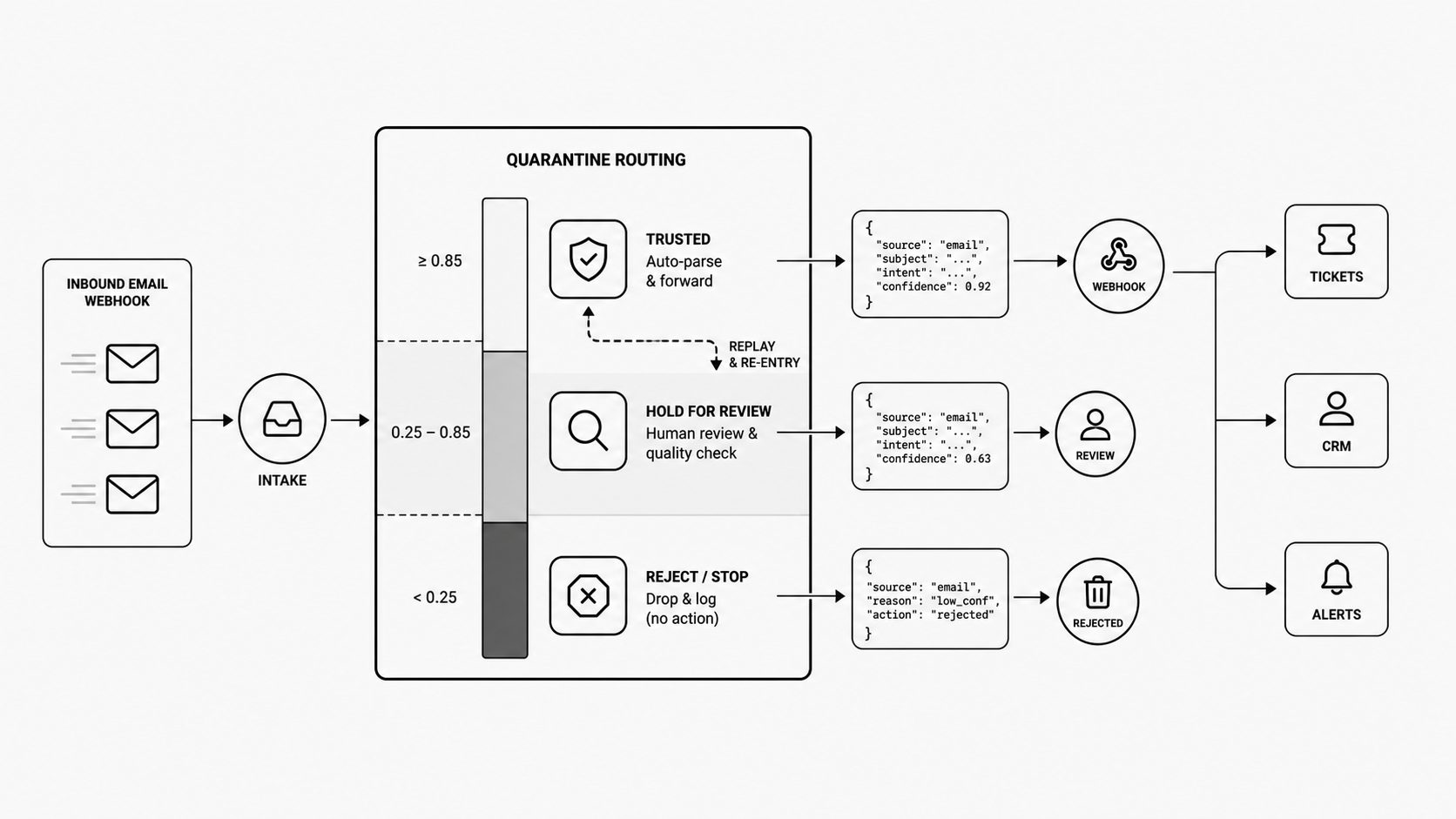
As inbound email parsing becomes a trigger for tickets, CRM updates, routing rules, and downstream actions in an email-to-webhook workflow, the old idea of quarantine as just a spam bucket stops being useful. Inside an email ingestion layer, quarantine becomes one of the controls that decides which messages can become application-ready input. Ops owners and security-conscious buyers need a better frame: quarantine is a control surface for the intake layer.
That shift matters because automation fails in two ways: obvious threats get through, and uncertain messages behave like trusted input. A low-confidence email can create bad records, trigger noisy alerts, misroute work, or quietly erode trust in the systems that depend on clean intake. The safer design is a deliberate middle path for messages that deserve review before action.
In this post, I look at quarantine as an operational tool: a defined lane for uncertain messages, a way to turn spam thresholds into routing policy, a protection for automation quality, and a review-and-replay pattern that lets valid messages move forward safely. When teams treat quarantine as a designed control in the intake path, automation gets calmer, safer, and easier to trust.
So where should low-confidence email go?
When teams expand automation, one question reveals the risk fast: where does the weird email go? If the answer is “into the same flow as everything else,” trouble is coming, because low-confidence messages can trigger bad records, bad alerts, and bad downstream actions in systems that trust inbound parsing. Established email security guidance also treats quarantine as a valid post-inspection action alongside forwarding, parking, cleaning, blocking, or deleting, which supports using it as an intentional control point. (NIST SP 800-45 Version 2)
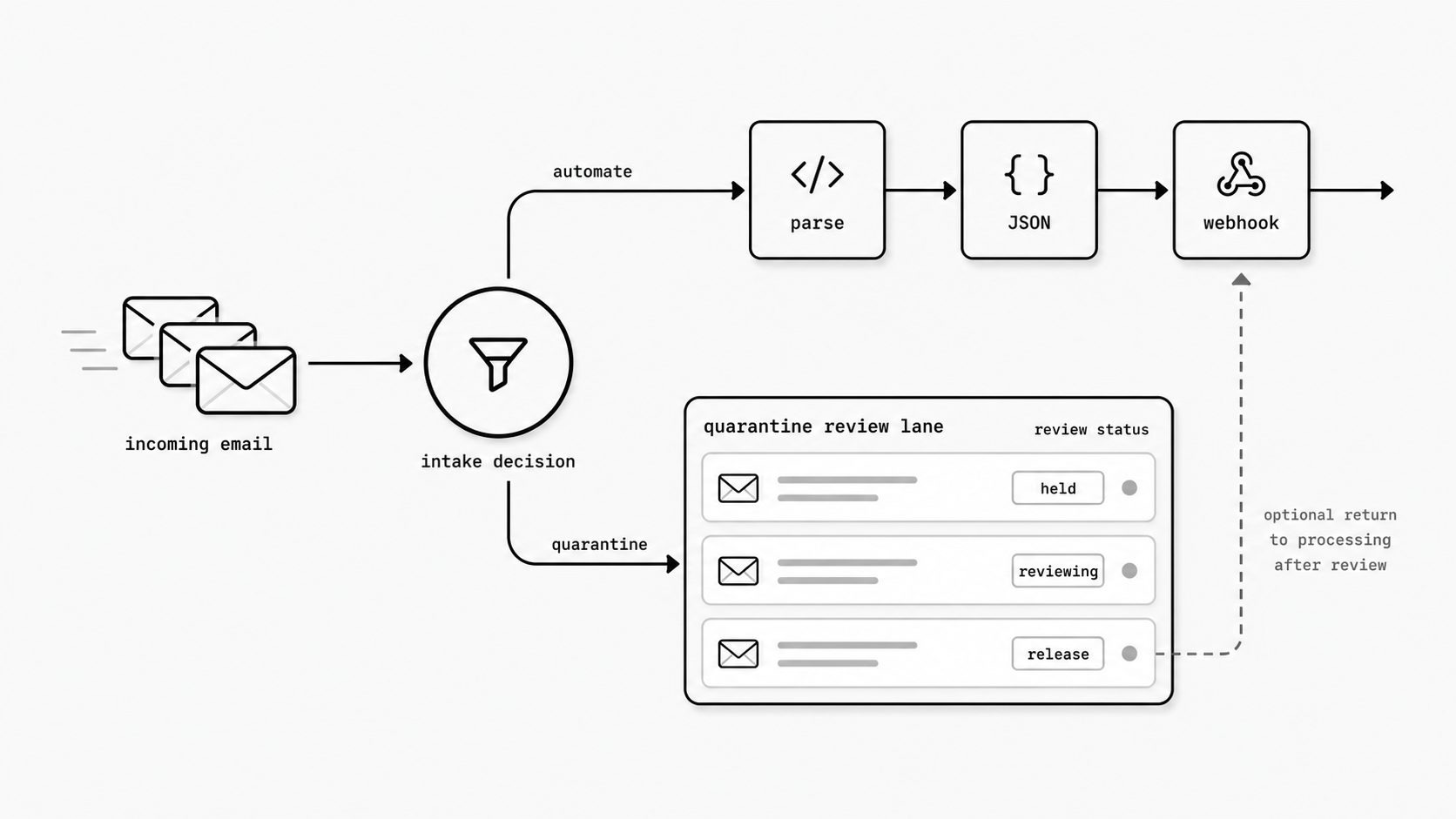
A quarantine review lane works as a decision point in the intake layer. Some messages are clearly safe and can move forward, while others are clearly malicious and should be blocked. The uncertain middle group needs a defined place to wait, and recognized email security guidance supports quarantine as one of the standard actions available after inspection.
Key term: Quarantine review lane means a controlled path where low-confidence email is held, inspected, and deliberately released, rejected, or replayed before automation acts on it.
That matters operationally because automated workflows eventually encounter messages they should handle carefully. A review lane creates a controlled branch for exceptions so the message can be preserved, inspected, and deliberately routed. This reduces the chance that questionable input changes CRM data, ticket queues, fulfillment actions, or internal notifications before anyone notices.
The framing also improves accountability. When low-confidence email has its own lane, operators can see what was held, why it was held, and what decision came next. Over time, that creates a feedback loop for better handling policies and a calmer intake system with fewer surprises.
Design quarantine as part of the workflow from day one. Treat it like a staffed checkpoint with clear routing, visible status, and an intentional path back into processing for legitimate messages. That approach aligns with established guidance recognizing quarantine as a normal response option after message inspection, and it helps protect trust in the rest of your automation.
A score by itself is only a signal
I have seen teams treat a spam score like a final answer. It feels clean. The system assigns a number, and the number seems objective. Then the real world shows up. A vendor changes domains. A customer forwards a long email chain. A form tool sends from a shared service. Suddenly a message with business value lands in the gray area, and the score alone cannot tell your operation what to do next. (Apache SpamAssassin Documentation)
That is why I treat threshold setting as an operating policy, even when it lives inside mail hygiene settings. Apache SpamAssassin documents a configurable scoring model and notes a default score of 5.0 for tagging mail as spam, which is a useful reminder that the cutoff is a chosen rule with operational consequences. Once you see that, the important question changes from “what score is spam?” to “what should happen at each score range inside our intake flow?”
This is where many automation programs get stuck. Detection logic identifies risk. Decision logic maps that risk to a response. In practice, that means defining what your systems do with high-confidence junk, what they do with clearly safe mail, and what they do with everything in between.
Key term: Spam-threshold operationalization means turning spam-score thresholds into explicit intake policy, so each confidence range has a defined response before route rules select the workflow.
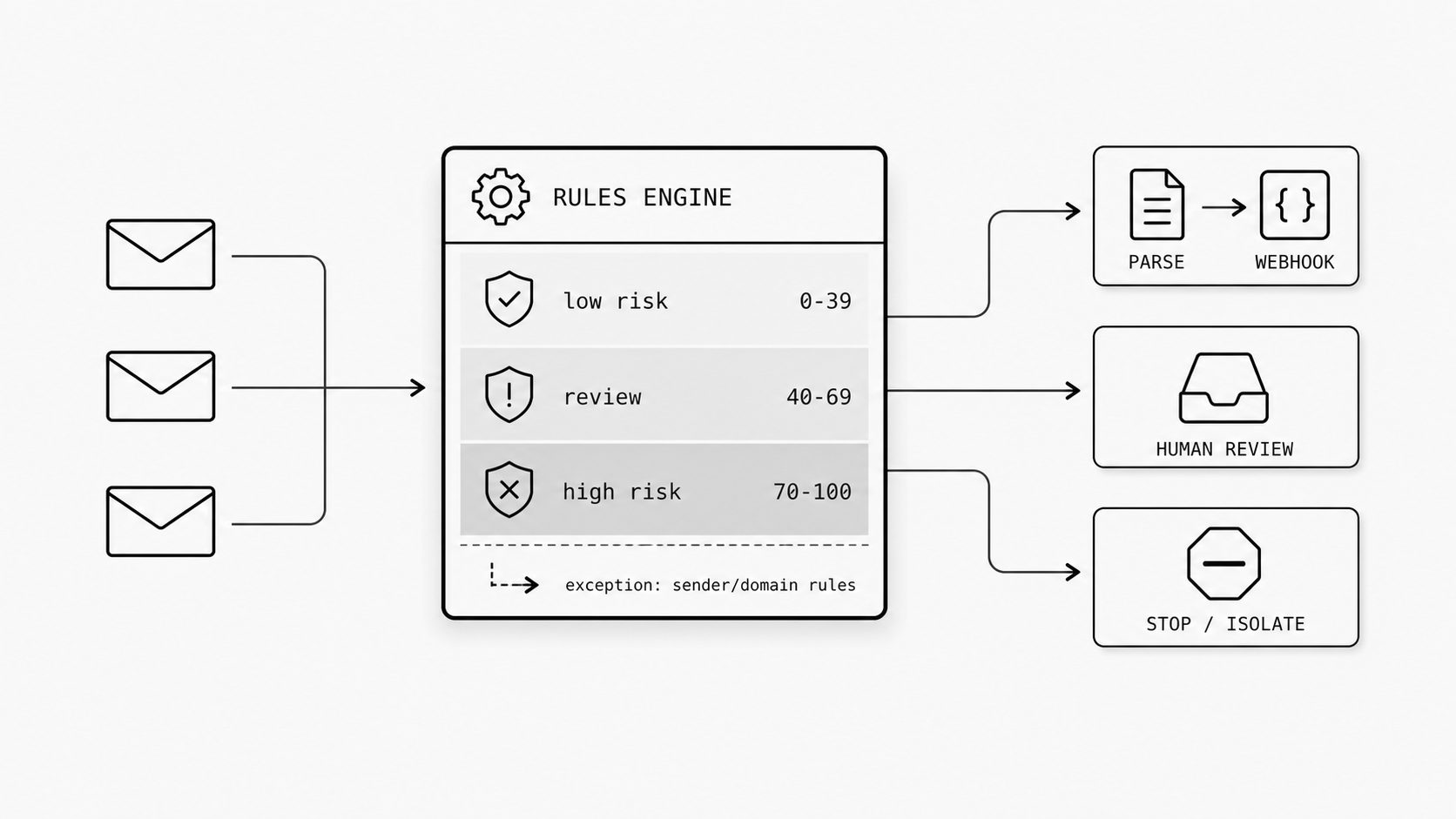
I like to make that middle zone explicit. For example, a team may decide that very low-risk messages can move straight into normal processing, very high-risk messages can be rejected or heavily restricted, and mid-range messages should be routed for human review under conditional email routing rules. The exact numbers matter less than the operating response. The threshold becomes part of workflow design.
You might be wondering: where does this become operational? My answer is simple. It becomes operational when the threshold is connected to routing behavior your team can explain in one sentence. “Scores in this range go here.” “Messages with these traits trigger this branch.” “Messages from this sender domain follow this exception path.” That is when a setting becomes a control surface.
This is also where hosted mailbox spam thresholds and route rules work together. In MailWebhook, hosted mailbox policy owns the spam-score decision: reject above one threshold, quarantine above another, and skip webhook delivery for quarantined events until review or replay. (MailWebhook docs - Hosted mailbox quarantine behavior) Route rules then handle workflow selection on supported message facts such as subject, sender or recipient address, sender domain, headers, attachment MIME, and boolean logic. (MailWebhook docs - Route rules) Together, those controls turn intake policy into repeatable action before questionable mail becomes a ticket, a record update, a fulfillment step, or a noisy alert.
I also think this framing helps security-minded buyers and ops owners speak the same language. Security teams care about reducing exposure. Operations teams care about keeping workflows reliable. A threshold-backed intake policy serves both goals because it gives the organization a shared way to decide what enters automation, what waits, and what never proceeds.
The practical takeaway is this: give the spam score one job. It should trigger a policy decision your operation has already designed.
If I were pressure-testing an intake flow, I would start with three short questions. What score range moves forward automatically? What score range gets stopped immediately? What score range gets routed for inspection and a deliberate follow-up action? Those answers turn mail filtering from a background setting into a visible part of workflow governance.
When teams do this well, they get cleaner inboxes, steadier automation, clearer exception handling, and a system that behaves predictably when confidence is incomplete.
Here is what bad intake does to good automation
I have seen smart teams blame the wrong layer when automation starts to drift. They blame the parser. They blame the model. They blame the workflow engine. In many cases, the real problem starts earlier. Bad intake teaches good automation to make bad moves.
That risk gets bigger as inbound email parsing becomes a normal path into ticketing, CRM updates, routing rules, and downstream actions. If a suspicious message is allowed to behave like trusted input, the system may create records, trigger alerts, or push work to people who assume the intake layer already did its job. NIST SP 800-45 treats quarantine as a standard action after message inspection. In an email automation path, that makes quarantine useful as the pause before low-confidence mail can trigger business work. (NIST SP 800-45 Version 2)
This question crosses security and quality. The design issue is what happens when uncertain mail is allowed to influence systems that assume the intake layer has already made a trust decision.
Once an email crosses the trust boundary, a lot can happen very fast. An email parsing API can convert raw mail into structured data. An email webhook can pass that data into applications. Rules can assign owners, open tickets, update contacts, and start follow-up actions. That speed creates value when the input is dependable.
The same intake-quality principle applies to email attachment webhook handling: files should be controlled before they reshape delivery, storage, or review behavior downstream.
This is why I treat protection of automation quality as an operational design choice. The goal is to prevent uncertain messages from shaping clean systems. A malformed invoice email, a spoofed sender, or a phishing-style message with believable business language can all look close enough to normal that downstream logic reacts before a human ever sees the original context.
Key term: Automation quality protection means keeping uncertain or suspicious messages from creating records, alerts, or workflow actions until the intake layer has enough trust to proceed.
The damage is often quiet at first. You get duplicate records. Wrong tags. Misrouted work. False urgency. Operators lose trust in alerts because too many weak signals reach production flows. Then teams start adding exceptions everywhere, which makes the whole operation harder to govern.
I think this is the key mindset shift: quarantine protects system behavior. It gives the organization a place to pause questionable input before an inbound parse turns into action. That pause helps preserve the quality of your data, the credibility of your automations, and the attention of the people who depend on both.
So what does that look like in practice? I look for one simple rule. If message trust is incomplete, business action should be incomplete too. Suspect messages need a lower-confidence path before they create the same downstream certainty as validated messages. They can be held, inspected, and classified before they are allowed to influence records or trigger operational steps.
The practical value is straightforward. When you protect automation quality at intake, you reduce bad system actions before they become cleanup work. You also create a cleaner signal for the tools and people downstream, which makes your automations easier to trust and easier to improve over time.
If I were reviewing an intake design, I would ask one question first: what can an untrusted message cause in our environment today? The answer usually reveals whether quarantine is being treated as a real control surface or just a storage folder.
That is the standard I would use. The failure mode is quiet: duplicate records, wrong tags, misrouted work, and false urgency slowly teach the business to doubt its own systems. By the time someone asks why the CRM stopped being trustworthy, the intake layer has already been leaking low-confidence decisions for weeks.
What happens after a message gets held?
A quarantine decision starts the design. The harder question is how a valid message gets back into the system safely. Enterprise platforms already treat quarantine as a review step with controlled release, which shows this pattern is operationally familiar. (Google Workspace Admin Help - Manage Quarantined Messages)
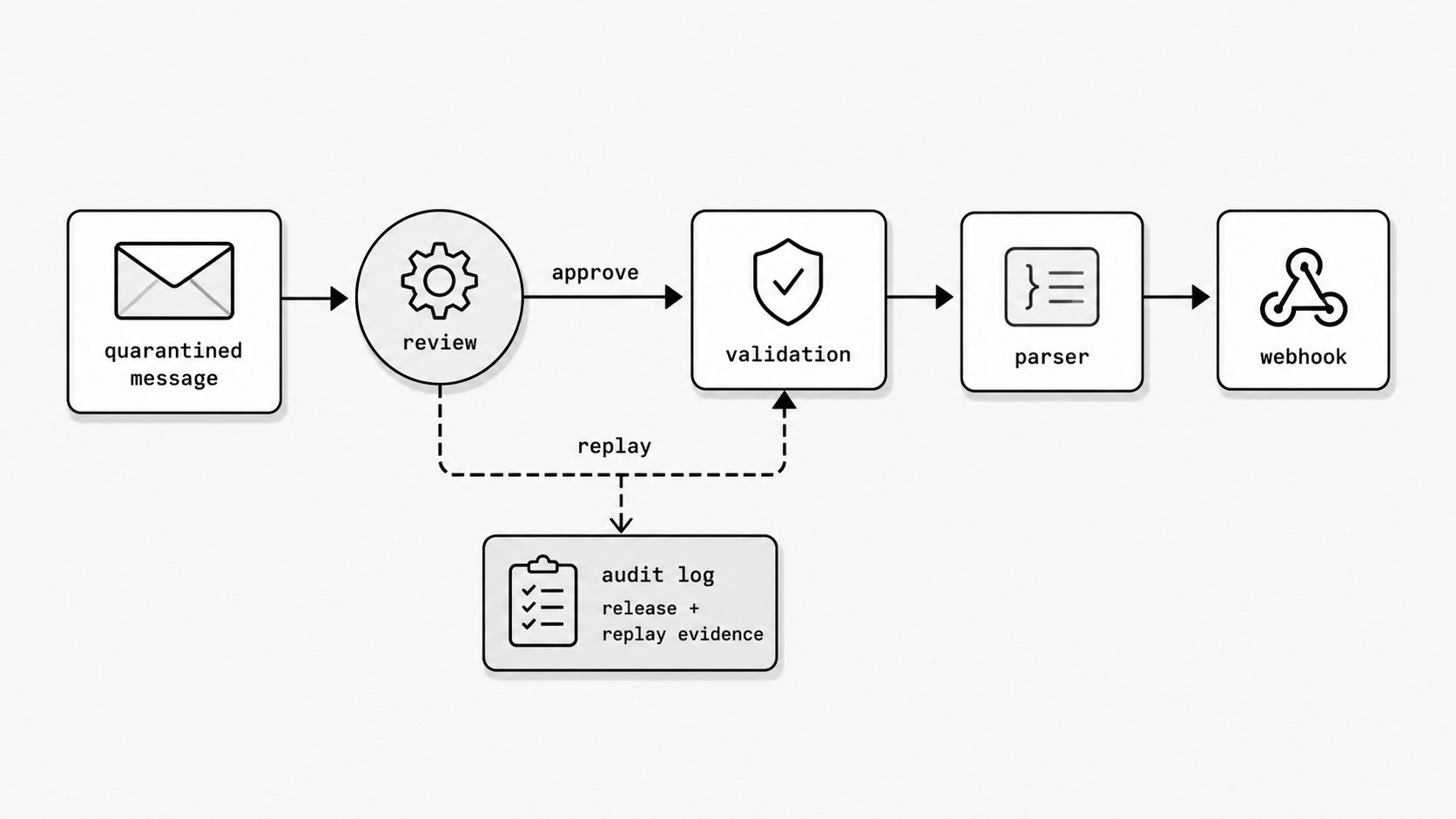
After review, the safest next step is replay with intent. When an operator clears a message, it should re-enter through a defined path and pass the checks your intake flow expects. That matters even more when inbound email is converted into structured events that can create records or trigger downstream actions quickly. A healthy review-and-replay loop lets an operator approve a message through normal controls while preserving verification, traceability, and repeatable handling. (Microsoft Learn - Find and Release Quarantined Messages)
In MailWebhook, replay is an explicit delivery action. The platform queues a new delivery attempt for an existing event, rebuilds the request from the stored message and current route configuration, and keeps retries and replay tied to the same deterministic idempotency key for the same message and route. (MailWebhook docs - Webhook retries and replay)
Key term: Review-and-replay loop means the controlled process for inspecting a held message, approving it when valid, and sending it back through the normal intake path with traceability.
The payoff is controlled message recovery. A good review-and-replay loop preserves operator control while keeping automation trustworthy, so valid mail can move forward through the system’s normal protections. A quick pressure test is to ask who can approve release, what path the approved message takes back into processing, and what evidence is logged after replay.
The core idea is simple: quarantine belongs inside your workflow design as a visible control surface. Teams get a safer place for low-confidence email, clearer threshold-driven routing, better protection for downstream automation, and a practical way to review and intentionally replay valid messages.
That gives quarantine value across data quality, operational noise, and shared security and operations decisions. It gives teams a common mechanism for deciding what should move, what should wait, and what should stop. As automation expands, that kind of intake discipline becomes increasingly important.
The natural next step is event logging. Quarantine review decides what should happen to a held message; durable event logs preserve why that decision happened and what replay did next.
If you want dependable email webhook workflows, start by asking a basic operational question: what happens when message trust is incomplete? The maturity of your answer usually tells you whether quarantine is just storage or a real part of system control.