

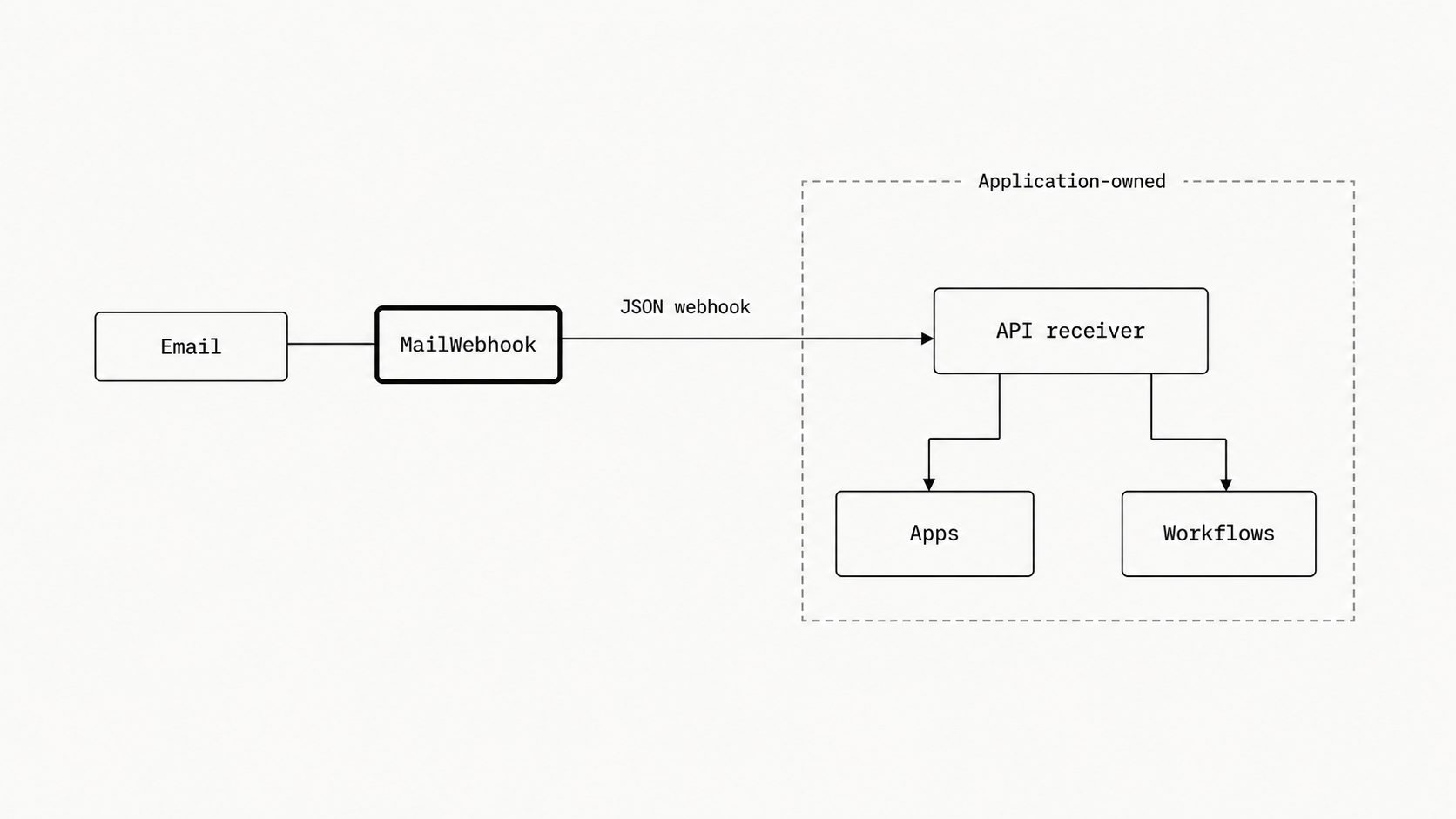
Email integration needs a clear boundary: incoming messages become usable input, while applications retain authority over business changes. I place MailWebhook as a specialized layer at that handoff. The executive decision weighs the value and support commitment of adding a service. This article focuses on the connections: how email reaches an application API, when an optional queue belongs behind the receiver, and which system can publish a confirmed business event.
Inbound-edge integration role: placing MailWebhook at the email boundary
Key term: A webhook sends data about an event to a chosen URL through an HTTP request, allowing the receiving service to respond.
I place MailWebhook at the email boundary, where incoming messages become structured input for internal systems. That position gives the product a clear scope in the integration stack.
MailWebhook reads or receives email through a mailbox, puts message fields into a common format, applies route rules, transforms the data, and sends JSON to a configured HTTP endpoint.
This handoff places inbound email parsing, message shaping, and delivery on the email side. The receiving application keeps authority over business changes.
For an emailed request to update a customer record, assign message preparation to this boundary. Keep the checks on who may request the change and which fields they may edit inside the application that owns the record. This gives sponsorship a defined scope: turning email into usable input while preserving application control over its effects.
Complementarity with downstream systems: keeping APIs, queues, and apps accountable
Key term: An event broker is a service that carries events from the systems that create them to the systems that process them.
MailWebhook fits alongside existing APIs, queues, and apps when each keeps a clear job and a named owner.
Microsoft’s Azure Architecture Center separates event producers, channels, and consumers. It also notes that brokers add operational work that simple request-response flows may not justify.
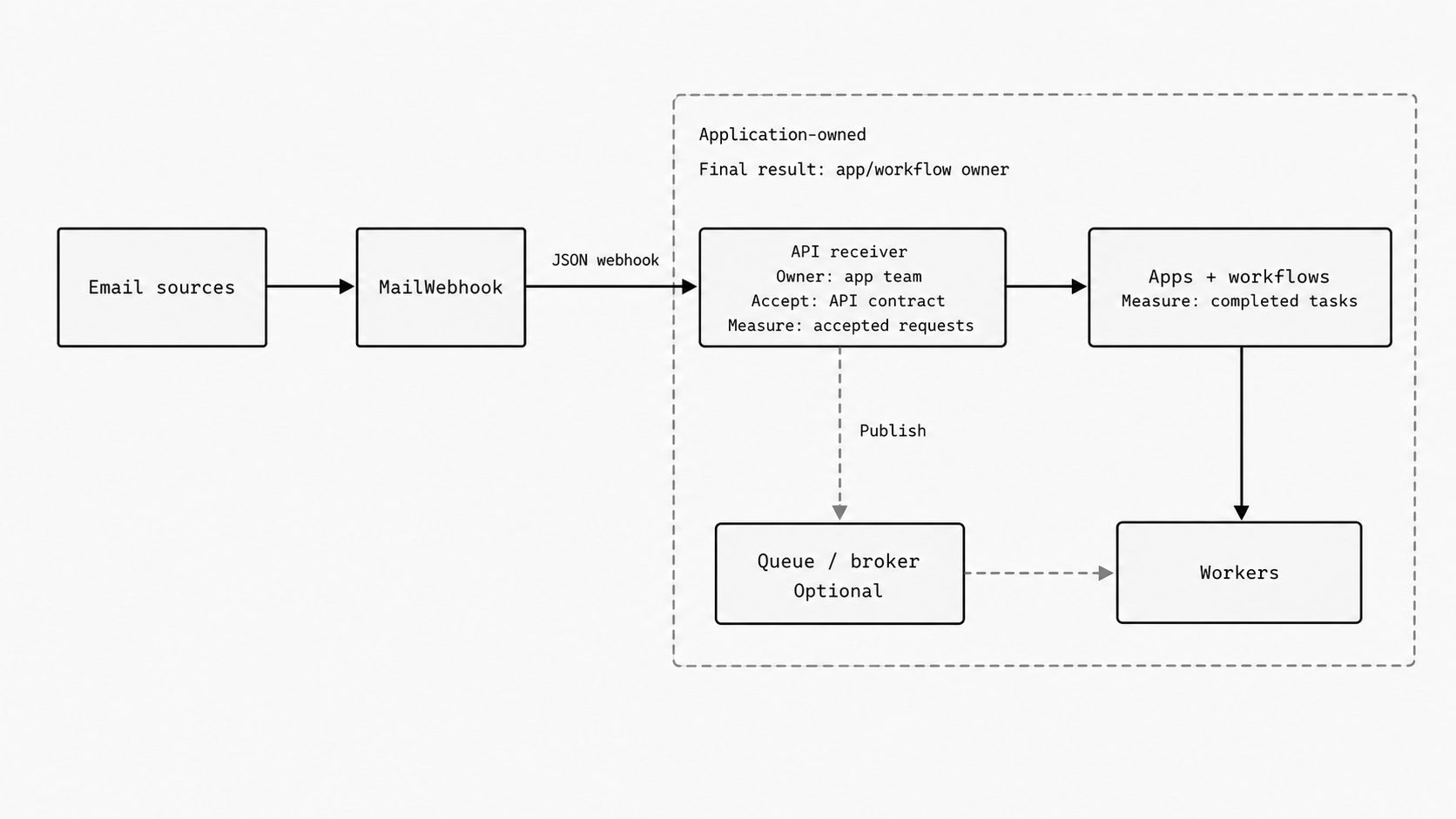
In this design, an API owned by the application team receives the email webhook. Its contract defines which requests count as accepted. Keep business changes behind the app’s existing API, and use automation tools to coordinate approved steps across services. These assignments preserve a clear role for the systems already responsible for business results.
Place a queue behind the receiver when accepted work needs to wait for processing. Define storage, retry, and ordering requirements, then verify them against the chosen service. Keep a direct API path for simple flows that meet timing and volume targets. The choice depends on the workload and the team’s ability to operate it.
I judge accountability by what happens after the receiver accepts work. In this design, the app or workflow owner answers for the final result, with separate measures for accepted requests and completed business tasks.
Translation boundaries: keeping email fields separate from application models
Key term: An anti-corruption layer translates between systems with different data models and meanings so an application can keep its own model.
Define where email fields become application inputs and who maintains that mapping. The application API should express the business operation it accepts.
Microsoft’s guidance for an anti-corruption layer allows an internal component or a separate service and identifies added latency and service-management work as tradeoffs. I use this pattern as an architectural analogy: the mapping should translate email-specific fields into the application’s own model. Assess the mapping and its maintenance needs against the workflow’s requirements.
Reuse common message fields across workflows, while giving each receiving API its own mapping and validation rules. An invoice intake endpoint needs different fields and checks from a shipment-status endpoint. Assign ownership of each mapping and test how changes to email formats affect the receiving contract.
Place email-specific translation in the intake pipeline or a receiver adapter, with authorization and business validation owned by the application. Make missing or invalid fields visible at that boundary so downstream processing has a defined outcome for rejected input.
Modern stack narrative placement: connecting email inputs to business events with clear ownership
Key term: An event contract defines the meaning and required contents of an event so producing and receiving systems can interpret it consistently.
MailWebhook’s place in a modern stack becomes clear when each event states what happened and which system can confirm it.
In this example, your receiver translates the MailWebhook payload into an internal email.received event. The customer application publishes customer.updated after checking authorization and saving the change.
Give those contracts distinct meanings. The receipt event confirms that a message arrived. Its contents remain a request for the application to assess. Reserve the business outcome event for a completed change that the owning application can verify. This makes the event name a clear statement about the evidence behind it.
The architectural goal is one meaning for customer.updated across requests from email, a portal, or another channel. Downstream teams then have a consistent business fact to work with. That gives leaders a useful measure of fit: adding email as an input preserves the agreed meaning of a completed business action.
Review the complete path from email receipt to API acceptance, any queued processing, and the final business event. Name the owner of each handoff and verify its failure behavior. MailWebhook has a clear architectural role when its structured email output fits that path and the application remains accountable for the completed business change.