

Email-triggered workflows are only as useful as the systems that deliver their events downstream. That sounds obvious, but in practice a surprising amount of webhook pain comes from the final step: the sender wraps the payload, leaves the media type ambiguous, invents transport conventions inside the body, or forces every receiver to learn one more special case. For backend engineers and integration owners, that kind of friction adds up fast. The real job of outbound delivery is not to be clever. It is to be exact, legible, and dependable.
I think webhook delivery should be intentionally unremarkable. If the pipeline has already produced the event, the delivery layer should send that body as-is, describe it clearly with standard HTTP semantics, support stable header requirements without turning each destination into a one-off project, and make operational behavior easy to explain. In a moment when webhook fatigue is growing, boring is not a lack of ambition. It is the design standard that lets downstream teams treat email events like trustworthy application inputs instead of ongoing integration archaeology.
This post zooms in on delivery as the fourth stage of the inbound email processing pipeline. For the full model, see Inbound Email Processing Architecture: How to Turn Raw Email Into Trusted Webhook Events.
What MailWebhook sends
For MailWebhook endpoints, these delivery habits are part of the actual HTTP contract. The endpoint docs define the request like this:
POST <endpoint-url>
Content-Type: application/json
User-Agent: mailwebhook/...
X-Idempotency-Key: <sha256(message_id|route_id)>
Idempotency-Key: <same delivery key, when the compatibility header applies>
X-MailWebhook-Signature: t=<unix>, kid=<kid>, v1=<base64(hmac_sha256(t+"."+body, secret))>
<endpoint custom headers>
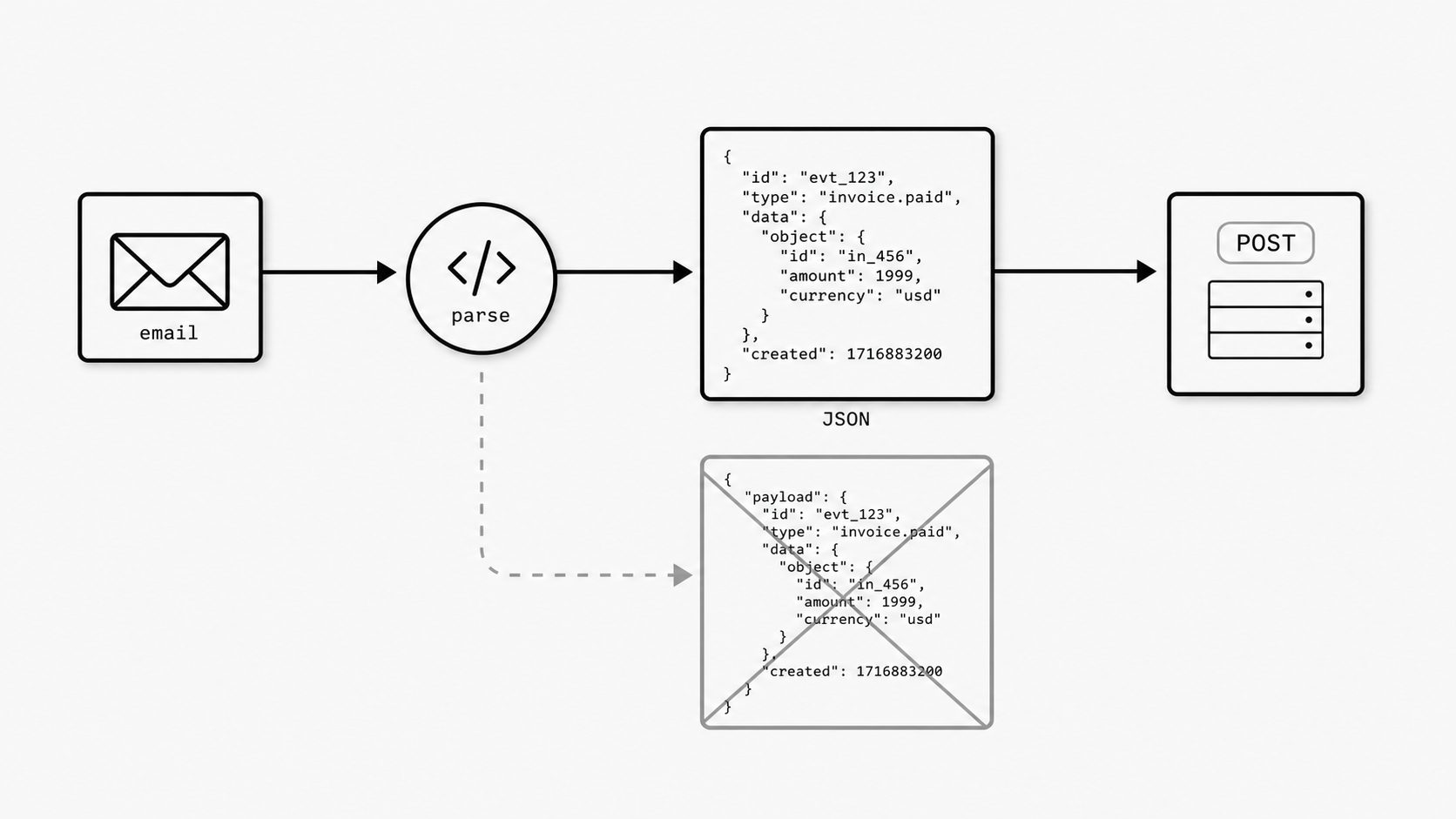
The request body is exactly the route pipeline output bytes. Generic JSON, Slack-simple, and Custom JSON can produce different bodies, and delivery sends that output without adding another wrapper. The primary duplicate-delivery key is X-Idempotency-Key; Idempotency-Key is a compatibility alias when that header is present. Endpoint custom headers are included with the request, so fixed downstream tokens or routing headers stay in the endpoint profile instead of the body.
If the body changes at the last step, trust drops fast
Teams can model an event carefully through the whole pipeline, then lose trust in the final inch when the delivery layer adds a wrapper or reshapes the body before sending it. HTTP already provides headers such as Content-Type to describe the representation, so the body does not need extra delivery metadata mixed into it. When signatures are computed from payload contents, even small body changes matter because verification depends on the exact delivered bytes. (RFC 9110: HTTP Semantics)
This is why an exact-body delivery contract matters: if the pipeline produces the final event payload, that output should become the POST body as-is. The delivery step still handles transport duties like opening the connection, setting headers, retrying, and recording outcomes, but those responsibilities should stay outside the event body. HTTP semantics distinguish representation metadata from the representation itself, which supports keeping transport description in headers rather than mutating the payload. A stable body also helps receivers maintain one parser, more durable fixtures, and clearer debugging boundaries because signature verification and request validation depend on the delivered payload bytes remaining consistent. (GitHub Docs: Validating webhook deliveries)
The practical payoff is speed and trust: when the delivered body is the same body the pipeline produced, receivers can rely on examples, signatures, and parsers with much less hesitation. HTTP already has standard semantics for describing the representation through headers, so the clean rule is to finish the event before delivery starts and then send those exact bytes.
Receivers should know what to parse before they read a single field
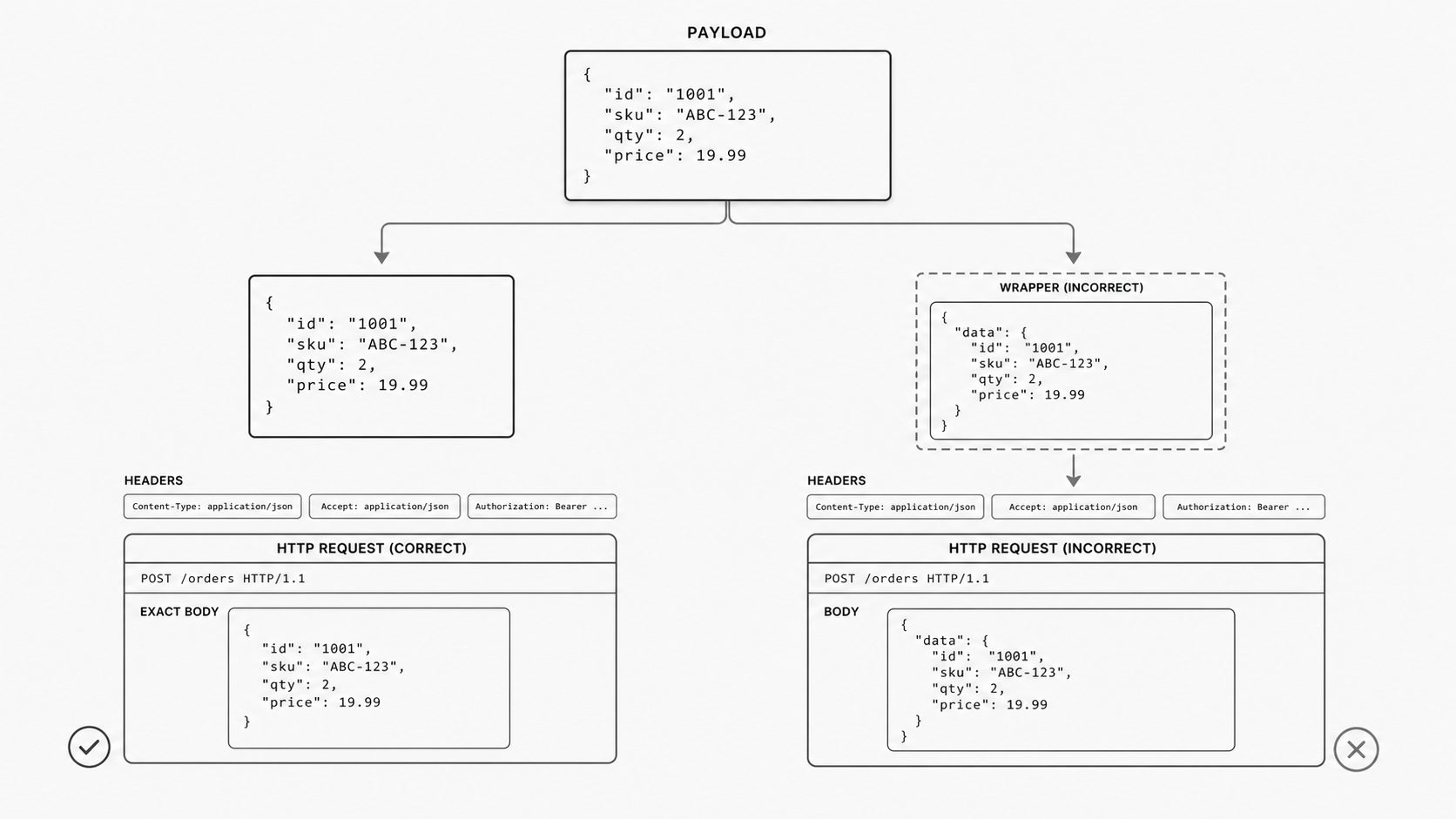
I have seen this mistake more times than most teams expect: the payload is valid JSON, the endpoint is healthy, and the integration still starts with guesswork. The receiver opens the request and has to answer a basic question first: what am I looking at? The HTTP and JSON standards already give us a clean answer here. JSON’s registered media type is application/json, and HTTP uses Content-Type to describe the representation being sent. When that header is missing or vague, recipients may fall back to a generic binary assumption or inspect the body to figure the type out. That is friction before business logic even begins. (RFC 8259: The JavaScript Object Notation (JSON) Data Interchange Format)
This is where disciplined delivery earns its keep. A webhook contract should tell the receiver, in the protocol itself, that the body is JSON. That shapes the first branch in every handler: parse as JSON, validate against the expected schema, then move to business rules. Without a declared media type, teams end up writing defensive code, fallback detection, and extra support notes just to answer a question the sender could have answered up front. Documentation also gets cleaner when the contract says Content-Type: application/json, because examples, helpers, fixtures, and validation rules all align around one explicit representation. Large platforms model this in practice: GitHub’s webhook event examples show POST requests using Content-Type: application/json.
My rule is simple: if you are delivering JSON, declare JSON every time. That reduces receiver-side guesswork, lowers parser complexity, and makes the contract easier to document and maintain. Mature webhook ecosystems already model this behavior clearly. (GitHub Docs: Webhook events and payloads)
Static endpoint headers keep delivery consistent without custom transport logic
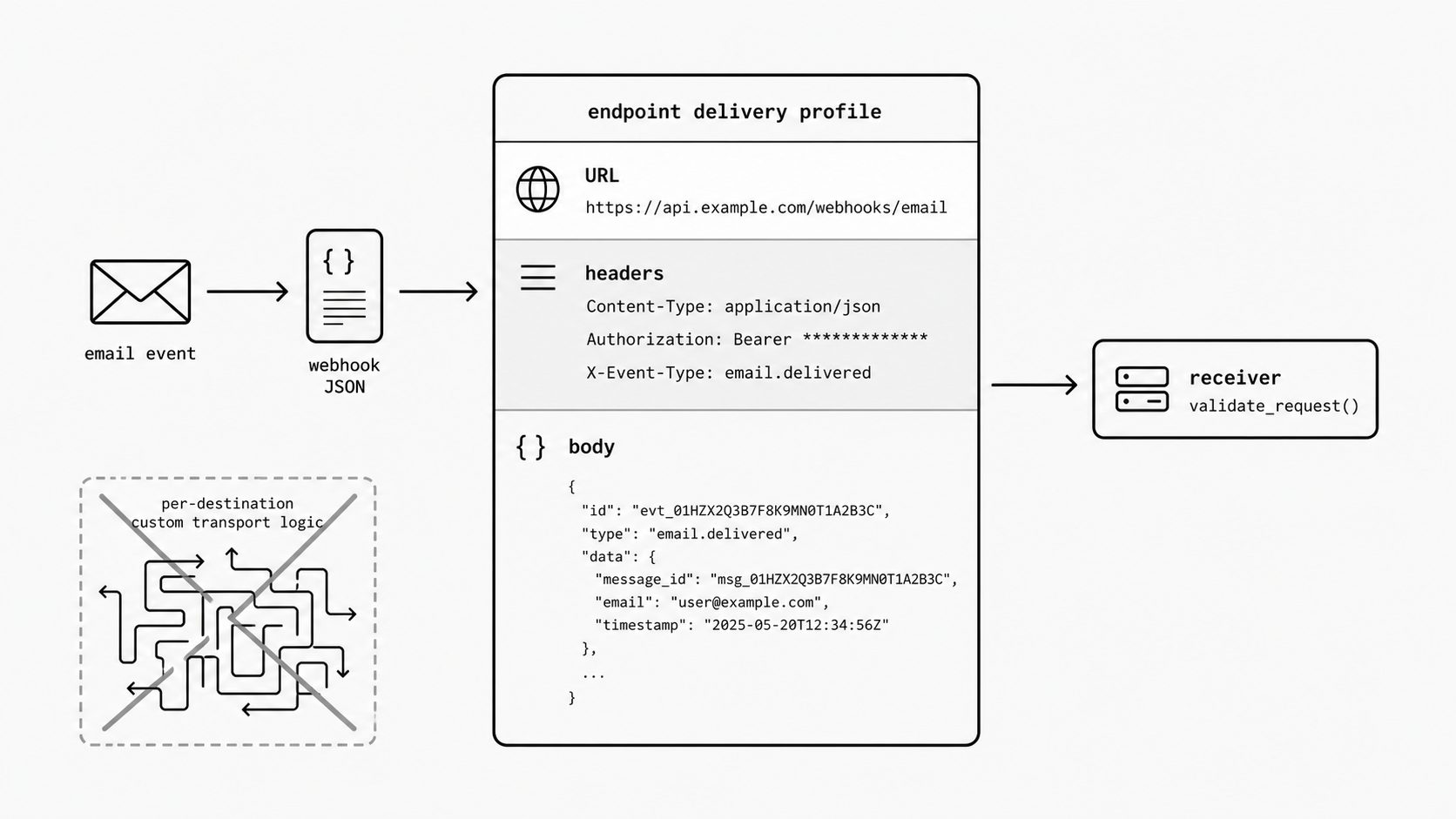
A webhook can start simple and still spiral into custom transport work when each destination asks for its own fixed routing or authentication headers. HTTP already defines header fields as the standard place for request metadata, so declaring stable headers once in the endpoint profile is often cleaner than building per-destination delivery logic.
Many receiving systems rely on headers for practical concerns separate from the event body, such as routing, fixed credentials, or policy checks that happen before the payload is processed. That fits normal HTTP behavior, and it supports a disciplined webhook design when those values are fixed and declared up front. A clear boundary helps prevent endless customization: support a limited set of declared headers, apply them consistently, and keep one delivery model across many destinations. This pattern also aligns with real-world webhook security guidance. GitHub documents validating webhook deliveries using signature information sent in a header, and Stripe documents verification using the request payload, the Stripe-Signature header, and an endpoint secret. Together, those examples show that transport-level trust and request context often belong in headers while the body remains the business event. (Stripe Documentation: Receive Stripe events in your webhook endpoint)
The practical takeaway is to treat fixed downstream header requirements as part of the endpoint definition, not as a reason to create custom delivery code for every integration. That keeps HTTP metadata where HTTP expects it, supports common signature-validation patterns used by platforms like GitHub and Stripe, and gives receivers a steadier contract to operate against.
Boring is what scale feels like when the contract is right
The best webhook systems often earn a strange compliment: nobody talks about them much. That sounds minor until you have lived the opposite. Stripe documents one model: failed webhook deliveries in live mode are retried for up to three days with exponential backoff. GitHub documents another: failed webhook deliveries are not automatically redelivered, so recovery is manual. (Stripe Docs: Configure webhooks; GitHub Docs: Handling failed webhook deliveries)
That is why I call this the boring integration ideal: a webhook design goal where receivers spend very little effort adapting to delivery behavior and can treat transport as predictable plumbing. In practice, boring means the contract keeps the same habits under stress. Operators should know which recovery path applies, where delivery outcomes are recorded, and what action is expected when an endpoint fails. Reliability depends on making the policy explicit enough for teams to design around it.
Use a simple test: if a new integration owner can explain the delivery behavior in a few plain sentences, the system is probably ready to scale. Stripe and GitHub show that webhook platforms can choose different delivery policies while still making those policies explicit enough for operators to plan around them. Aim for a contract that is easy to describe, monitor, and recover from. For the companion receiver-side problem of repeated deliveries changing business outcomes, see Why Retries and Duplicates Break Trust in Email Webhooks.
The common thread in all of this is discipline. A dependable webhook sender does not reshape the body at the last second, does not make receivers guess the content type, does not confuse normal header needs with a blank check for custom transport logic, and does not hide retry behavior behind surprises. None of those choices are flashy, but that is exactly the point.
When email webhook delivery is boring, downstream teams move faster. Parsers stay simple, signatures remain trustworthy, documentation gets clearer, and operations become easier to reason about under failure. That is the standard worth aiming for: a delivery model so steady and explicit that the transport fades into the background and the event itself can do the real work.
For receiver teams, Email Webhook API is the commercial owner for this delivery contract and endpoint setup.