

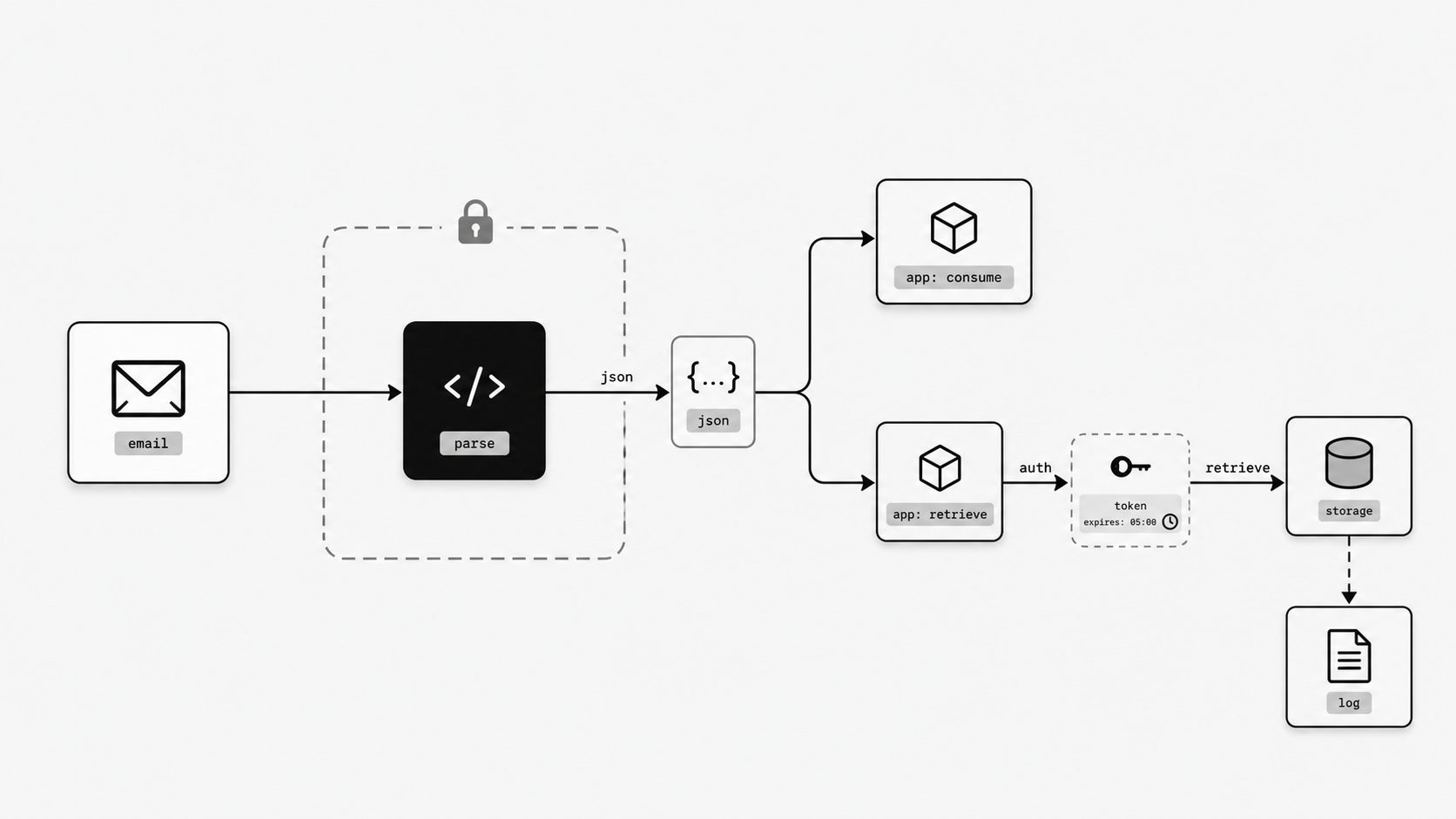
This post follows Email Attachment Webhook Handling: Why Files Should Travel Separately. That post covers why binary data should stay out of the webhook event; this one covers how the retrieval model works in practice. For the broader system frame, Inbound Email Processing Architecture: How to Turn Raw Email Into Trusted Webhook Events explains how attachment handling fits into normalization, routing, transformation, and delivery.
Attachments tend to complicate an otherwise clean inbound email architecture. The moment a webhook carries binary files by default, a simple event stream starts acting like a distribution channel for documents, and that expands the security, storage, and governance burden for every downstream system that receives it. For security-aware technical teams, that is usually the point where the design stops feeling lightweight.
I think pre-signed retrieval changes that conversation in an important way. Instead of forcing attachment delivery into the webhook itself, it lets teams separate message notification from document access. The webhook can say that a file exists. A separate authorized step can decide whether any given service should fetch it. That shift matters because it creates a cleaner control model: trust the event, authorize the file, and keep binary movement tied to actual need.
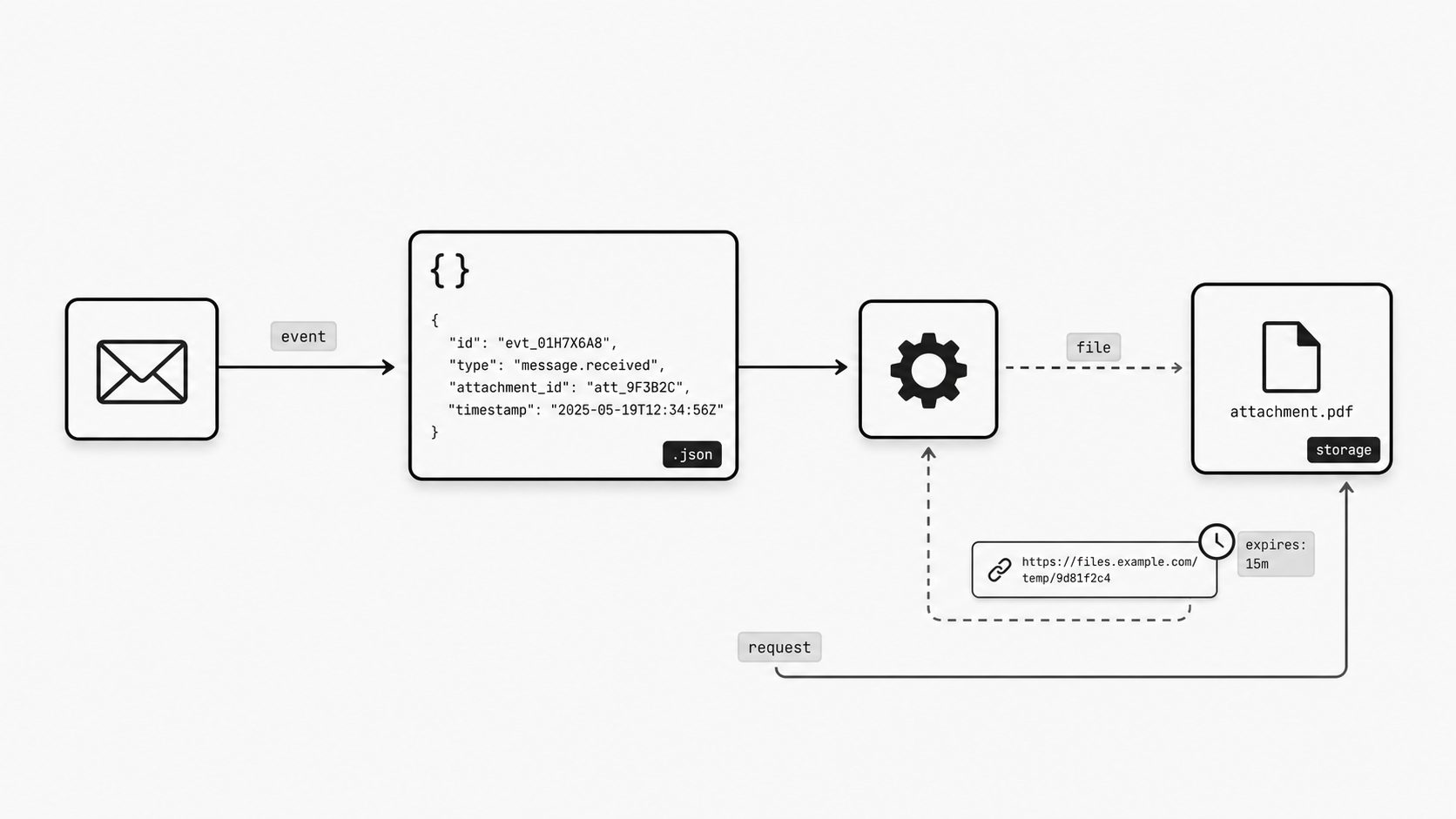
In MailWebhook’s email webhook API, this is the attachment download URL flow: webhook payloads carry attachment descriptors in body.attachments, while file bytes and download URLs stay out of the event. When a backend needs the file, it uses message.message_id and the attachment id to request a short-lived URL with X-API-Key, then fetches the content through that temporary link. The attachment payload docs show the exact descriptor shape and retrieval handoff.
From that base, I focus on how that design improves attachment handling across an email webhook pipeline. I will look at why default attachment delivery creates risk so quickly, why the real control point should live at retrieval time, why not every receiver should become a file custodian, and what changes operationally when file access becomes a governed event with its own lifecycle.
So why does attachment delivery feel risky so fast?
Attachment delivery starts feeling risky the moment a simple event turns into a file distribution path. When every receiver gets the binary by default, teams inherit extra storage, scanning, retention, and access-control obligations that may be unnecessary for the actual workflow. (Download and upload objects with presigned URLs - Amazon S3)
Pre-signed attachment access changes the design by separating event delivery from file retrieval. Instead of sending the document everywhere up front, the receiving system gets the event first and then requests temporary access only if it actually needs the file. Major cloud platforms support expiring object-access mechanisms, which shows that short-lived retrieval is an established control pattern rather than an improvised workaround. (Signed URLs - Google Cloud Storage)
This separation improves governance because access can be bounded by time, and in AWS the usable lifetime of a presigned URL can also be limited by the lifetime of the credentials used to create it. Azure also supports policy controls that limit the expiration interval for shared access signatures, reinforcing that lifecycle constraints can be enforced at the platform level. In practice, that makes attachment access easier to reason about as a deliberate, governed retrieval event instead of an uncontrolled copy spreading across systems. (Configure an expiration policy for shared access signatures - Microsoft Learn)
The actionable takeaway is to deliver the message first and make the attachment a separate, short-lived retrieval step. That approach reduces unnecessary file duplication, keeps document access closer to actual intent, and gives security teams a clearer control story based on expiring links supported by major cloud platforms.
Here is where I want the control point to live
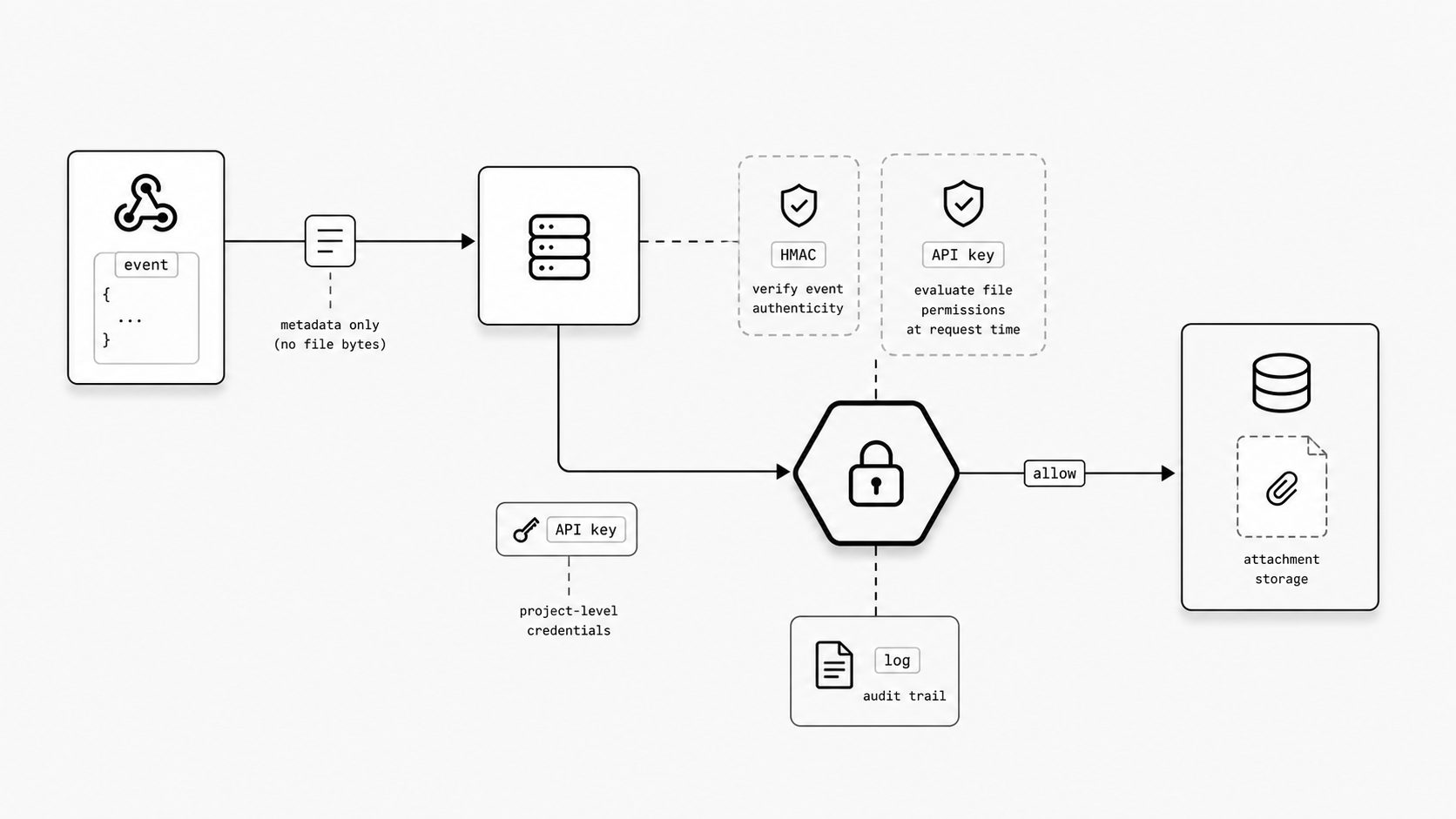
I want the control point to live at the moment a system asks for the file, not at the moment an event is delivered. That distinction matters. An inbound parse webhook or email parsing API event can prove that a message arrived and that the payload is authentic, especially when teams validate an HMAC webhook signature. Still, event authenticity answers a different question than file permission. OWASP treats access control as a core security function and stresses that applications need to enforce permissions deliberately. For me, that is the real design shift: the webhook can announce that a document exists, while a separate API call using project-level credentials decides who gets to retrieve it. (Access Control - OWASP)
You might be wondering: why add another step? Because this step creates a clean authorization boundary. When the receiving app has to present an API key before it can request attachment access, the platform gets a chance to evaluate that request as its own security event. That is much easier to govern than treating attachment delivery as an automatic side effect of message processing. (Least Privilege Principle - OWASP)
I have found that security-aware teams usually want three things from document workflows: a clear permission check, a clear audit trail, and a clear way to limit exposure when a downstream system should see metadata but does not need the binary itself. OWASP’s least privilege guidance supports exactly that mindset by emphasizing that systems should operate with only the permissions required for the task. In practical terms, a service that can read message fields from an email to JSON API does not automatically need standing access to every attachment referenced by that event. Separating those rights keeps the control model tighter and easier to explain to security reviewers.
This is also where file handling discipline improves. OWASP’s File Upload guidance calls for access control and careful handling around uploaded content, including the storage and serving path. If attachment retrieval sits behind an authenticated request, teams can apply policy checks before releasing the file, log which client asked for it, and keep the retrieval path aligned with the same project boundary used elsewhere in the platform. That gives platform teams a cleaner story during design reviews because the webhook channel carries the event, while the retrieval API carries the permission decision. (File Upload Cheat Sheet - OWASP)
The payoff is simple: I get a control model that is easier to defend. Webhook signature validation helps me trust the event source, and API-key-mediated retrieval helps me govern file access at the exact moment access is requested. That separation supports least privilege, reduces accidental overexposure, and creates a reviewable boundary around attachment release that fits how security teams already think about permissions and sensitive content handling. If I am designing a modern parse incoming email API workflow, this is the architecture choice I want readers to notice: trust the event, then authorize the file.
Why I do not want every receiver to carry every file
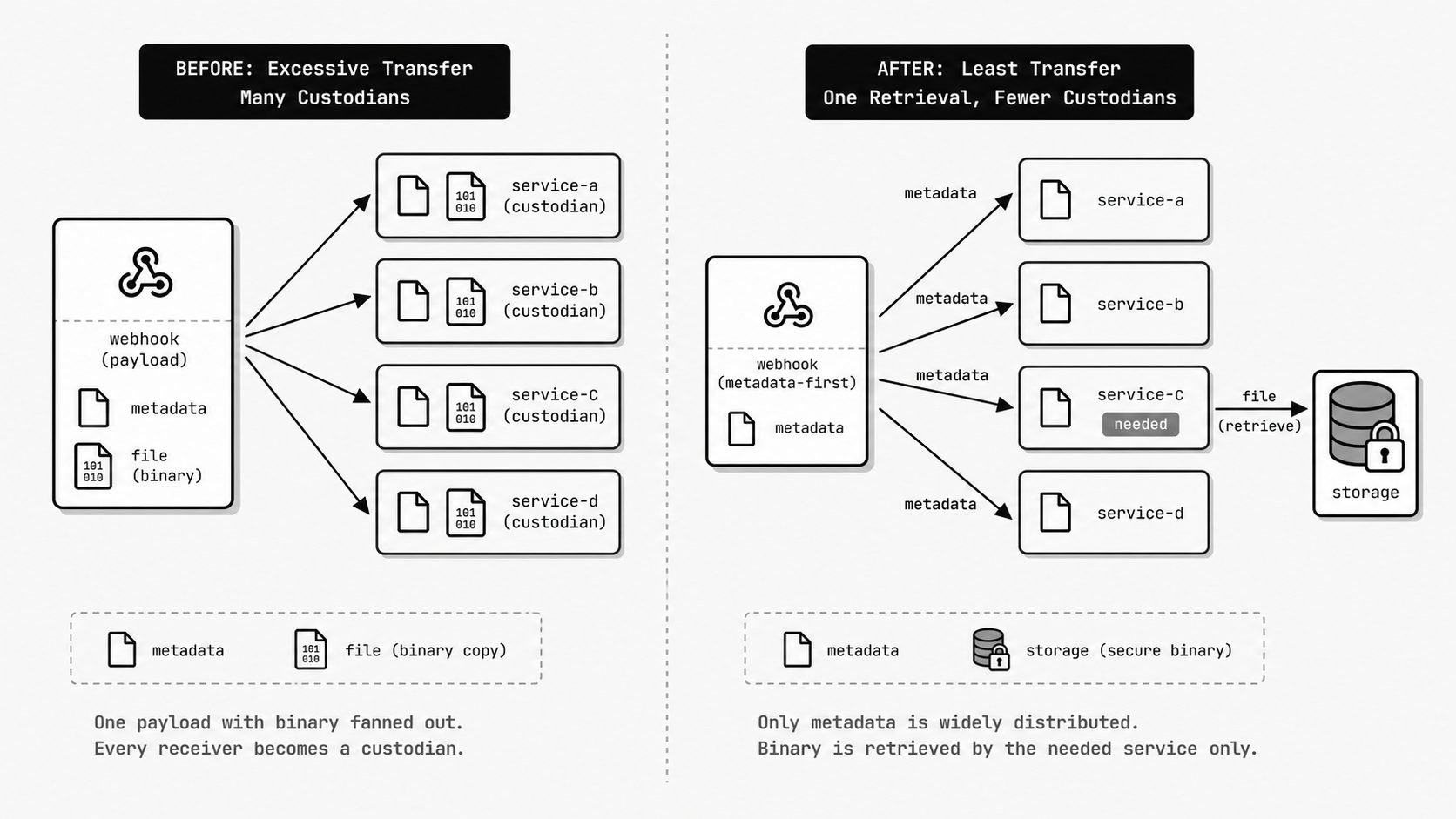
I get nervous when an email webhook quietly turns every downstream system into a file warehouse. The moment binaries ride along by default, each receiver can become a new place where sensitive content is stored, governed, reviewed, and protected. That is a bigger architectural decision than it looks like in the diagram. It changes who holds data, who needs read access, and who now sits inside the audit story for documents that may never have been needed in the first place.
This is why I keep coming back to a metadata-first design. I want the event to tell downstream systems that a file exists, what it is, and why it may matter. Then I want each consumer to make an explicit choice about retrieval. That approach fits OWASP access control guidance because exposure should be limited to the users and systems that actually require the resource.
In practice, this changes the conversation from delivery convenience to custody discipline. If five services receive the same payload and only one service truly needs the PDF, I do not want the other four to inherit a copy by default. Even when those extra copies sit in internal systems, they still widen the surface area for retention decisions, access reviews, and downstream handling controls. You might be wondering: is that really a meaningful difference if all the systems are inside the same stack? I think it is. Least privilege is not only about human users. It also applies to services and components, which should operate with only the access required for their role.
Key term: Least-transfer principle means limiting which systems receive file content to only those that have a genuine business reason to fetch it, rather than distributing copies by default.
That is where the least-transfer principle becomes useful language for security-aware technical teams. I am not only trying to reduce network movement. I am trying to reduce unnecessary possession. A service that reads sender metadata, classifies a request, or updates a ticket may need the email JSON schema and message attributes, while another service may be the only one that needs the actual document bytes. When I separate those cases, contracts often get simpler because more receivers can stay in the world of structured events instead of binary handling. As an architectural inference from OWASP’s least privilege guidance, fewer unnecessary copies usually mean fewer places that need durable read access and fewer places that need attachment-specific review.
I have found that this also makes conversations with platform and security teams clearer. Instead of debating whether every subscriber should be trusted with every attachment, we can ask a narrower question: which system has a real business reason to fetch this file now? That is a much better design question because it ties file movement to intent.
The payoff is a cleaner control model and a cleaner operating model. When receivers get metadata first and binaries only by choice, fewer systems become attachment custodians, fewer flows need document-specific handling, and the path from business need to file access becomes easier to explain in review. For me, that is the real value of the least-transfer principle: it keeps the webhook channel lean, keeps the document contract tighter, and helps teams treat file possession as something earned by need rather than granted by default.
File access lifecycle control: making retrieval observable and time-bound
The big shift happens when I stop treating attachment access like a hidden part of delivery and start treating it like a real event in its own right. A storage platform like Google Cloud describes signed URLs as a way to grant time-limited access to a specific resource, which reinforces the idea that retrieval can be bounded and intentional rather than automatic. AWS sharpens that control model by noting that a presigned URL stays valid only for its configured period and can become unusable sooner if the credentials behind it expire first. (Signed URLs - Google Cloud Storage)
What improves when I make that mental shift? First, expiry handling gets easier to explain. If retrieval is its own event, I can define when access starts, what condition ends it, and why a stale link should fail later. That matches how major cloud platforms document temporary URL access: it is deliberately limited in scope and duration, and in AWS the usable window can also be shortened by credential lifetime. (Download and upload objects with presigned URLs - Amazon S3)
Second, incident review gets cleaner. A delivery event can show that a document exists, but a governed retrieval event gives a distinct place to reason about when access was exercised. Treating retrieval separately is consistent with the bounded-access model described for signed and presigned URLs.
Third, the operating model becomes easier for security reviewers to follow. When the inbound event stays focused on metadata and the document fetch follows its own lifecycle with its own expiration behavior, governance conversations become more precise. That separation is an architectural inference from how cloud providers define temporary URL access, but it is a useful one because access has a clear start condition and end condition.
The practical takeaway is simple: design retrieval so it leaves a clean operational footprint. If a document is fetched through a separate governed step, I gain a better answer for expiration, a better record for review, and a better explanation for auditors and platform teams who need to understand how access works. That is why file access lifecycle control is more than a storage detail. It turns attachment retrieval into something observable and manageable.
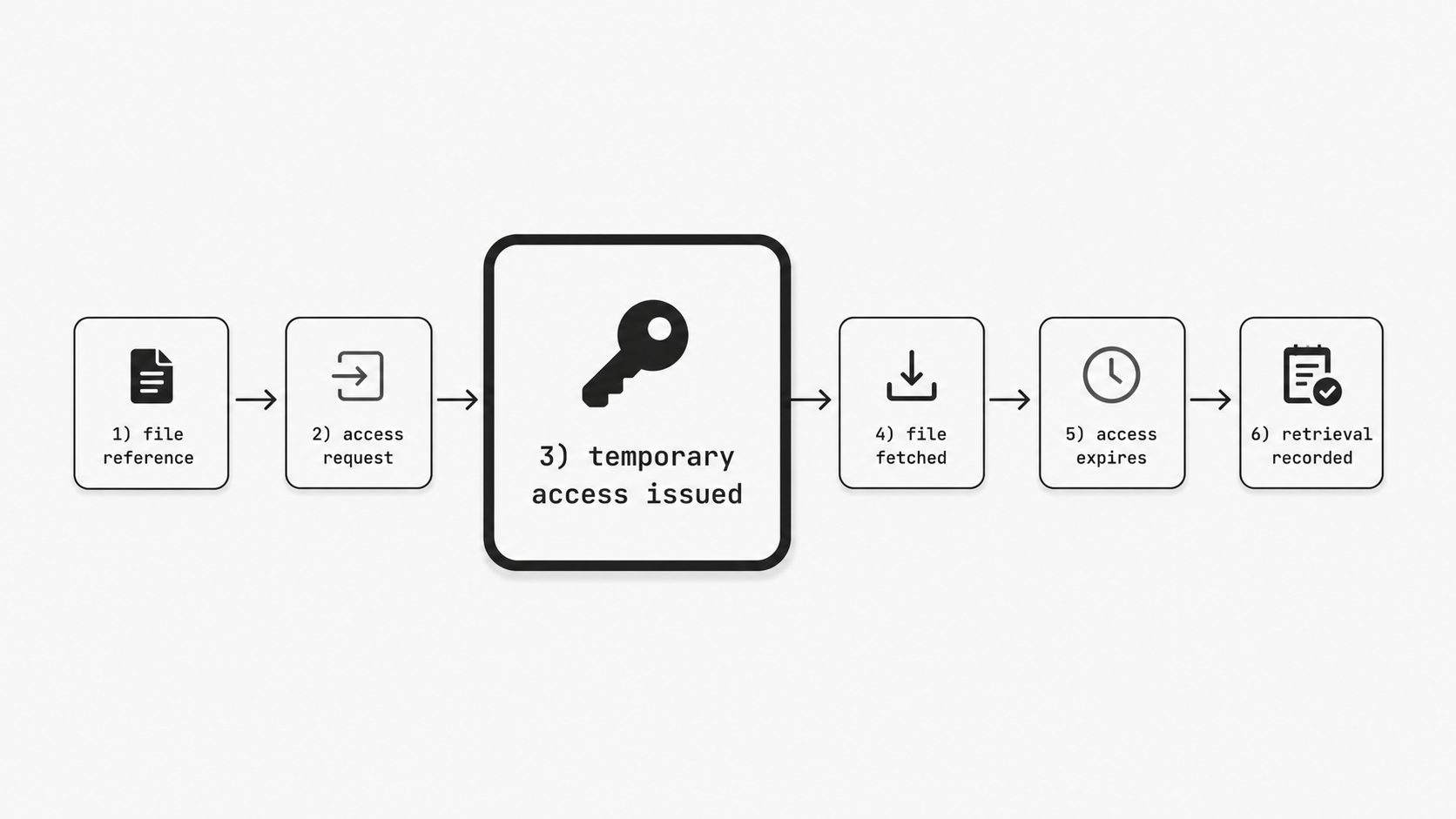
What I like about this model is that it resolves a tension that often shows up in document workflows. Security teams want a defensible explanation for who can access files and when. Platform teams want webhook payloads that stay focused on events instead of becoming bloated containers for binary data. Pre-signed retrieval gives both groups a better answer because it separates delivery from access without breaking the workflow.
That separation leads to a more disciplined attachment model. The inbound event stays lightweight. Authorization happens when a service actually asks for the file. Fewer systems inherit copies they do not need. And retrieval can be governed with expiration, logging, and project-level controls that are easier to review and reason about.
If I were designing an inbound email processing pipeline for a security-aware team, this is the pattern I would want to standardize: announce the document through the webhook, then make access a deliberate, temporary, and authorized step. That is how pre-signed URLs change the attachment conversation from passive distribution to controlled retrieval.