

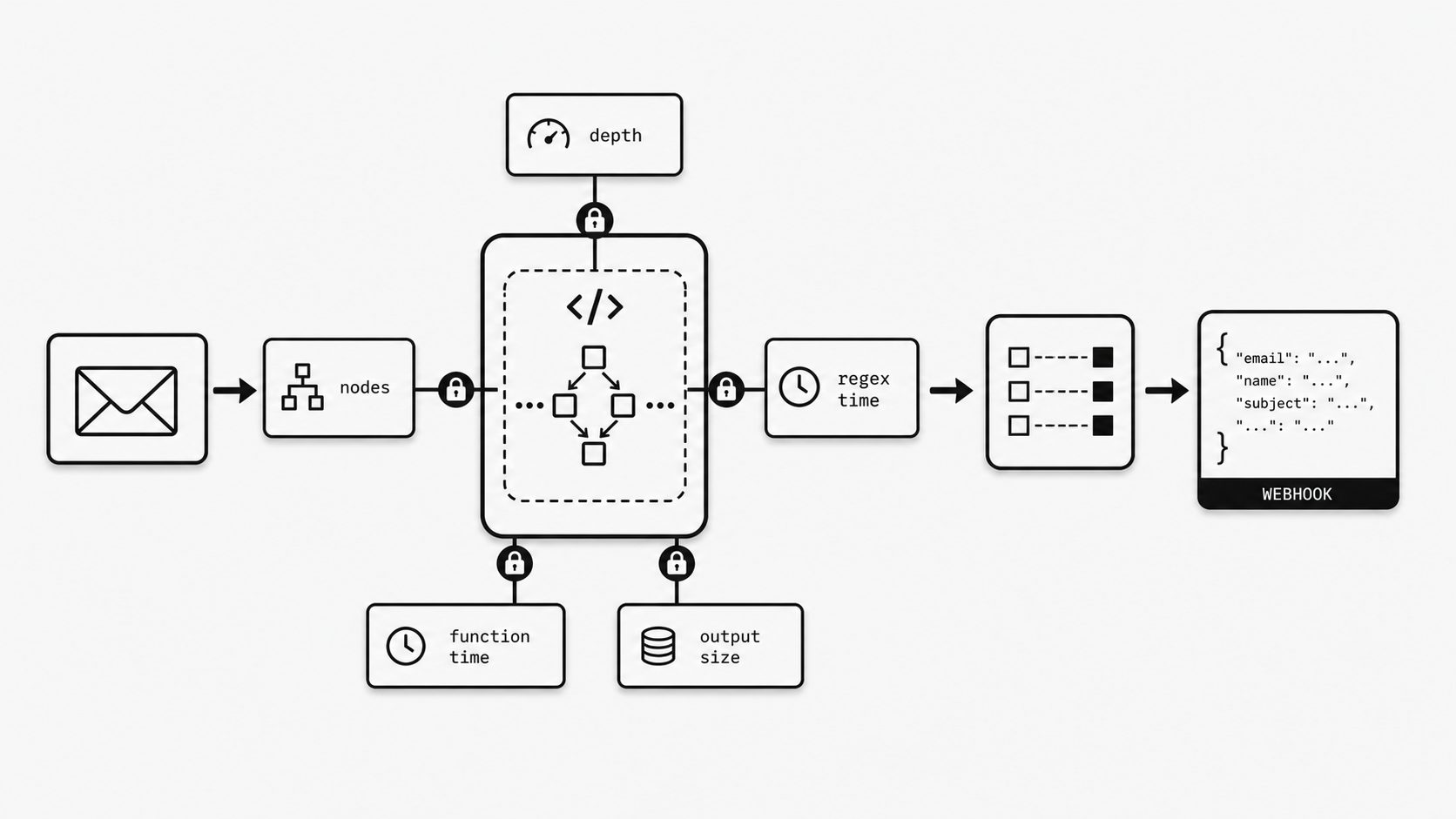
Webhook transformation safety limits define which mapping operations can run, how much expression evaluation is allowed, and what happens when a transform fails. Security approvers and platform leads need to understand how each limit is enforced, especially when input is malformed, helper operations are expensive, or traffic increases.
Transformation guardrails are one part of the broader review of webhook security for email automation. This post examines the Custom JSON mapper used with MailWebhook’s Email Webhook API, focusing on expression budgets, timeout behavior, and failure handling. It separates implemented controls from evaluation questions about output size and resource isolation, then shows how those boundaries support approval and later mapping changes.
Expression limits and execution budgets
Key term: Bounded expression surface means a defined set of mapping operations with explicit evaluation limits. Each limit needs a clear enforcement point; expression limits alone do not guarantee a CPU or memory ceiling.
When I hear a vendor say their platform is flexible, I ask a simple follow-up: what stops one bad message from eating the whole system? For a configurable mapper, the answer depends on the cost of its operations and the checks around them. A clever mapping rule can look harmless in a test payload and still become expensive when a malformed attachment, deeply nested structure, or regex-heavy field shows up at scale. OWASP warns that poorly designed regular expressions can drive extreme CPU consumption through catastrophic backtracking, so reviewers need evidence of how expensive regex operations are handled. (OWASP Regular expression Denial of Service - ReDoS)
I evaluate guardrails by asking separate questions: how much expression depth is allowed, how many evaluation nodes can run, how are regex and helper time limits handled, and is there a per-payload output-size limit? For each control, I want to know where the check runs, what it measures, and what happens when the limit is crossed. Input validation is one part of that review. (OWASP Input Validation Cheat Sheet)
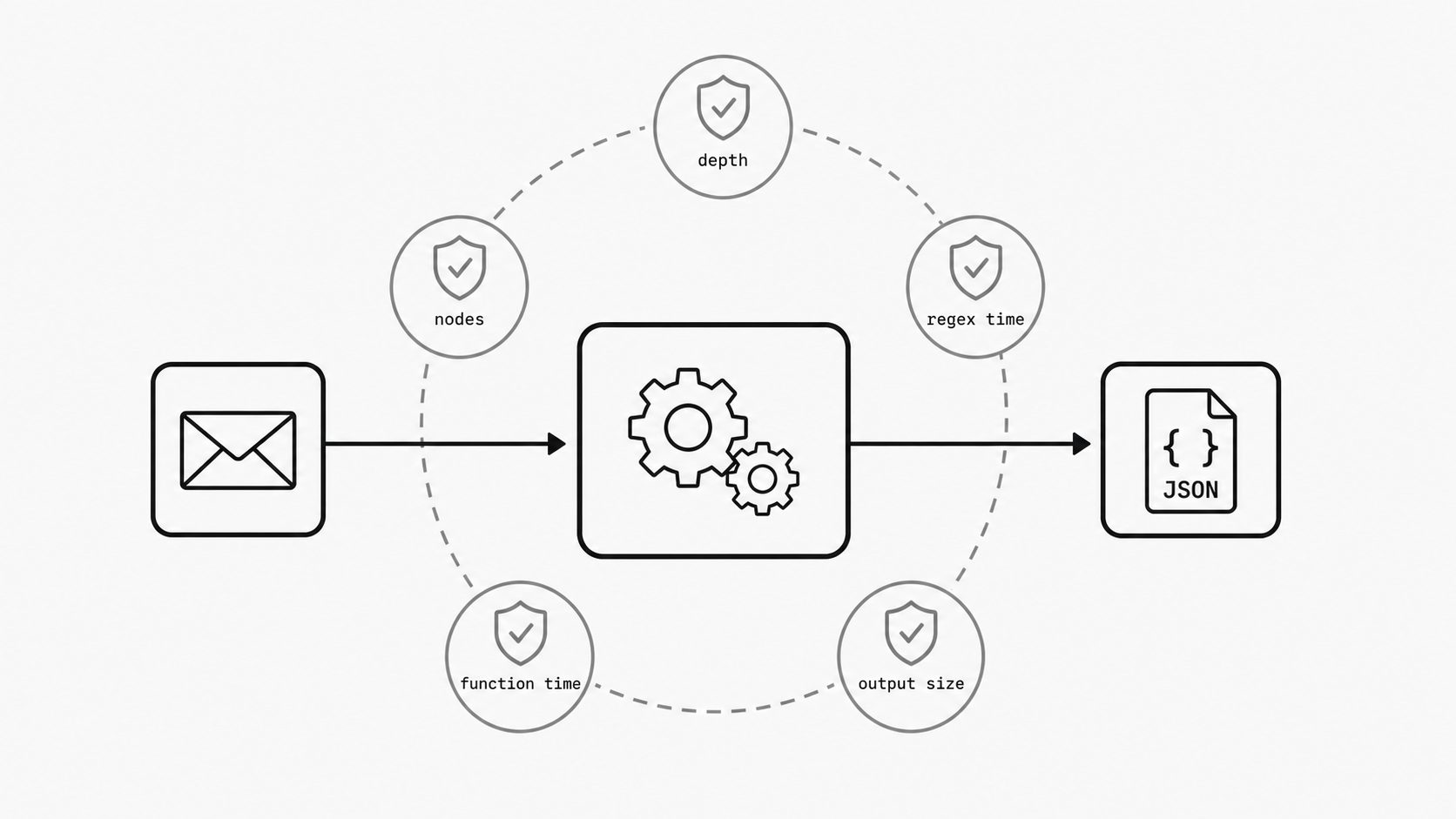
The Custom JSON validation and limits documentation provides the reference for expression limits and helper time checks. MailWebhook’s Custom JSON evaluator checks expression depth and the count of evaluated nodes as evaluation proceeds. In the reviewed implementation, it raises a transformation error when depth exceeds 50 or the evaluated-node count exceeds 10,000. These checks constrain expression evaluation. They do not establish a maximum amount of CPU time or memory for a message, because individual operations can have different costs.
Timing checks need their own review. Custom JSON passes a 50 ms timeout setting to its safe-regex helpers and uses a 200 ms threshold for selected helper calls. Some helper checks measure elapsed time after the operation returns. For example, HTML-to-text conversion completes before its wrapper checks elapsed time and raises a timeout error if the threshold was exceeded. That check reports an overrun; it does not interrupt conversion at 200 ms or prevent the resources already consumed.
Output size is a separate evaluation question. The reviewed Custom JSON path has no general per-payload output-byte ceiling. A monthly outbound-byte quota controls aggregate usage over a billing period and does not cap one transformation’s output or intermediate allocations. Reviewers should ask for distinct evidence of any claimed per-message size or memory limit.
These distinctions matter for webhook transformations because message bodies, attachments, headers, and encodings vary widely. A review should record each implemented limit, its enforcement point, and its failure behavior. Useful questions include whether a timeout interrupts work or detects an overrun afterward, and whether a size check happens before or after output is allocated. A reported timeout or a rejected result alone is insufficient evidence of a guaranteed CPU or memory ceiling.
What happens when a transform fails
Key term: Output schema constraints define the fields, types, and values a receiver accepts. The receiver must validate that business contract separately from the mapper’s configuration rules.
After I understand the guardrails, I ask what happens when the system still hits one. That is where trust is won or lost. Transformation failure behavior is part of the output contract. Real traffic is messy, and secure-by-design guidance says providers should reduce customer security burden through safer product behavior. (Shifting the Balance of Cybersecurity Risk: Principles and Approaches for Security-by-Design and -Default)
MailWebhook’s Custom JSON mapper distinguishes missing data from a hard transformation error. For example, an output template of {"customer_id": {"var": "vars.customer_id"}} can produce {"customer_id": null} when that variable is absent. A missing lookup alone does not raise a mapper error, so the resulting payload can continue toward delivery.
A hard mapper error, such as exceeding the expression depth or evaluated-node limit, takes a different path. The worker catches the transformation exception, records route_transform_failed with the error text in route failure notification state, and re-raises the exception. That execution stops before output serialization and before the HTTP delivery request. For steps to inspect the failure and understand why no webhook request reaches the endpoint for that attempt, see how to troubleshoot Custom JSON mapper errors. Retry scheduling requires a separate review of the worker’s retry policy.
Mapper configuration validation checks the supported configuration structure and expression rules. It does not guarantee that the generated payload satisfies the receiver’s business schema. In the example above, a valid mapping can still produce a null customer_id that the receiver requires to be a nonempty string. The receiving application needs its own payload validation before business logic runs.
For review evidence, include both cases: an absent variable that becomes null, and a hard mapper error that prevents the delivery request. Check the generated payload for the first case and the recorded failure code and error text for the second. Clear failure records support the visibility expected in security reviews. (NSA and CISA Red and Blue Teams Share Top Ten Cybersecurity Misconfigurations)
Allowed functions and configuration boundaries
Key term: Unconstrained expression risks are the resource costs, data access, and side effects that configurable logic can introduce when its capabilities and limits are unclear or unenforced.
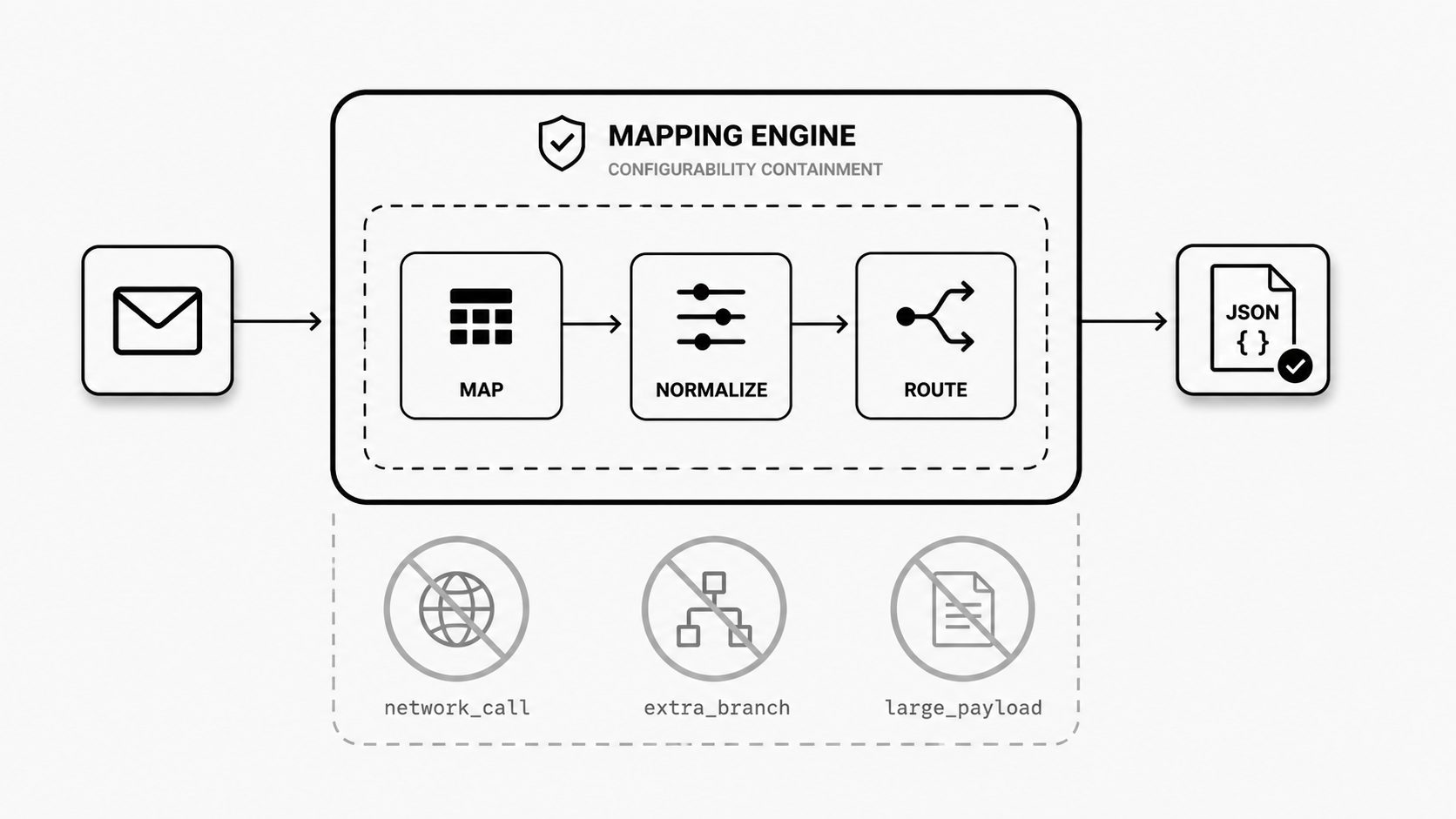
I read the function catalog alongside the runtime limits. For every operation, I want to know what data it can read, what work it can trigger, and how it fails. That is how I apply least privilege to a mapping layer: each capability should have a clear purpose in the transformation. (CISA - Enhanced Visibility and Hardening Guidance for Communications Infrastructure)
My questions are practical. Can this function make a network call? Can it reach beyond the message? Could a short expression build a large value in memory? I look for answers in the implementation before treating a restriction as protection. Secure-by-default guidance gives me a useful standard for that review. (NSA and CISA Red and Blue Teams Share Top Ten Cybersecurity Misconfigurations)
Here is how I translate the Custom JSON and delivery-worker code into decisions I would make for an integration. These findings come from source inspection. I would still need separate evidence for resource isolation and capacity under load.
| What I check | What the code does | What it means for my integration |
|---|---|---|
| Expression depth above 50 or evaluated-node count above 10,000 | Raises a hard transformation error. | I can rely on an evaluation boundary; CPU and memory costs still vary by operation. |
| HTML-to-text helper’s 200 ms elapsed-time check | Raises a timeout error after conversion returns if the threshold was exceeded. | I treat this as overrun detection. The conversion has already consumed resources. |
| Missing variable lookup in an output field | Can emit null and continue toward delivery. |
I validate required business fields in the receiver. |
| Mapper configuration validation | Invalid configuration raises a transformation error. | I check the generated payload against the receiver’s business schema too. |
| Hard transformation exception in the worker | Records route_transform_failed and stops the attempt before HTTP delivery. |
I inspect the recorded error and check retry scheduling separately. |
| Monthly outbound-byte quota, when configured | Can block delivery after the outgoing body has been produced. | I treat this as an aggregate usage control. Custom JSON has no general per-payload output-byte ceiling. |
Governance-compatible flexibility: making mappings easier to approve and maintain
Key term: Governance-compatible flexibility means configurable behavior with clear capabilities, limits, and failure outcomes that teams can assess during approval and revisit when a mapping changes.
The table above is what I want to bring into a security review. It lets me explain what a mapping can do, which checks apply, and where the receiving application still has work to do. I can point to the depth and node limits, show how a hard error stops a delivery attempt, and make the remaining questions about resource use explicit. That gives an approver specific behavior to assess.
I find that same clarity useful when a mapping changes. If a team adds a field or swaps a helper, I want to see how the change affects its inputs, possible null values, operation costs, and failure handling. The existing control inventory gives us a starting point for that discussion. We can identify which assumptions still hold and which need new evidence.
For example, if I add customer_id to a mapping, I would check a message where the value is missing and agree with the receiving team on how to handle the resulting null. Before relying on an HTML-to-text helper, I would account for its after-the-fact timeout check. Those are concrete maintenance decisions that a configuration schema alone cannot settle.
That is the flexibility I want from a transformation layer: room to adapt the mapping, with enough clarity to explain each change and assign the remaining responsibilities. Guardrails support governance when the team can carry those explanations from the first approval into later maintenance.
For me, useful flexibility starts with knowing what I can rely on. MailWebhook’s expression limits and hard-error path give me concrete behavior to build around; receiver validation and resource questions still need their own decisions, and overall capacity needs runtime testing. A guardrail earns trust when I can explain what it stops, what remains, and what a mapping change asks us to review again.