

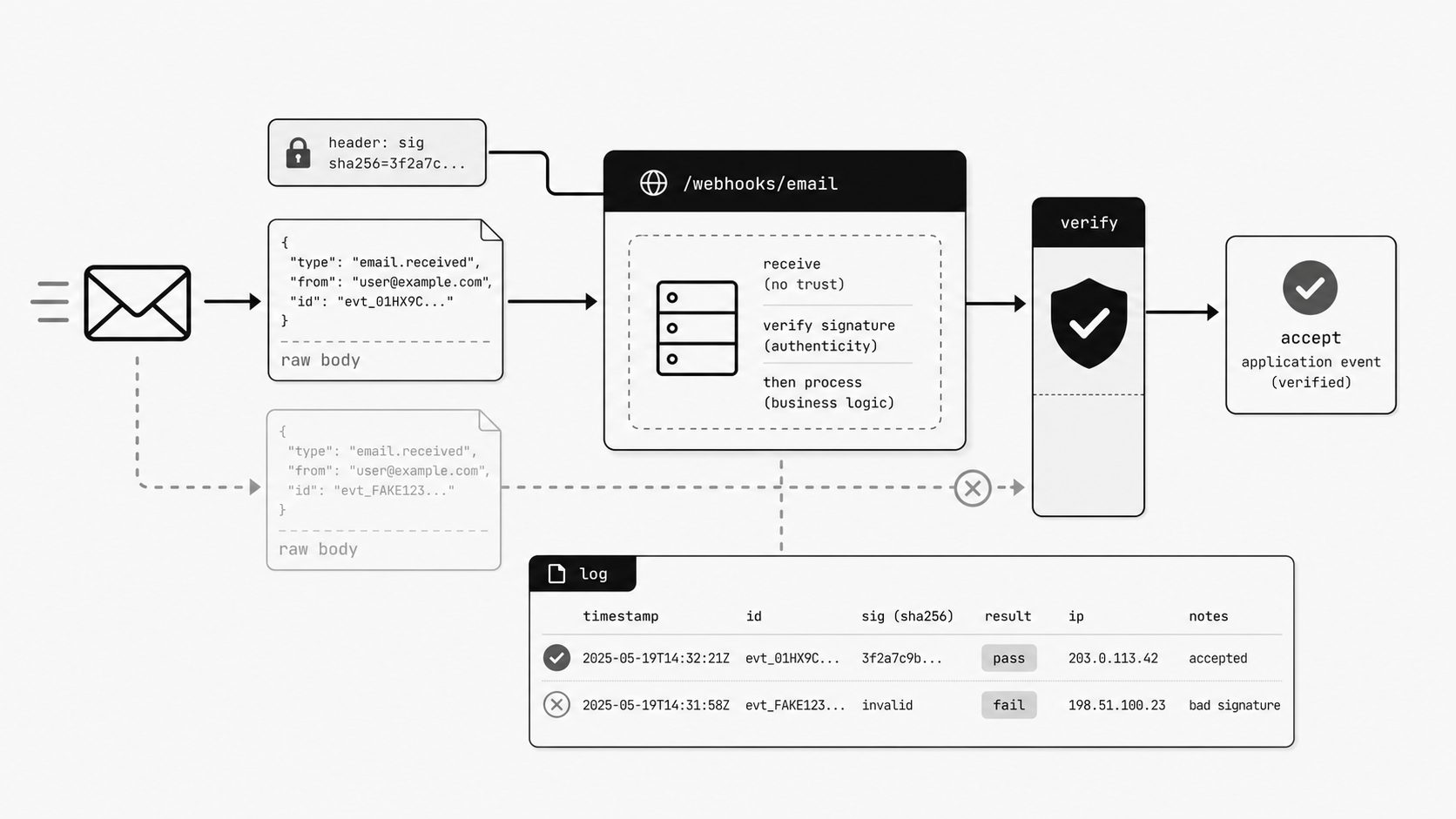
Security approval for email-driven integrations usually slows down at the same point: the moment an approver asks why a public webhook endpoint should be trusted. That question is getting sharper now because security and IT teams are under more pressure to prove authenticity, traceability, and operational accountability in every inbound integration path. If an email webhook can create records, trigger workflows, or move data into internal systems, reviewers want to know what stands between an internet-reachable endpoint and a business action.
This is why I see signed webhook delivery as a trust accelerator. Teams can show approvers the check performed on each delivery, explain what happens when it fails, and document how the control fits into the receiving flow. Those details give security or IT approvers a concrete mechanism to review. For implementation teams, it often means faster approval without a full receiver redesign.
This post goes deeper on Question 1 from Webhook Security for Email Automation: can I confirm every webhook is authentic? Here, I focus on how signed delivery makes that check easier to implement and review.
For product context, MailWebhook’s email webhook API explains how inbound email connects to your receiving service.
The first question every approver asks
When security or IT approvers review a webhook integration, the first question is often whether an inbound request can be verified as genuinely coming from the expected sender. That matters because webhook receivers accept inbound traffic by design, and a single accepted request can trigger downstream automation or data handling. (GitHub Docs - Validating webhook deliveries)
Key term: Signed delivery verification means checking a webhook’s cryptographic signature before processing its payload to confirm authenticity and detect changes to the signed content.
Signed webhook delivery gives reviewers a concrete authenticity control to inspect. A receiving service can validate the signature in the request before acting on the payload, and GitHub explicitly tells receivers to validate webhook signatures before processing deliveries to help confirm the payload came from GitHub and was not changed in transit. Stripe similarly documents verification around the raw request body, the Stripe-Signature header, and the endpoint secret. For approvers, this creates practical review questions about secret storage, failure handling, and whether the raw body is preserved so verification can be computed correctly. (Stripe Docs - Resolve webhook signature verification errors)
MailWebhook signature contract: The header is
X-MailWebhook-Signature: t=<unix>, kid=<kid>, v1=<base64_hmac_sha256>. Select the route signing secret bykidand compute HMAC-SHA256 overt.raw_body: the Unix timestamp in seconds encoded as ASCII, a literal period, and the exact raw request body bytes. Base64-decodev1and compare the digests in constant time. Reject timestamps outside the receiver’s accepted replay window; 300 seconds is a documented starting point. See the signed delivery documentation for implementation examples.
The takeaway is simple: put signature verification at the edge of the receiving service, reject requests that fail validation, and let only verified events reach business logic. That gives security and IT a testable trust step while preserving the overall webhook architecture.
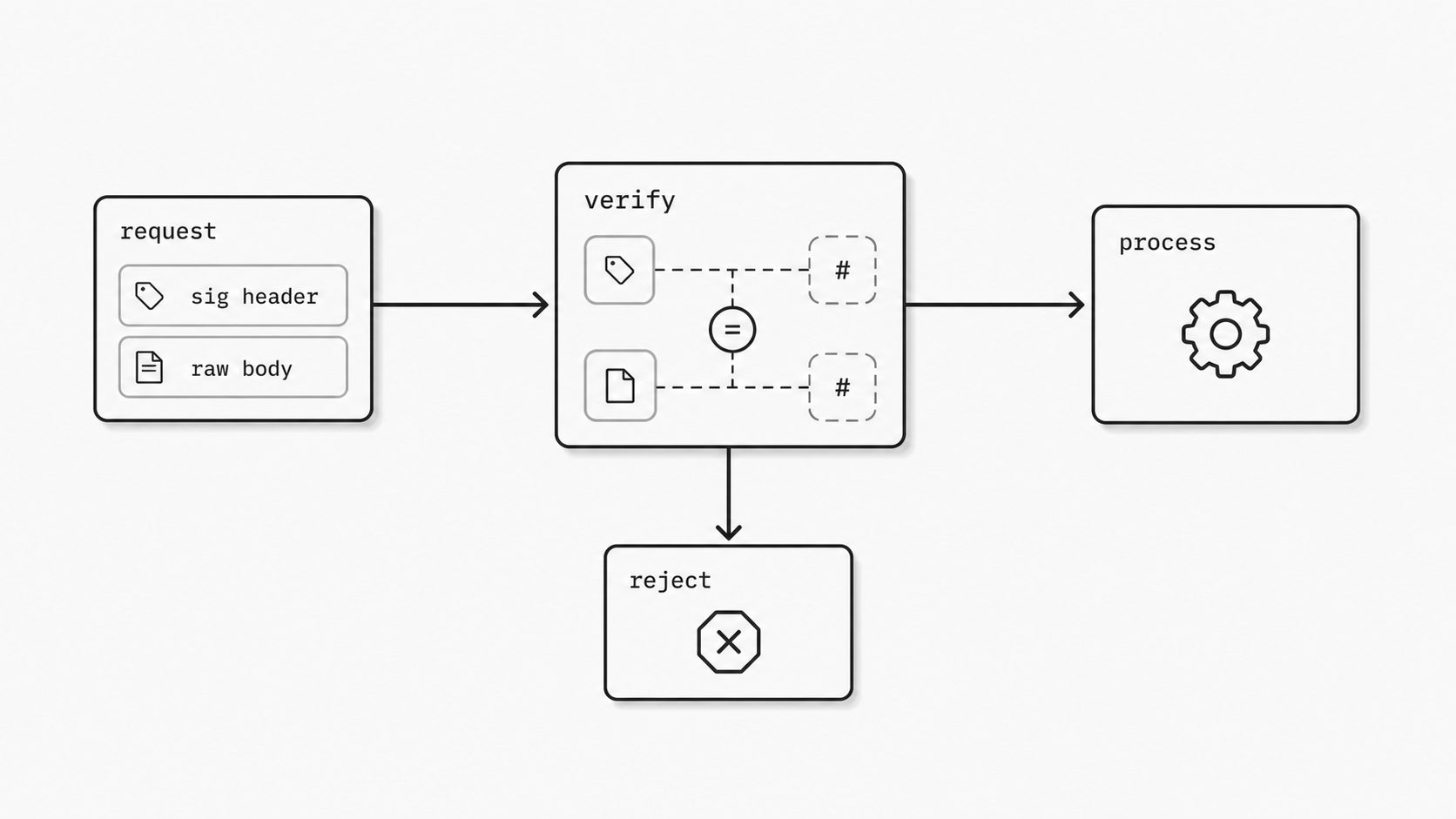
Reviewable authenticity controls: turning trust into inspectable evidence
Key term: Reviewable authenticity controls are checks that security teams can inspect, test, and document to show how a webhook receiver verifies the sender.
Security reviews often stall when reviewers lack evidence of how authenticity checks work. Major platform guidance gives reviewers something concrete to validate: Slack says incoming requests should be verified with a signing secret, signature header, raw body, and timestamp check to help detect replay attempts. When that mechanism is visible, the review becomes easier to reason about. (Slack Developer Docs - Verifying requests from Slack)
Inspectable trust looks like a small set of reviewable artifacts. A team should be able to show where the webhook signature header is checked before any business logic runs, preserve the raw request body so verification is computed correctly, and reject stale requests using the timestamp window Slack recommends for request verification. These checks give reviewers an implementation path they can test. Review becomes even easier when delivery evidence exists after the fact: GitHub documents endpoints to list webhook deliveries, fetch a specific delivery, and redeliver one, with delivery details that include headers, payload context, status data, status code, and whether the attempt was a redelivery. This turns trust into evidence an approver can revisit later. (GitHub Docs - REST API endpoints for repository webhooks)
The immediate takeaway is to package trust as evidence. Show reviewers three things quickly: where the request is verified, what happens when verification fails, and what delivery record remains for later inspection. If those artifacts are easy to inspect, reviewers can resolve authenticity questions and assess operational fit sooner.
What risk gets reduced when the sender has to prove itself
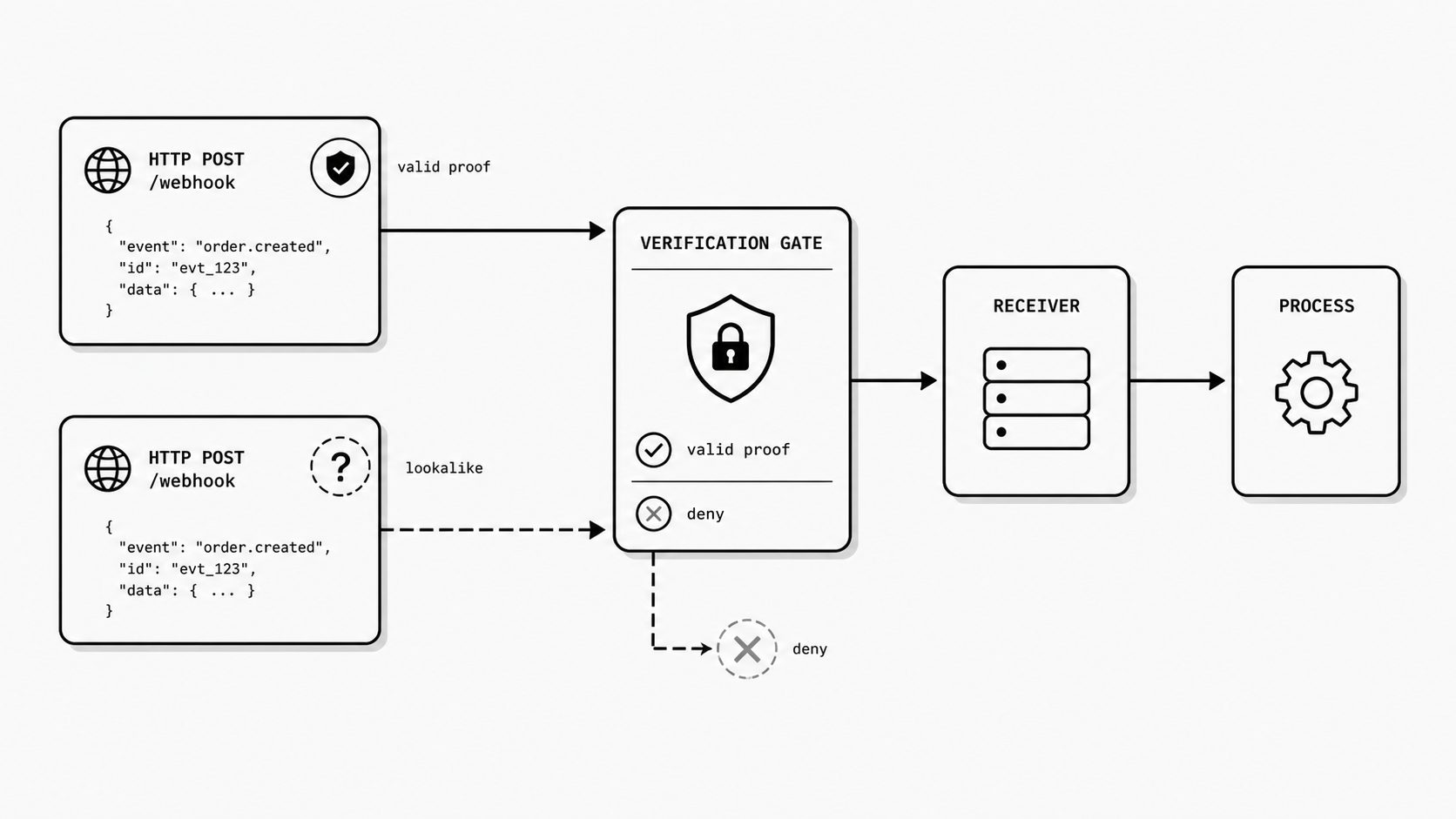
I have seen approvals slow down when a webhook endpoint is treated like an open door. The worry is easy to understand: if a system accepts HTTP requests from the internet, what stops a bad actor from sending a lookalike event and triggering downstream actions anyway? Signed webhook delivery lowers that risk by forcing the sender to prove possession of a secret before the receiver trusts the message. That matters most in workflows where one inbound event can create a ticket, release data, update a record, or kick off an email notification across other systems. (Slack Developer Docs - Verifying requests from Slack)
Key term: Spoofing resistance means making it harder for an attacker to pretend to be the real webhook sender.
Here is how I explain it in security review language. An attacker may be able to discover the endpoint URL, reach the service, and copy the shape of a request. That still does not give them the signing secret used to create the proof attached to the request header. When the receiver checks that proof against the raw payload, a forged request should fail verification if the attacker does not hold the secret. GitHub describes webhook validation as a way to confirm the payload came from GitHub and was not changed in transit, and Slack documents request signing so apps can verify requests are genuinely from Slack.
That is why this control changes the tone of an approval conversation. I can show a reviewer where signature verification gates access to business logic and how it fits alongside transport and network controls. In practice, that makes the risk discussion more concrete: if someone sends a fake event without the right proof, the service rejects it before processing continues.
Signature verification reduces forgery risk by requiring cryptographic proof tied to the sender secret and payload content. An attacker would need the secret or a flaw in verification to forge a request that passes the check. Secret compromise and implementation errors remain risks to assess. Security or IT approvers can review those risks alongside evidence of where failed checks are logged and denied.
An HMAC webhook signature gives your receiver a direct test of payload authenticity before it processes the event.
My practical takeaway is simple: when the sender has to prove itself, spoofing becomes a harder and less scalable attack path. Checking authenticity on every delivery gives approvers a clear control to evaluate. Teams still need to maintain the receiver’s other security controls. For a security reviewer, that is the real win. The control is easy to explain, easy to test, and closely tied to the risk they are trying to reduce.
Security that teams can add without rebuilding the receiver
Security reviews often stall when a control sounds like a rewrite. Signed webhook delivery is easier to adopt because vendors document how to add request validation to the existing handling flow. (Stripe Docs - Resolve webhook signature verification errors)
Key term: Implementation-friendly security means a control teams can add to an existing service with limited code and process change.
A mature pattern gives teams established implementation steps to follow and reviewers a clear basis for approval. Stripe documents a practical failure mode: verification can break when middleware or frameworks alter the raw request body before the check runs. That guidance focuses the work on preserving the body correctly and placing verification at the right point in the request flow. Twilio similarly tells customers to validate incoming requests and provides helper methods in its SDKs for that purpose. Those helpers give teams a documented path for adding the control. (Twilio Docs - Security)
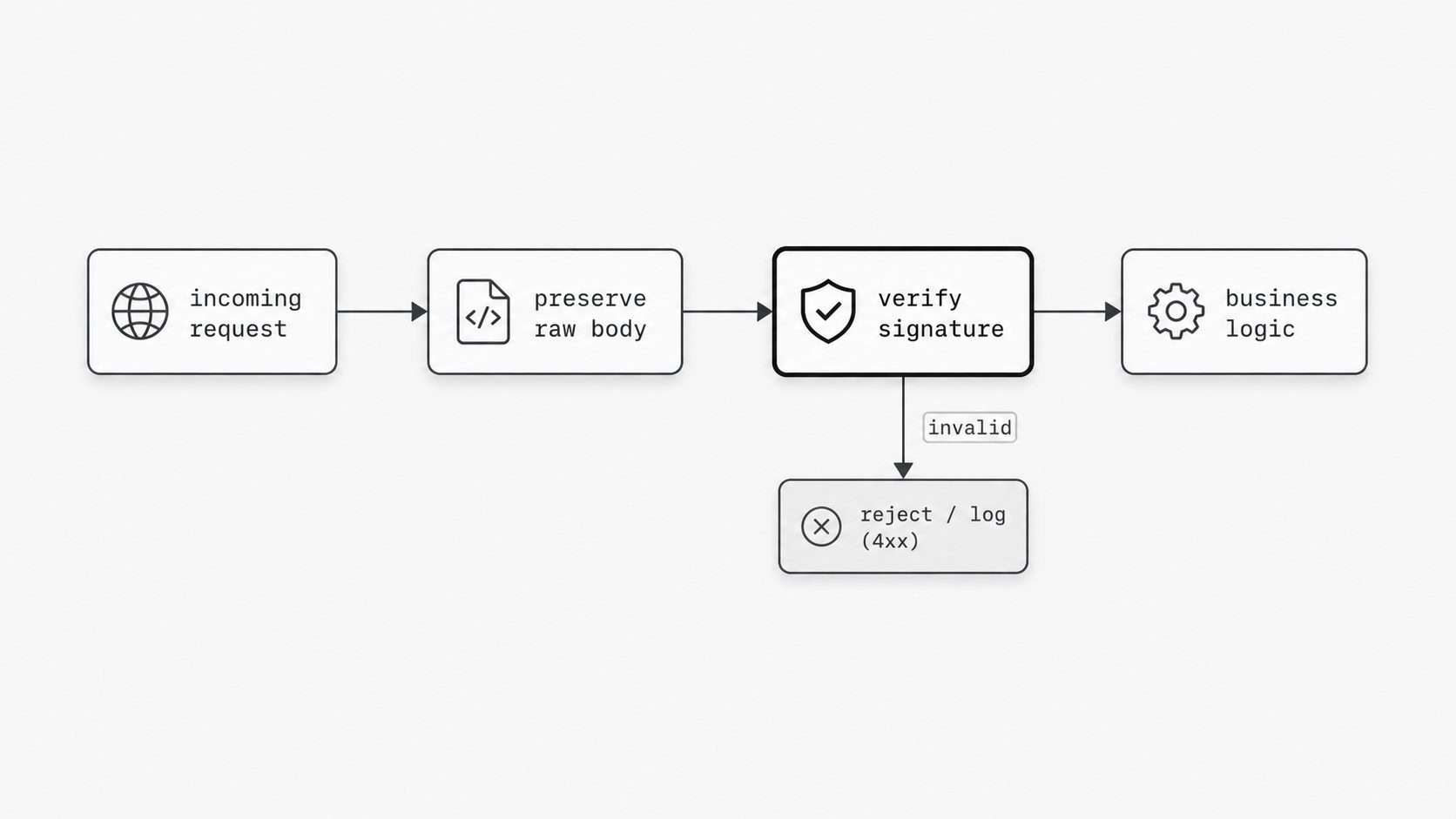
In practice, the effort usually becomes a short checklist: preserve the raw payload until the trust check completes, read the webhook signature header and compute the expected value using the shared secret or platform method, reject the request early if values do not match, and log the failure for later review. Each step needs careful implementation and testing within the existing receiver.
For a hands-on check, use the HMAC Signature Verifier with a synthetic payload and test secret to explore how changing the signed input affects verification. Use the signed delivery documentation above for MailWebhook’s exact input format, encoding, and timestamp checks when implementing your receiver.
Frame this control as a narrow change with a clear test path. Show where the request is checked, confirm that the raw body is preserved for verification, and demonstrate that failed requests stop before business logic runs. That gives approvers evidence of stronger trust checks while giving delivery teams a path they can realistically ship.
Signed webhook delivery gives security and IT approvers a control they can review, test, and explain. Clear evidence of that control can help them reach an approval decision sooner. The sender can be checked, failures can be denied early, and delivery behavior can be documented in a way that stands up to follow-up questions later.
That is the broader value for email integrations in particular. Once inbound email is converted into application events, the webhook receiver becomes part of a larger operational and security chain. A signed delivery step helps protect that chain without forcing product teams to rebuild it from scratch. When teams can show how trust is established at the edge, how suspicious requests are stopped, and how the control fits into existing implementation patterns, review gets easier for everyone involved. That is why I see signed webhooks as a practical way to help trustworthy integrations ship sooner.
The companion control to verification is destination restriction. See MailWebhook’s endpoints documentation for the allowed URL schemes and public-address checks that constrain delivery destinations.