

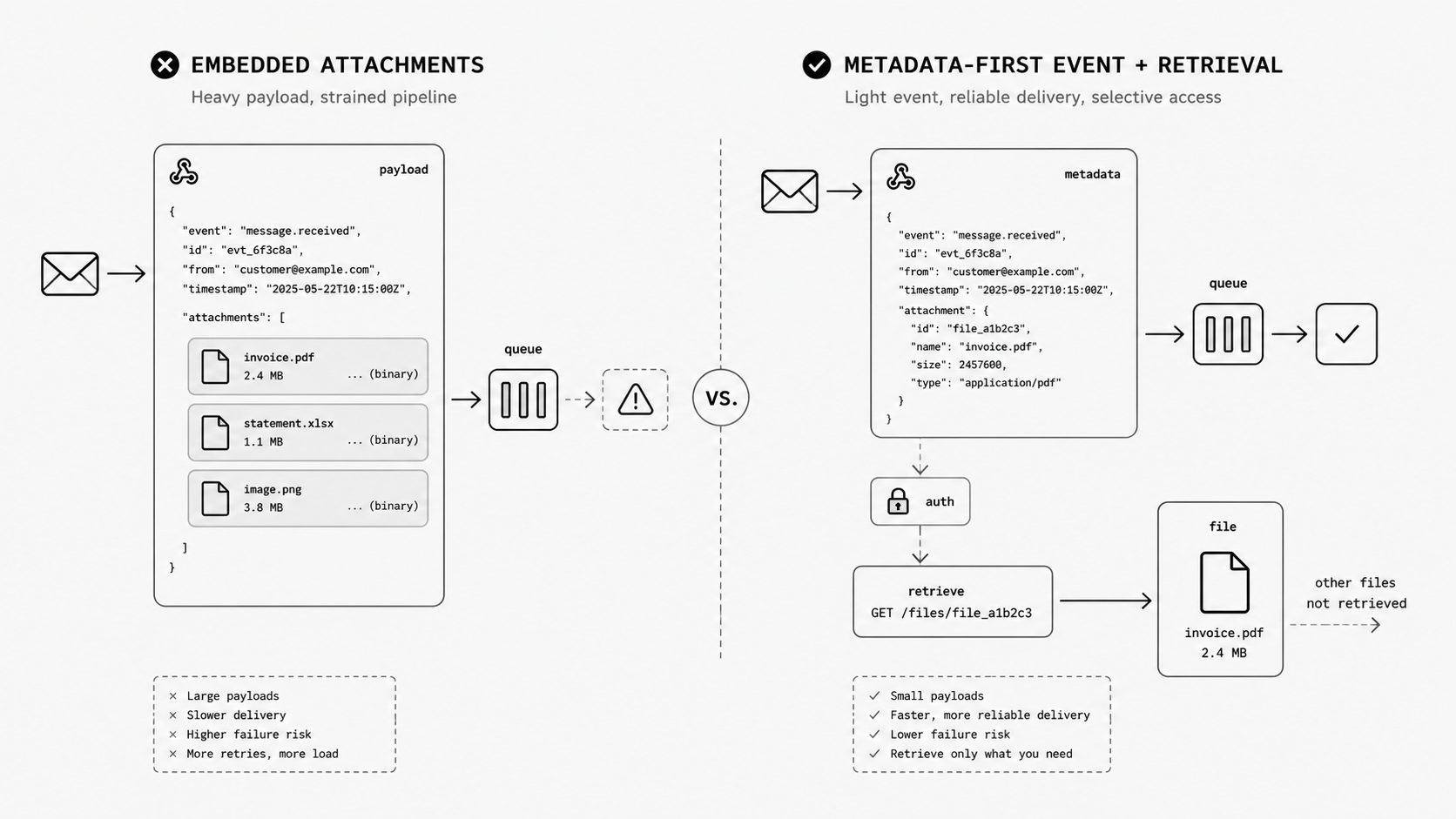
Attachments can change the category of an otherwise simple email webhook. A payload that begins as a small event becomes a variable binary transfer when files travel inside it. That changes the delivery contract: request size depends on message contents, and every delivery attempt must move the event metadata and file bytes as one unit. For backend engineers and solution architects building file-rich integrations, that coupling is usually the wrong tradeoff.
The better shape is simpler and more durable: let the webhook report that files exist and include the facts needed to make a decision, then retrieve the binary content through a separate authenticated flow only when the workflow actually needs it. This keeps the event contract easier to reason about, reduces pressure on the delivery path, and gives teams more control over how file access is governed in production. In the broader inbound email processing architecture, this boundary keeps transformation focused on the event shape and delivery focused on a predictable handoff.
Start with the event shape, because attachment bytes change the whole contract
When I look at an email webhook design, I start with a simple question: what exactly is the sender promising to deliver as one unit? If the body carries every attachment in full, the contract binds the event and its binary content to the same request. Attachment count and size now determine the size of the webhook body, so the event cannot cross the delivery boundary independently of the files.
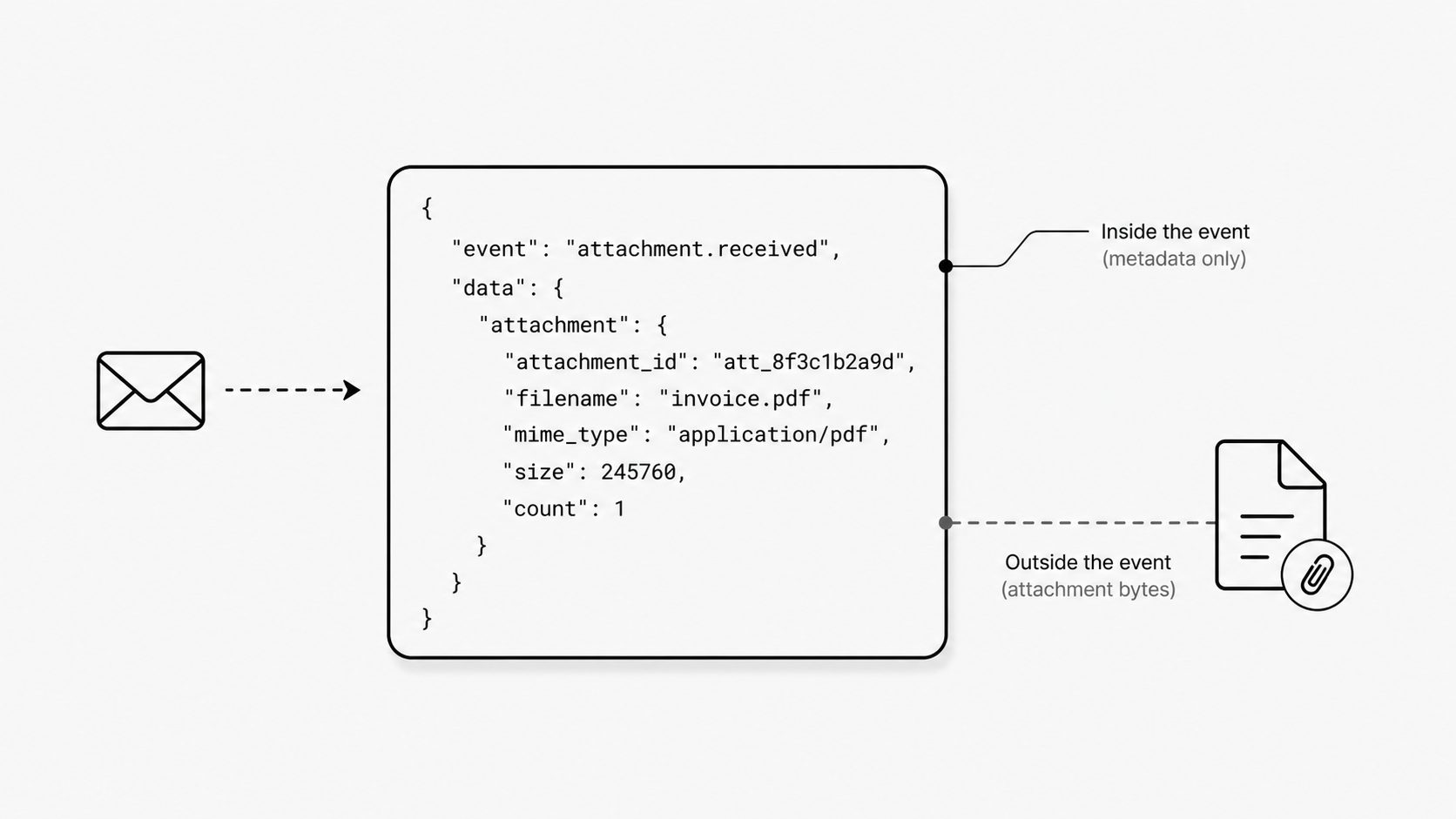
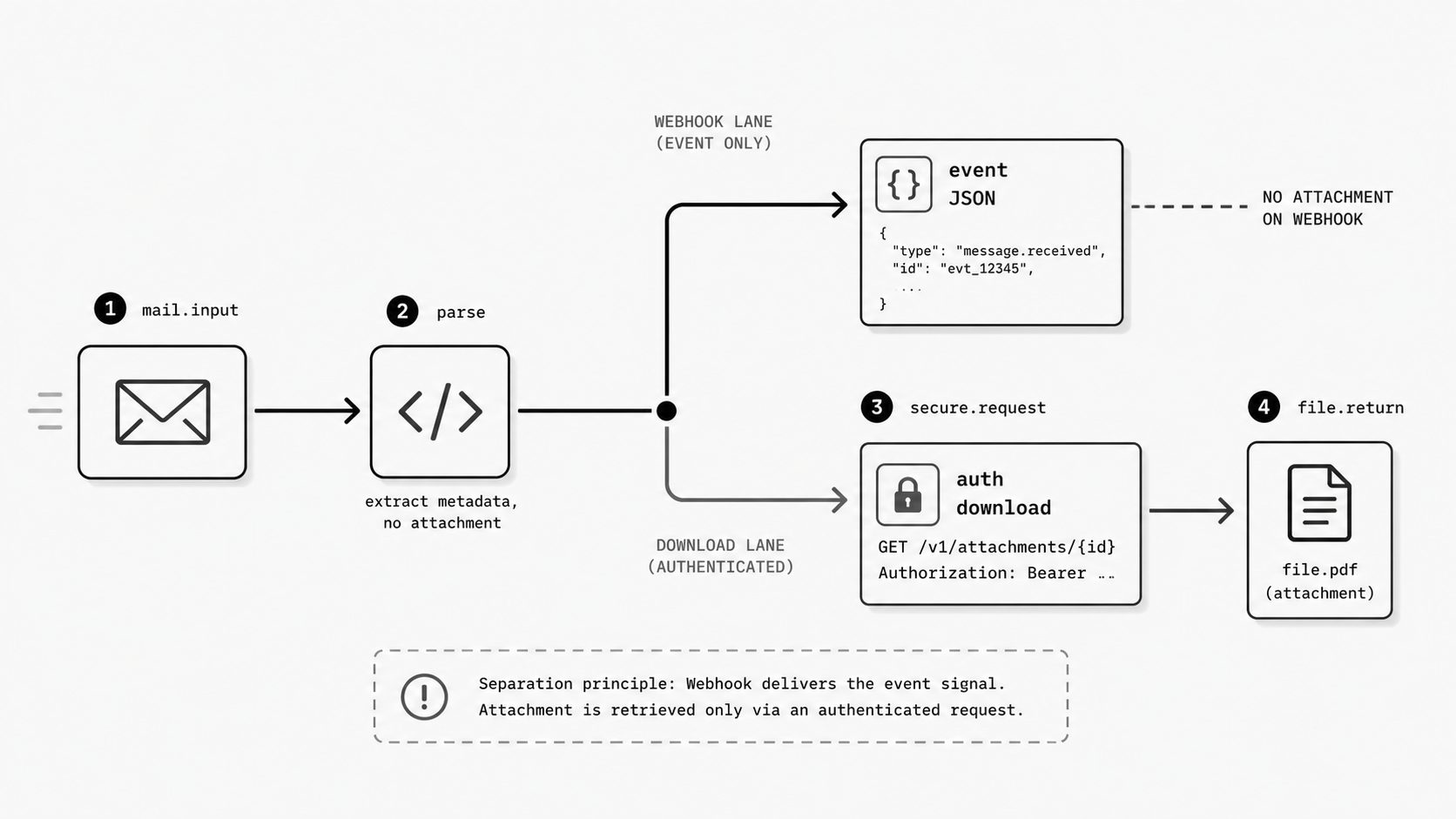
A metadata-first contract keeps notification independent from file transfer. MailWebhook’s Generic JSON attachment contract lists descriptors in body.attachments, including each attachment’s id, filename, content_type, and size. It includes neither file bytes nor a download URL. When a backend needs a file, it sends message.message_id and the attachment id in a request authenticated with X-API-Key to obtain a short-lived URL. Embedding files makes every delivery attempt repeat the binary transfer. A metadata-first event keeps each attempt to the same bounded control message.
Start your email-to-webhook design by treating attachments as referenced objects. Let the event describe each file through a fixed schema, then retrieve the bytes through a separate path when needed. This keeps the request size predictable and prevents a file’s byte count from redefining the webhook contract for each message.
That transport choice has downstream operating effects, which Why Attachment-Heavy Email Workflows Break First covers from the workflow side.
So where do the files go? Into a separate path with its own controls
Here is the question I want architects to ask early: when an attachment shows up, do I want my event delivery path to become my file transport path too? Some email parsing APIs support the heavier model. Twilio SendGrid, for example, documents that its Inbound Parse Webhook can post parsed email data and attachments to an endpoint as multipart/form-data. That means the same request carries the event fields and file content as one delivery unit. (Twilio SendGrid Docs - Settings: Inbound Parse)
I prefer a cleaner split. I let the webhook tell my system what arrived, then I give files their own retrieval path with controls that fit file handling. An embedded multipart body requires the receiver to parse mixed fields and files before business logic can begin. It also puts event authentication and file access at the same boundary. A separate retrieval flow lets the webhook and the file transfer have distinct authentication, access scope, audit behavior, and lifetime rules.
The design lesson is straightforward: attachments deserve their own lane. Use the webhook to trigger decisions, and use a separate authenticated flow to retrieve file content only when the workflow truly needs it. That keeps the event surface easier to operate and gives binary access the stronger, more specific controls it deserves.
Payload size spends time and bandwidth before processing begins
When teams design an email webhook, they often put attachments inside the event for completeness. The result is a larger, more fragile delivery, and GitHub documents a 25 MB webhook payload cap with oversized payloads not delivered. (GitHub Docs - Webhook events and payloads)
Hard caps are the most visible boundary. Transfer time matters before a receiver can validate the complete body. On a 10 Mbps connection, a 10 MB attachment inside the webhook takes about eight seconds to transfer under ideal conditions, before protocol overhead or network delay. A 2 KB metadata event takes about 1.6 milliseconds on the same connection. That simple comparison shows how attachment size can consume the delivery window before application logic begins.
Redelivery multiplies the difference. Three attempts at 10 MB move 30 MB across the delivery path. Three attempts at 2 KB move 6 KB, and each 10 MB attempt carries about 5,000 times as much data as a 2 KB attempt. Any gateway, queue, or failure store that retains complete request bodies inherits the same size gap. A metadata event can be redelivered on its own, while file retrieval follows a separate policy and happens only when the workflow needs the content.
Bounded metadata is a reliability design choice. Carry the attachment descriptors and message.message_id in the event. Request a short-lived download URL from MailWebhook only for files the workflow selects. The webhook’s transfer time, retry volume, and storage footprint no longer grow with every attachment byte.
Most workflows do not need every file, and your pipeline should reflect that
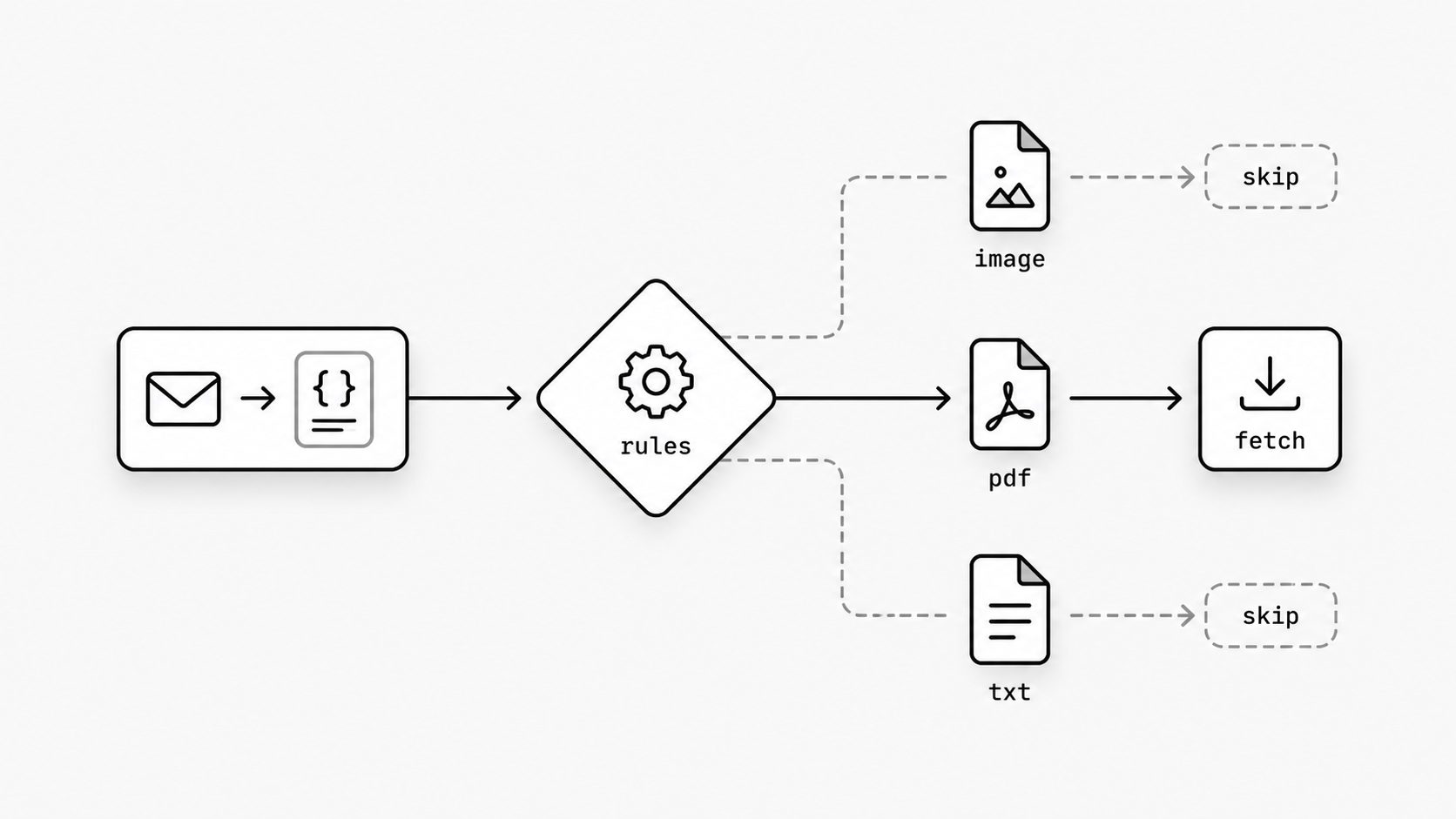
A common mistake in attachment-heavy integrations is assuming every file deserves immediate processing the moment an event lands. In practice, many downstream steps only need to know that a file exists, what kind of file it is, and whether it matters to the business rule being evaluated. In an email parsing API, that difference matters because the first decision often routes the event before file handling begins. If an invoice bot only needs PDFs above a certain confidence threshold, or a support workflow only needs image attachments for damage claims, pulling every file into the pipeline up front creates work that many requests never needed.
This is where the design becomes more mature. Once attachment facts arrive with the event, downstream services can make conditional choices before any binary handling begins. One service can inspect sender, subject, tags, or file type and stop there. Another can fetch a single document for OCR. A third can ignore all files because the message only updates a ticket record. That kind of branching keeps infrastructure aligned with actual business intent and reserves the most expensive path for files that matter.
There is also a transport reason to prefer this approach. The initial receiver must accept the full request body before it can treat the delivery as complete. File transfer and multipart parsing add more work to that boundary. If the receiver’s first job is to validate a bounded event, record the attachment facts, and hand off simple decisions, the delivery edge stays easier to stabilize.
In a real email-to-JSON API flow, this looks like a filter chain. The event lands. The system checks message rules. It decides whether any file deserves deeper work. Only then does a later step request the specific asset that matches the use case. That pattern reduces unnecessary byte handling, lowers storage churn, and narrows the number of places where sensitive file contents are exposed during normal processing.
The payoff is simple: the pipeline becomes more intentional. Every attachment earns the download through a business rule. That gives backend teams tighter control over cost, cleaner orchestration, and fewer accidental touchpoints for file content. For solution architects, the event tells you what is available, and the system chooses what is worth retrieving. That is a better fit for production behavior, where relevance is uneven and only a fraction of files drive the next business action.
Attachments matter. Their place in the integration contract is the core design choice. When file facts travel in the event and file bytes move through a separate retrieval path, the webhook stays small, stable, and easier to operate under failure, retries, and scale.
That model gives teams a clearer schema, better reliability boundaries, and more intentional control over which files are ever fetched. It is also the attachment boundary behind MailWebhook’s email webhook API: the webhook signals what arrived, and file bytes travel through a path built for binary work.