

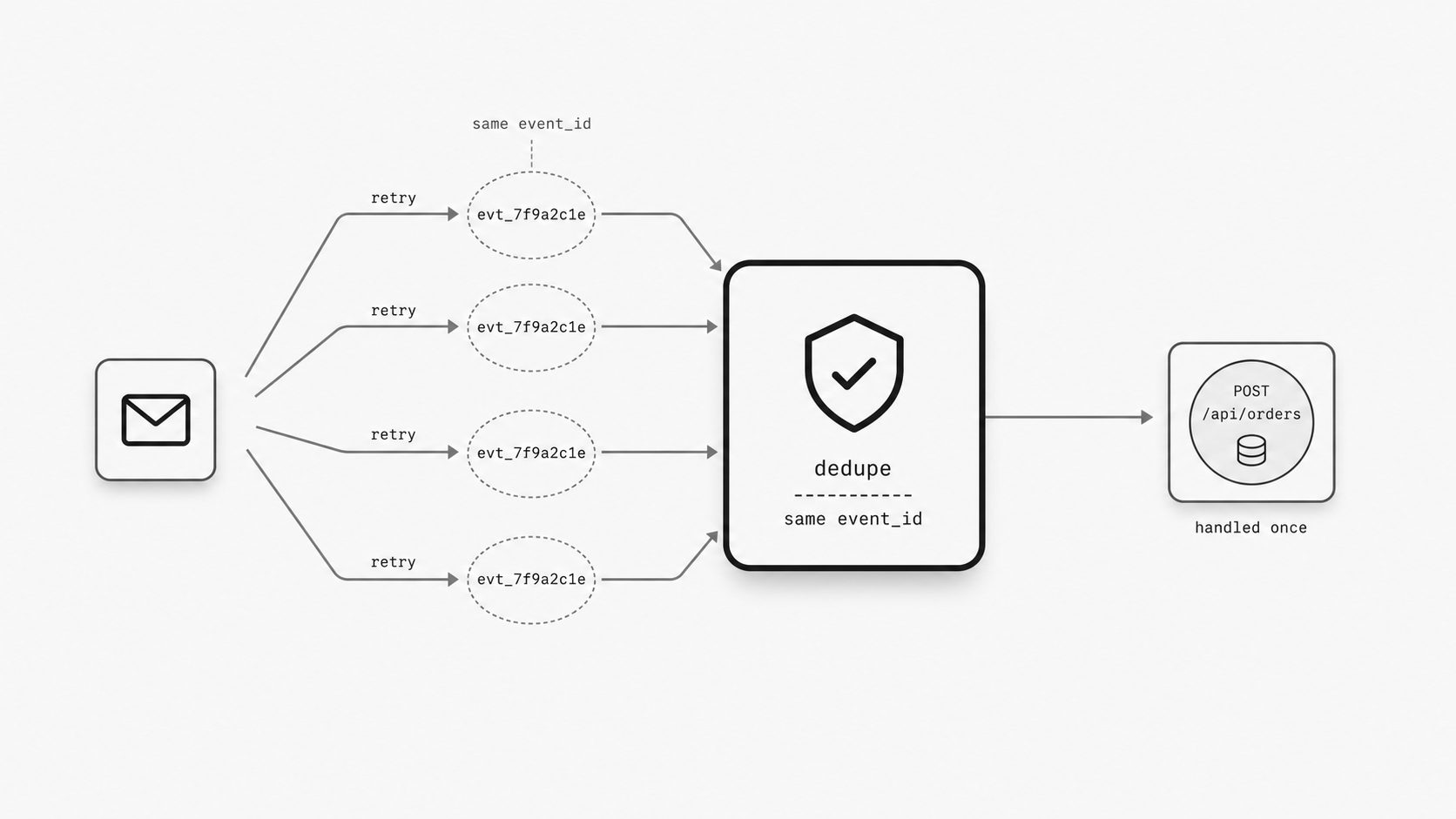
Email automation gets easier to approve once teams believe retries will not create business damage. I covered that reliability problem in Why Retries and Duplicates Break Trust in Email Webhooks. This post starts from the implementation side: the same event may arrive more than once, and downstream systems still need one correct outcome.
In this post, I go deep on idempotency as the bridge between messy inbound reality and disciplined API processing. This builds on the delivery contract in Reliable Webhook Delivery Best Practices: Why Boring Is the Right Standard, where the sender side owns exact bodies, JSON content types, stable headers, signatures, and explicit retry behavior. Here, the receiver uses that contract by treating idempotency keys as the control point before business side effects begin.
The first thing I stabilize is the event identity
When retries make the same email event look new, downstream systems can create duplicate tickets, updates, or customer messages. A delivery idempotency key gives every retry the same stable identity so the receiver can recognize the same business event again instead of treating it as fresh work. (Stripe API docs: Idempotent requests)
The practical test is simple: if a sender, gateway, or worker retries the same event five times, can the receiving API tell that all five attempts refer to the same underlying business fact? Stripe documents idempotency as a client-supplied key that lets the server return the original result for the first processed request during safe retries. AWS describes the same pattern from the service perspective, where a unique request identifier allows retries to be treated as the same intent and to produce a semantically equivalent outcome within a defined interval. Applied to email-driven automation, this means the identity must attach to the business event, not to each transport attempt. (AWS Builders’ Library: Making retries safe with idempotent APIs)
Use one stable key for one business event, and reuse it across every timeout, redelivery, or replay. The key can come from a provider event ID, a durable upstream message identifier, or deterministic immutable event attributes; what matters is that retries keep the same key while new business events get new ones.
For MailWebhook, the receiver contract is the delivered header. Store the X-Idempotency-Key value from the request, because that is the stable key MailWebhook reuses across retries and replay. Its derivation follows the same rule: the value is based on the upstream message identity and the route that emitted the webhook, X-Idempotency-Key: <sha256(message_id|route_id)>. (MailWebhook endpoint docs)
For the commercial receiver/API surface, see Email Webhook API.
The recompute example below is useful for understanding or diagnostics. It should not replace the normal receiver path of reading and storing the delivered header.
from hashlib import sha256


def mailwebhook_delivery_key(message_id: str, route_id: str) -> str:
    """Build the idempotency key for one routed email event.

    Args:
        message_id: Stable upstream email message identifier.
        route_id: Route that emitted the webhook.

    Returns:
        Hex-encoded SHA-256 key reused across retries.

    Raises:
        ValueError: If either identifier is missing or blank.
    """
    if not isinstance(message_id, str) or not message_id.strip():
        raise ValueError("message_id is required")
    if not isinstance(route_id, str) or not route_id.strip():
        raise ValueError("route_id is required")

    return sha256(f"{message_id}|{route_id}".encode("utf-8")).hexdigest()
The delivered header value is the receiver’s duplicate-control field. When the compatibility alias is present, it carries the same value:
X-Idempotency-Key: 0f4d8f8a2cf8a8a0e48f2e0ff8f322f3...
Idempotency-Key: 0f4d8f8a2cf8a8a0e48f2e0ff8f322f3...
What the receiver should do with the key
A stable key only matters if the receiver treats it like a control point instead of a label. Teams can add a key to an inbound event and still trigger the same ticket, refund review, or CRM update twice if duplicate checks happen too late. The receiver has to decide, with a durable record, whether the event was already handled before any outward action begins. (Stripe API docs: Idempotent requests)
Key term: Consumer-side deduplication design means the receiver keeps a durable record of event identities so retries do not repeat business actions. (Stripe docs: Advanced error handling)
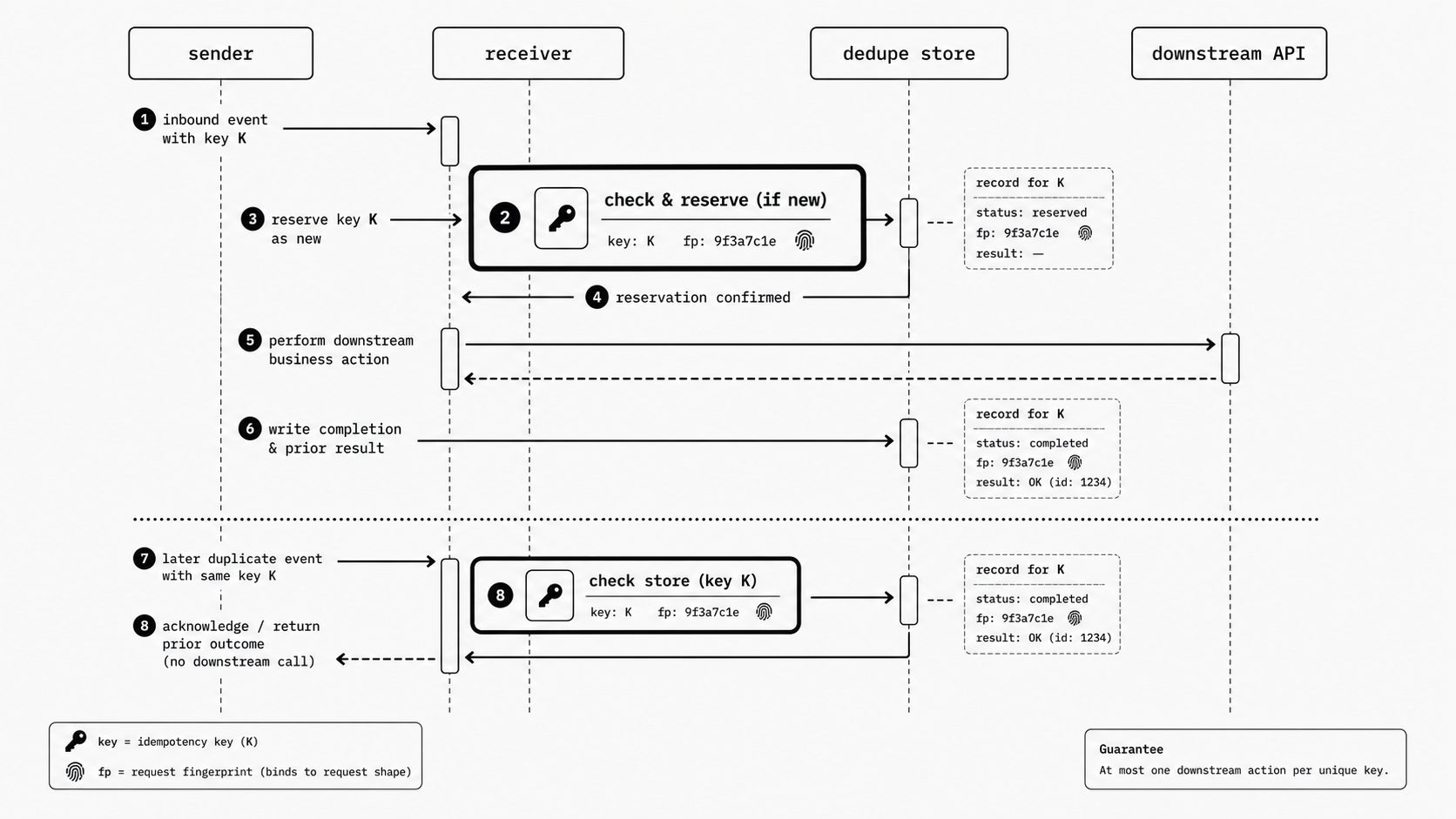
In practice, this works like a gate at the front of the workflow. When an event arrives, the receiver reads the stable identity, checks its store, and tries to reserve that identity before doing anything else with side effects. If the identity is new, processing can continue. If the identity is already marked as handled, the system can return the prior outcome or safely stop.
A PostgreSQL store for that gate can stay small. It needs the key, a fingerprint of the normalized request, the processing state, and the recorded response:
CREATE TABLE webhook_idempotency (
    idempotency_key text PRIMARY KEY,
    request_hash char(64) NOT NULL,
    status text NOT NULL CHECK (status IN ('processing', 'completed')),
    response_status integer,
    response_body jsonb,
    created_at timestamptz NOT NULL DEFAULT now(),
    completed_at timestamptz
);
The atomic claim is the part to get right. One insert reserves the key. A duplicate delivery gets zero rows back, because the primary key already exists:
INSERT INTO webhook_idempotency (idempotency_key, request_hash, status)
VALUES ($1, $2, 'processing')
ON CONFLICT (idempotency_key) DO NOTHING
RETURNING idempotency_key;
That order matters. If the system sends a customer message, writes a ticket, or calls a billing API first, duplicate control is already lost. The store that tracks handled identities has to be durable enough to survive restarts and retries, because transient memory does not help when the same event returns later from another worker or delivery path.
A useful guardrail is to bind the stored identity to the shape of the original request. Stripe documents that when an idempotency key is reused, it compares incoming parameters with the original request to prevent accidental misuse. For email-driven systems, the same principle helps distinguish a true retry from a bad collision caused by upstream bugs or mapping drift.
Here is the same three-step pattern as code. This version assumes the business mutation is local to the same database transaction. If the mutation calls an external system, use the same idempotency record to write an outbox job first, then let a worker make the external call.
import json
from collections.abc import Mapping
from hashlib import sha256
from typing import Any


def header_value(headers: Mapping[str, str], name: str) -> str | None:
    """Return a nonblank HTTP header value using case-insensitive lookup.

    Args:
        headers: Request headers from the webhook receiver.
        name: Header name to find.

    Returns:
        The stripped header value, or None when the header is absent or blank.
    """
    for key, value in headers.items():
        if (
            key.lower() == name.lower()
            and isinstance(value, str)
            and value.strip()
        ):
            return value.strip()
    return None


def request_fingerprint(event: Mapping[str, Any]) -> str:
    """Return a stable hash for the normalized event payload.

    Args:
        event: Validated email event payload passed to business logic.

    Returns:
        SHA-256 hash of the canonical JSON representation.

    Raises:
        ValueError: If the event is not a mapping.
    """
    if not isinstance(event, Mapping):
        raise ValueError("event must be a mapping")

    canonical = json.dumps(
        event,
        ensure_ascii=False,
        separators=(",", ":"),
        sort_keys=True,
    )
    return sha256(canonical.encode("utf-8")).hexdigest()


def handle_email_event(
    db: Any,
    event: Mapping[str, Any],
    headers: Mapping[str, str],
) -> tuple[int, dict[str, Any]]:
    """Process one email webhook through a durable idempotency gate.

    Args:
        db: Database client with transaction, fetch_one, and execute methods.
        event: Normalized and validated email event.
        headers: Request headers containing X-Idempotency-Key.

    Returns:
        HTTP status code and response body for the receiver.
    """
    idempotency_key = header_value(headers, "X-Idempotency-Key")
    if idempotency_key is None:
        return 400, {"error": "missing idempotency key"}

    request_hash = request_fingerprint(event)

    with db.transaction() as tx:
        claimed = tx.fetch_one(
            """
            INSERT INTO webhook_idempotency (idempotency_key, request_hash, status)
            VALUES (%s, %s, 'processing')
            ON CONFLICT (idempotency_key) DO NOTHING
            RETURNING idempotency_key
            """,
            (idempotency_key, request_hash),
        )

        if not claimed:
            existing = tx.fetch_one(
                """
                SELECT request_hash, status, response_status, response_body
                FROM webhook_idempotency
                WHERE idempotency_key = %s
                """,
                (idempotency_key,),
            )
            if existing is None:
                return 503, {"error": "idempotency record unavailable"}
            if existing["request_hash"] != request_hash:
                return 409, {
                    "error": "idempotency key reused with a different payload"
                }
            if existing["status"] == "completed":
                return existing["response_status"], existing["response_body"]
            return 202, {"status": "processing"}

        response_status, response_body = create_ticket_from_email(tx, event)
        tx.execute(
            """
            UPDATE webhook_idempotency
            SET status = 'completed',
                response_status = %s,
                response_body = %s::jsonb,
                completed_at = now()
            WHERE idempotency_key = %s
            """,
            (response_status, json.dumps(response_body), idempotency_key),
        )

    return response_status, response_body
The shape is the contract. First, persist the event identity with an atomic claim. Second, bind that identity to a normalized request fingerprint. Third, mark completion with the response that later retries should see. With that gate in place, retries become routine operational noise instead of repeated business actions.
At-least-once delivery is the starting point
This implementation starts from at-least-once delivery as an accepted premise. Timeouts, dropped acknowledgments, and provider retries can make one email event arrive more than once, so the receiver has to protect the business outcome.
For MailWebhook-specific delivery behavior, the retries and replay docs cover how repeated delivery attempts and replay fit into that contract.
From here, the question is narrower and more practical: what should the consumer do when that repeated delivery arrives? It should read the idempotency key before side effects, reserve or check that key in durable storage, compare the normalized request shape when the key has been seen before, and return the recorded outcome or stop safely. The delivery model may send more than one attempt; the consumer contract should still produce one business result.
Building API-safe email events: the intake pattern that makes retries harmless
I do not ask email to be clean before it reaches my platform. I ask my platform to make it clean on arrival. That shift matters because raw email is full of messy inputs, retries, and trust questions, while downstream APIs need a stable event they can process with confidence. When I turn an inbound email webhook into a disciplined application event, I am giving the rest of the system something much more useful than a message dump. I am giving it a contract with identity, authenticity, and repeat-safe handling. (AWS Well-Architected Framework: Perform operations as idempotent)
Key term: API-safe email events are email-originated events that are normalized into a stable, trusted, retry-aware contract before downstream systems act on them. (AWS Builders’ Library: Making retries safe with idempotent APIs)
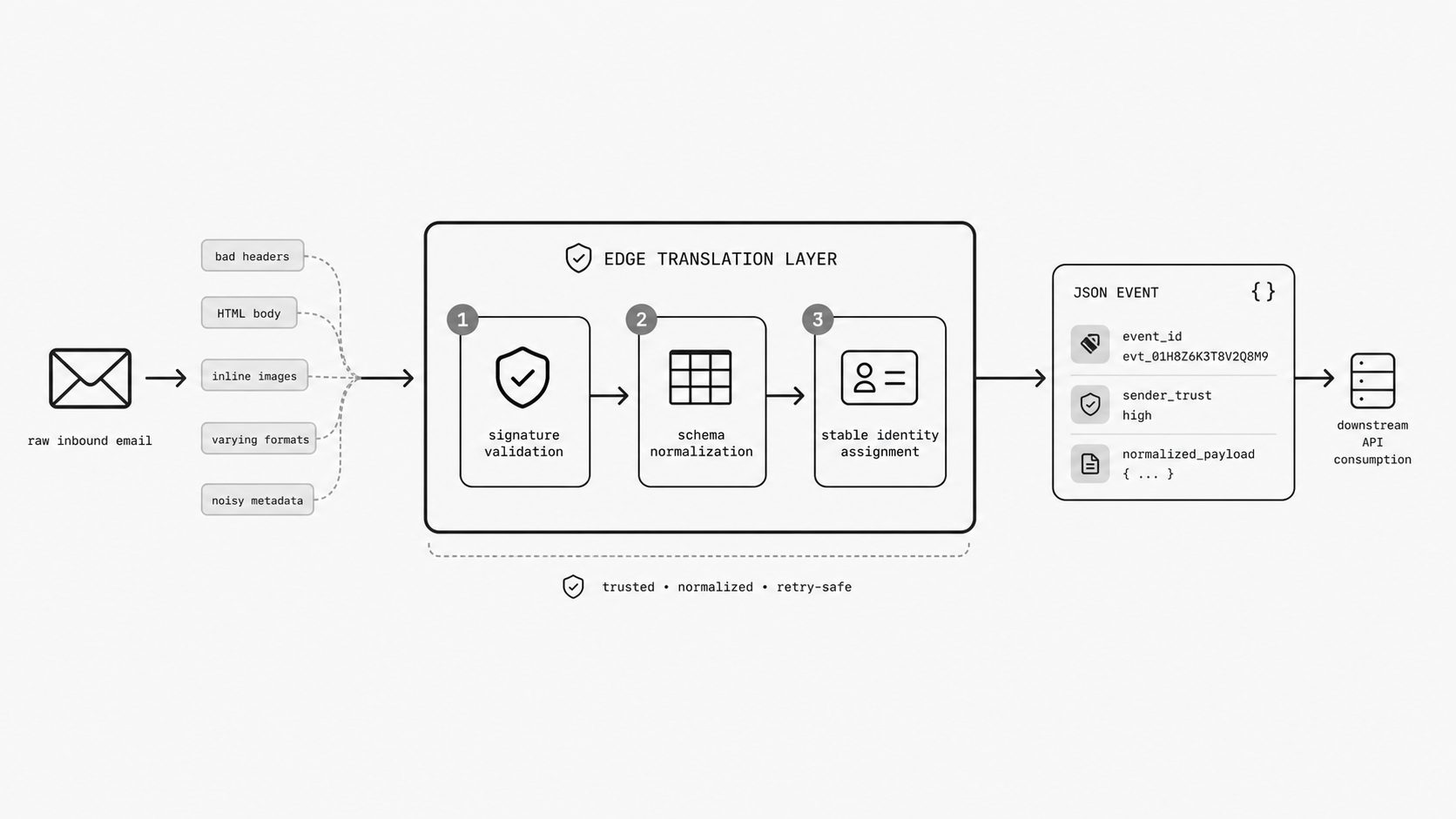
This is the point where the architecture usually gets easier to reason about. I stop treating email as a special channel with special excuses, and I start treating it like any other event source that must meet a few basic rules. First, the event needs a stable identity so retries map to the same business fact. Second, the payload needs a consistent shape, which is where an email JSON schema earns its value. A stable contract lets every consumer read the same fields the same way, instead of guessing at loosely structured content on each delivery attempt.
Third, I need to know the event came from a sender I trust. That is where webhook signature validation belongs in the intake path. If a provider supports an HMAC webhook signature, I validate the payload before I let the event enter business processing, because identity alone is not enough if the source itself cannot be trusted. I have found that teams often separate these concerns in conversation, yet in production they work together. Stable identity controls repeats. Signature checks control trust. Schema normalization controls predictability.
You might be wondering: what does this look like in practice? I think of it as a small translation layer at the edge. The mail webhook arrives. The platform verifies origin, extracts the durable identifiers, maps the message into a deterministic payload, and only then hands a clean event to internal APIs. At that point, the downstream system no longer has to understand SMTP-era messiness, provider-specific retry behavior, or inconsistent raw fields. It sees one event model and one operating contract.
That contract also changes how I define success. Success is no longer “the email arrived.” Success is “the business event became safe to consume.” AWS guidance on idempotent operations points in this direction by emphasizing that systems should produce a consistent effect even when the same request is retried. For email-driven automation, that means my intake layer has done its job when the rest of the platform can process the event without inventing duplicate side effects or second-guessing whether the payload is genuine.
So the pattern I use is simple to describe, even if the implementation takes care. I convert email into an event contract before any business workflow starts. That contract includes who sent it, what happened, which stable event identity represents it, and which normalized fields every service can rely on. Once I do that, email stops being an unpredictable edge case and starts behaving like a disciplined event source that fits cleanly into API operations.
If you want one practical test for your own design, ask this: can a downstream team consume this event without learning the quirks of the email provider that delivered it? If the answer is yes, you are close. That is when email to webhook architecture becomes safe enough for serious automation, because the transport may still be messy, but the contract handed to the business is calm, trusted, and built for retries.
The delivery model I trust is not based on perfect transport. It is based on stable event identity, durable duplicate control, and a receiver contract that keeps retries from turning into repeated business actions. That is what makes automation possible for teams that need reliability without manual cleanup.
If you are a platform engineer or API owner, this is the practical standard worth aiming for: one business event, one intended outcome, even when the network forces multiple delivery attempts. Once email events are normalized into something trusted and repeat-safe, downstream systems can automate with confidence instead of caution.