

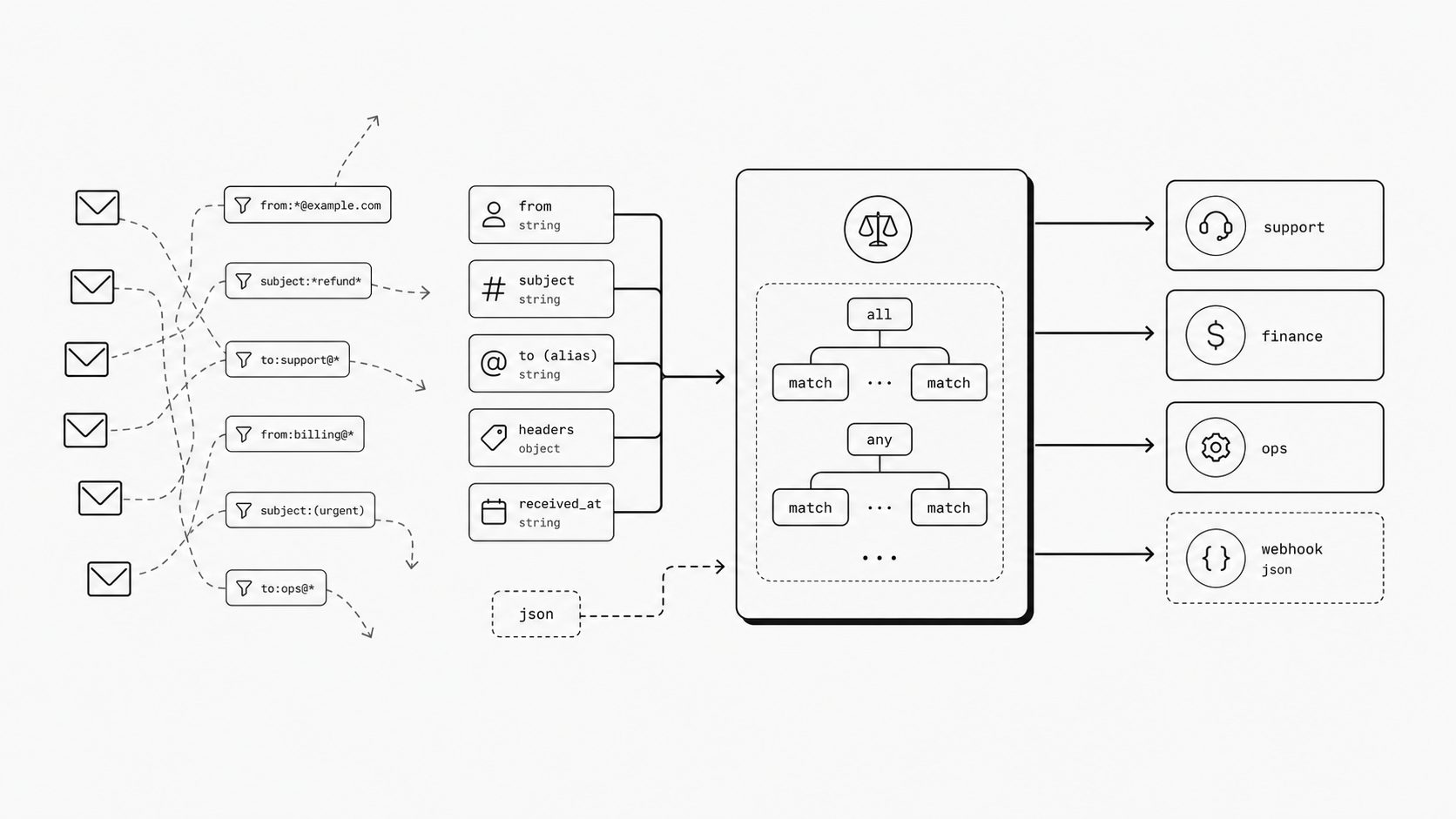
Email routing rules belong inside an email ingestion layer: the boundary where inbound messages are normalized, routed, shaped, and delivered as application-ready events. This post zooms into the rule layer as governed matching logic, with conditions that stay inspectable, maintainable, and safe to evolve as intake paths change.
For platform engineers and technical managers, the design work is practical: normalized matching, readable boolean logic, durable rule storage, and behavior that stays predictable in real-world message handling.
Start with predicates over normalized fields
For the problem framing behind this design boundary, start with Why Email Routing Rules Get Complicated Faster Than Teams Expect.
When I design an email routing rules API, I want each rule to say exactly what it evaluates. The rule should point at stable message fields such as sender domain, recipient alias, subject, parsed headers, or attachment facts. That gives reviewers a concrete contract: this condition looked at this field, used this operator, and selected this route when the result was true.
That contract depends on normalization before matching. Email is more structured than it looks on the surface. Message headers follow defined syntax, and those fields can include folding behavior, which means the raw form of the same logical value is not always stable enough for direct matching. Before I ask whether a message should go to finance, legal, or a product workflow, I want the sender, recipient, subject, and other relevant fields shaped into a consistent form I can inspect and reason about. (RFC 5322: Internet Message Format)
This is where predicate-based matching becomes useful. A rule can evaluate sender domain, recipient alias, subject terms, or parsed header values using the same stable structure each time. The result is easier to test because each predicate has a clear input and expected outcome. It is also easier to debug because a failed match can show which field, operator, or value caused the route to stop.
Governed matching also changes how teams discuss routing changes. Instead of asking whether a mailbox filter happened to catch a message, the team can review the predicate itself. Does this sender-domain rule include the right variants? Should this route use an exact address or domain match, a subject substring, a regex, or a header predicate? Does this route depend on parsed header values that every inbound source can provide?
That visibility matters most when an email webhook feeds downstream systems. Once a message triggers automation, a bad match can misroute work, create noise, or delay response handling. When the matching layer exposes the exact fields it evaluated, teams can explain outcomes to stakeholders and change logic without guessing what a mail server did with raw input.
The real value is control. When I model matching as governed predicates over normalized email data, routing becomes easier to audit, easier to evolve, and easier to trust across teams. If the parsing layer gives me clean fields, the routing layer can give me clear intent. That combination turns incoming mail into a manageable intake surface for automation.
Real intake logic is layered, so the rules should be too
I have seen this pattern over and over. A team starts with one rule for VIP customers, one for invoices, and one for alerts. A month later, they need to route invoices from known vendors to finance, except messages tied to open disputes, while urgent alerts still jump the line for a separate workflow. That is when flat rules start to bend under real intake pressure. Email filtering has a long history of using explicit tests tied to clear actions, which is a strong signal that routing works better when the logic is readable and structured instead of improvised. If I want an email routing rules API to stay understandable as workflows grow, I need the rule model to reflect how decisions are actually made across the business. (RFC 5228: Sieve Email Filtering Language)
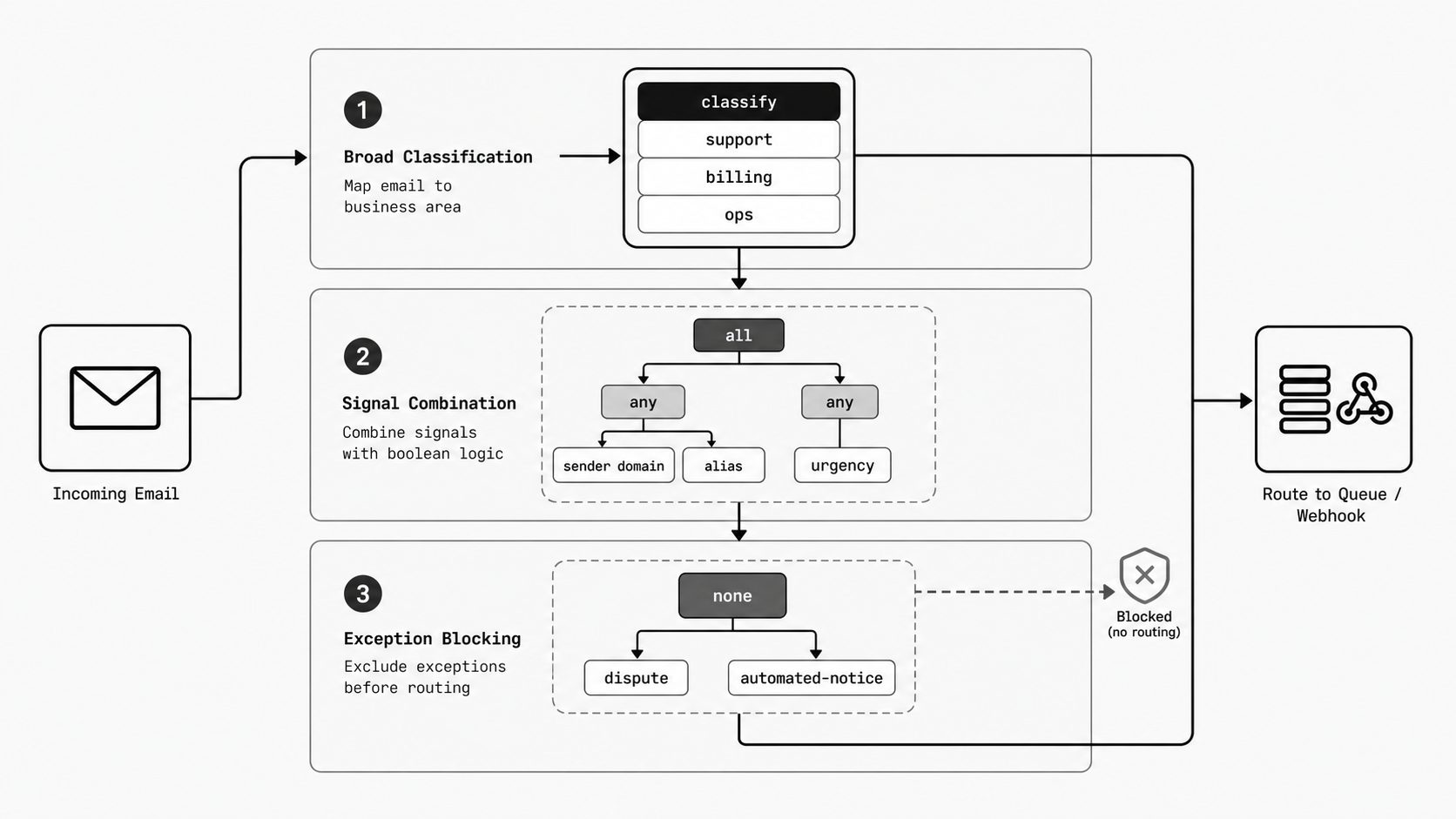
Real intake decisions usually happen in layers. First, I ask broad questions. Is this message for support, billing, or operations? Then I narrow it. Is the sender trusted? Is the recipient alias tied to a special queue? Does the subject suggest urgency? Finally, I carve out exceptions that keep edge cases from creating noise. That pattern maps naturally to boolean composition, where a route can require that all core conditions match, allow any of several valid signals, and block known exclusions before an action fires.
You might be wondering: why does that matter so much? Because teams rarely operate with one clean signal per workflow. In practice, routing often depends on several weak signals that become reliable only when combined. A finance intake path might look at sender domain, recipient alias, and subject terms together. A security path might allow multiple indicators of urgency while excluding known automated notices. A clean boolean structure makes that intent visible to reviewers and maintainers instead of hiding it inside a growing pile of one-off rules.
That visibility is where governed routing starts to pay off. When I can inspect a rule tree, I can explain why a message moved to a queue, why another one stopped, and where an exception changed the outcome. That matters even more when the next step is an email webhook that triggers downstream systems, because each routing decision can create tickets, launch workflows, or call an email filter webhook in production. Clear composition also helps technical managers review policy changes with less guesswork. They do not have to reverse engineer hidden precedence from a long list of mailbox tricks. They can read the logic in the same layered way the business describes it.
I also like this model because it scales with change. New programs rarely replace old intake paths all at once. They arrive as additions, exceptions, and temporary bridges. A routing model built from readable all, any, and none blocks can absorb that growth more gracefully than a flat list where each added condition risks side effects in unrelated paths.
The payoff is simple. When routing rules mirror the layered way teams make decisions, the system becomes easier to trust, audit, and evolve. I am no longer asking engineers to manage conditional email routing through fragile inbox habits. I am giving them a governed decision layer that matches how production intake really works. That makes the platform calmer for operators, clearer for managers, and safer for the automations that sit behind an inbound email webhook.
Rules only stay useful if the data model can evolve
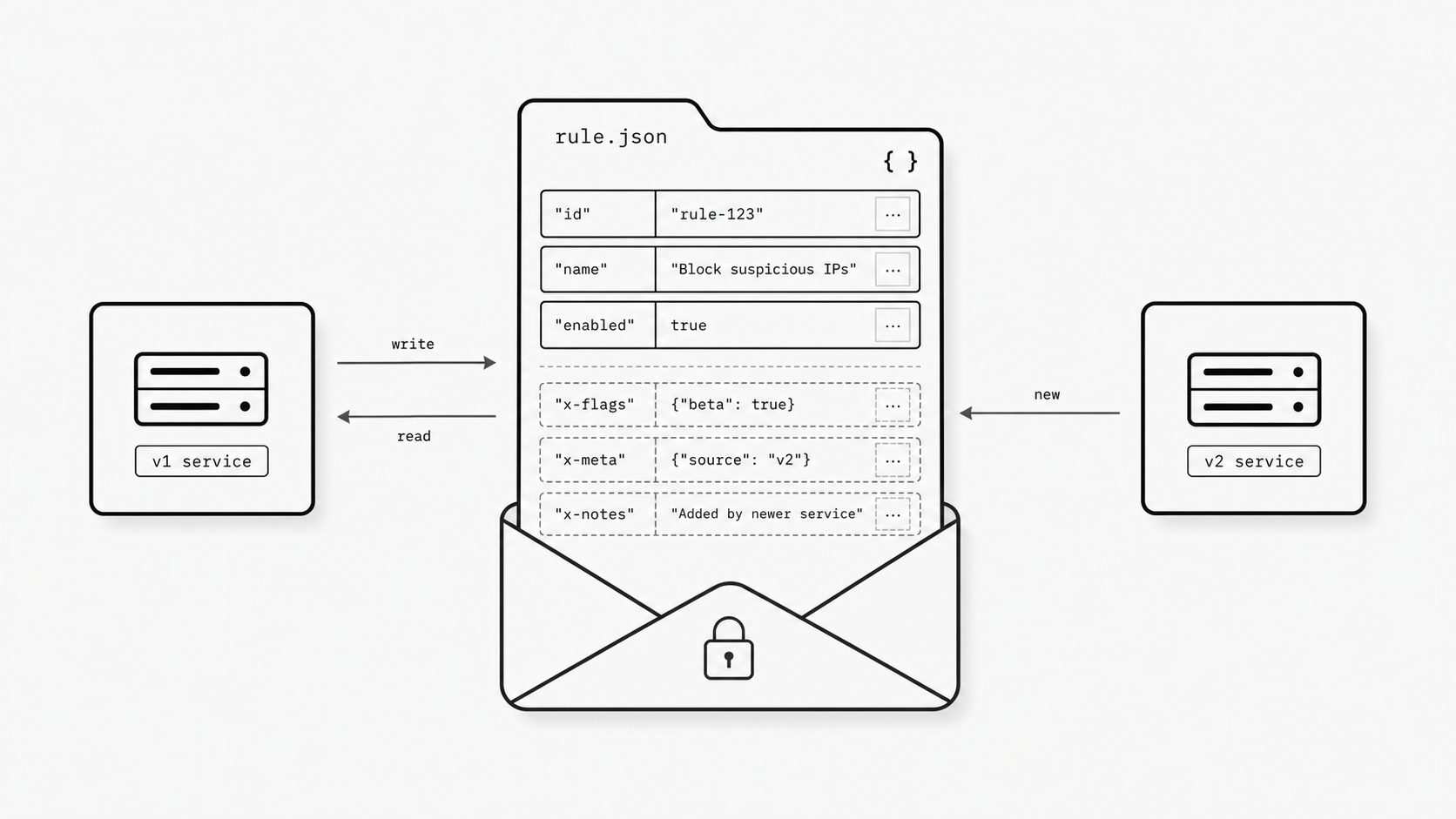
I have seen a quiet failure mode in routing systems that looks harmless at first. The rules work, the teams ship, and everyone assumes the format is settled. Then a new workflow arrives and needs one more field - maybe a confidence score from an email parsing API, a review flag, or a new action option for conditional email routing. If the storage model only keeps the fields today’s code understands, that new data can disappear the moment an older service reads and writes the rule again. That kind of loss is easy to miss because the rule still loads, still looks valid, and still passes basic tests. The danger shows up later, when behavior drifts and nobody can explain why one environment kept the new setting while another silently dropped it. (JSON Schema: Additional Properties)
You might be wondering: why make such a big deal out of a few extra keys? Because in a governed decision layer, the rule definition is the contract. When that contract sheds information during normal read and write cycles, the system becomes harder to evolve safely over time.
This is why I treat rule storage as a product design choice, not a serialization detail. A long-lived rule model needs room for growth. Teams add metadata, new operators, migration hints, audit attributes, and rollout controls as the platform matures. If the representation is lossy, every future change becomes more expensive because backward compatibility now depends on every component upgrading in lockstep. That is rarely how real platforms move.
There is a concrete design choice in JSON Schema that maps more directly to rule storage. The additionalProperties keyword controls properties that are not listed in properties or matched by patternProperties, and additional properties are allowed by default. I read that as a useful starting point for an email routing rules API that stores rule definitions in JSON: decide where the contract is open, where it is closed, and how extension fields should be validated.
In practice, I want the stored rule to behave more like a durable envelope than a narrow class instance. Known fields should be validated and used intentionally. Unknown fields should survive intact unless there is an explicit migration decision to remove or transform them. That gives platform teams breathing room. A newer service can write an added attribute. An older admin tool can still display, save, or move that rule without stripping the addition away. For technical managers, that matters because it lowers coordination risk. For engineers, it means fewer accidental regressions during staged rollouts, partial upgrades, and tooling changes.
I also find this approach improves governance. Inspectable systems need a trustworthy source of truth. If the stored document changes shape every time a different service touches it, review becomes harder and audits become less meaningful. Stable round-tripping keeps the rule definition closer to the author’s intent, even as the platform grows around it.
The payoff is bigger than format hygiene. Forward-compatible storage lets the routing layer mature without turning every schema change into an organizational event. That is how an email routing rules API stays useful as new workflows, parsers, and policy controls appear over time. I get a system that can absorb change, preserve intent, and stay inspectable across versions - which is exactly what I want from a governed matching layer that sits in the middle of production intake.
Small normalization choices decide whether teams trust the rules
I have learned that trust in routing rarely breaks because of a dramatic system failure. It usually breaks because of one small surprise. A manager sees two emails that look the same to a human reader, yet only one takes the expected path. An engineer opens the payload and finds the difference was simple: one header name arrived in a different letter case, or one sender value used uppercase characters that the rule author did not expect. In internet mail standards, header field names are treated as logical field names, which is a strong signal that matching logic should start from normalized input rather than raw presentation. I take that seriously because once an email webhook starts downstream work, even a tiny matching surprise can turn into a visible operations problem for the team. (RFC 5322 Section 2.2: Header Fields)
This is where many routing systems lose confidence. The business thinks it wrote a clear rule. The platform thinks it evaluated exactly what it received. Both sides feel reasonable, yet the outcome still feels inconsistent. I have found that case-insensitive handling is one of those quiet design choices that removes a lot of avoidable friction. When normalized matching treats equivalent letter case as the same logical value where the standards and processing model support that expectation, teams get behavior that feels stable instead of arbitrary. (RFC 5322 Section 2.2: Header Fields)
There is good reason for that expectation. RFC 5322 Section 2.2 defines header fields as lines beginning with a field name followed by a colon, along with the folding and unfolding behavior that parsers need to respect. RFC 8616 is narrower: it describes email-authentication header processing that converts field names to lowercase in a structured context. (RFC 8616) I read those standards as guidance for product behavior. If the ecosystem already treats those names as stable logical identifiers, a governed routing layer should preserve that predictability in how it evaluates rules.
You might be wondering: does that really matter if the parser is already decent? I think it matters even more once inbound email parsing enters the picture. Parsing gives me cleaner fields, but trust comes from what I do next with those fields. If one tool stores Subject, another emits subject, and a third admin view displays SUBJECT, I do not want the rule result to change just because the surface form changed. I want the matching layer to absorb that variation so the rule author can think about intent, not typography.
That has a practical management benefit too. Inspectable systems only feel inspectable when people can predict their behavior. If operators need to remember hidden casing quirks, every review, bug report, and policy update becomes harder to reason about. A normalization-first approach reduces those edge cases and makes rule outcomes easier to explain across engineering, support, and operations teams. For a platform team building email to webhook flows, that kind of predictability is part of the product value, because reliable intake logic lowers both troubleshooting time and stakeholder skepticism.
The payoff is subtle and important. Small normalization choices make the rule layer feel calm. When equivalent email fields match the same way regardless of letter case in the contexts where the standards support that behavior, teams stop second-guessing the system and start trusting it. That trust is what turns routing from a brittle set of technical checks into a governed decision layer people are willing to build on. If I want a mail webhook or intake path to stay maintainable as workflows grow, I need the matching behavior to be boring in the best possible way: consistent, explainable, and easy to verify.
The common thread across all of this is trust. Teams do not trust routing because it is clever. They trust it because the logic is clear, the inputs are normalized, the outcomes are explainable, and the rule definitions can survive change without falling apart.
That is why I keep coming back to the same framing: email routing rules are not just filters. They are a governed matching layer sitting between messy inbound messages and the systems that act on them. When that layer is designed well, platform teams get fewer surprises in production, managers get logic they can review with confidence, and downstream automations inherit cleaner decisions instead of inbox-era guesswork.
As workflows multiply, making decision logic explicit is not extra process. It is product value. The more your email intake behaves like part of the platform, the more its rules should be treated like part of the platform too.